Choosing the right independent electric vehicle diagnostic service can be the difference between a costly dealer visit and a practical, transparent repair that extends your EV's life. At KMC Electric, based in Kettering, Northamptonshire, we have provided Level 4 Master Technician-grade EV diagnostics since 2016. Below, we show you exactly what to expect, which tools matter, what battery health data really means, and how to find a certified EV technician near you. Most guides get this wrong by treating EV diagnostics as a single scan, it is a layered process spanning high-voltage electronics, drivetrain diagnostics, thermal management, and software systems simultaneously.
What an Independent Electric Vehicle Diagnostic Service Actually Covers
An independent electric vehicle diagnostic service covers the full spectrum of EV-specific systems: high-voltage battery state-of-health, charging architecture, regenerative braking, drivetrain integrity, and onboard software. Unlike a standard OBD-II scan at a general garage, a specialist diagnostic interrogates every subsystem that makes an EV fundamentally different from a combustion vehicle.
High-Voltage Battery Diagnostics and State-of-Health Reporting
Battery diagnostics are the centrepiece of any credible EV inspection. The HV battery is assessed for state-of-charge, state-of-health, cell balance, internal resistance, and thermal management performance. A proper report provides a cell-level breakdown showing which modules are degrading and at what rate, not just a pass or fail. For vehicles approaching the end of manufacturer warranty, this documented data can be presented to the manufacturer as evidence, not anecdotal complaints.
Pro TipRequest a written state-of-health report with cell-level data, not just a summary percentage. A technician who cannot provide this is not using professional-grade diagnostic equipment.
Charging System Diagnostics and Charging Port Repair
Charging system faults are among the most commonly misdiagnosed EV problems at general garages. A full charging system diagnostic covers the onboard charger, DC/DC converter, charging port integrity, and communication between the vehicle and charging infrastructure. Corrosion, connector wear, and software handshake failures can all produce identical symptoms; identifying the root cause requires specialist software capable of reading charging session logs and CAN bus communication data, not just clearing fault codes.
Regenerative Braking System Service and Drivetrain Diagnostics
Regenerative braking system faults often present as inconsistent brake pedal feel or unexpected energy recovery behaviour. Diagnosing them requires reading both the brake system ECU and inverter data simultaneously. A drivetrain diagnostic also covers motor temperature data, torque output consistency, and power electronics health. According to the Institute of the Motor Industry's EV technician guidance, drivetrain diagnostics on EVs require technicians trained specifically in high-voltage systems, a standard that general MOT garages rarely meet.
EV Battery Health Check: What the Data Actually Tells You
An EV battery health check is a structured assessment of a battery pack's current capacity relative to its original specification, expressed as a state-of-health percentage alongside cell-level voltage and temperature data. It reveals not just current condition but the trajectory of degradation, which is what actually matters for long-term ownership decisions.
Battery Degradation vs. Fault Codes: Understanding the Difference
Battery degradation and battery fault codes are not the same thing, and conflating them leads to expensive mistakes.
Battery degradation is a gradual, chemistry-driven process. Cells lose capacity over time due to charge cycles, temperature exposure, and usage patterns. It shows up in state-of-health data, not necessarily in fault codes.
Battery fault codes indicate a specific electronic or communication failure: a cell module reporting out-of-range voltage, a BMS communication error, or a thermal sensor fault. A vehicle can have zero fault codes and still show significant degradation. Conversely, a single fault code can trigger a cascade of warning lights that resolves with a software update.
A competent independent EV diagnostic service reads both layers and explains the difference clearly.
Cost-Benefit Analysis: HV Battery Rebuild vs. Full Replacement
A full HV battery replacement is the right call when degradation is widespread across multiple modules and the vehicle is still under a service contract. A hybrid battery rebuild, replacing only the degraded or failed modules, is often more cost-effective for out-of-warranty vehicles with localised cell failure, frequently restoring the majority of lost range at a fraction of full replacement cost. The key is having cell-level diagnostic data before committing to either path. Without it, any recommendation is guesswork.
Decision Factor
Battery Rebuild
Full Replacement
Fault location
Localised modules
Widespread degradation
Vehicle age
Out of warranty
In warranty or near-new
Cost profile
Lower upfront cost
Higher, often covered by warranty
Range restoration
Partial to full
Full
Best for
Older EVs, budget-conscious owners
Newer vehicles, warranty claims
Watch OutNever authorise a full battery replacement based on a single fault code scan. Insist on cell-level data first. Replacing a battery pack when only two or three modules have failed is one of the most common and expensive mistakes in EV ownership.
Electric Vehicle Diagnostic Tools Used by Independent Specialists
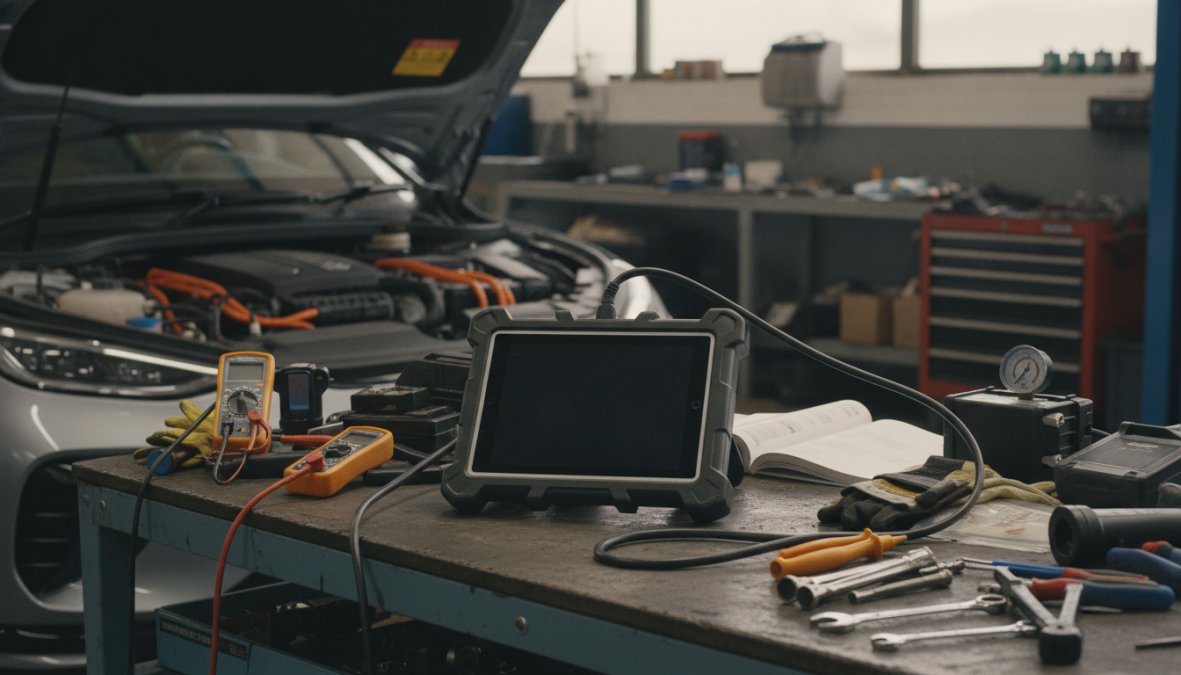
Professional-grade electric vehicle diagnostic tools are what separate a genuine EV specialist from a general garage that has downloaded a basic OBD-II app. The tools used directly determine the depth and accuracy of the diagnostic report. At KMC Electric in Kettering, a technician will typically have an Autel MaxiSYS Ultra EV or equivalent connected to the vehicle's high-voltage architecture within minutes of arrival.
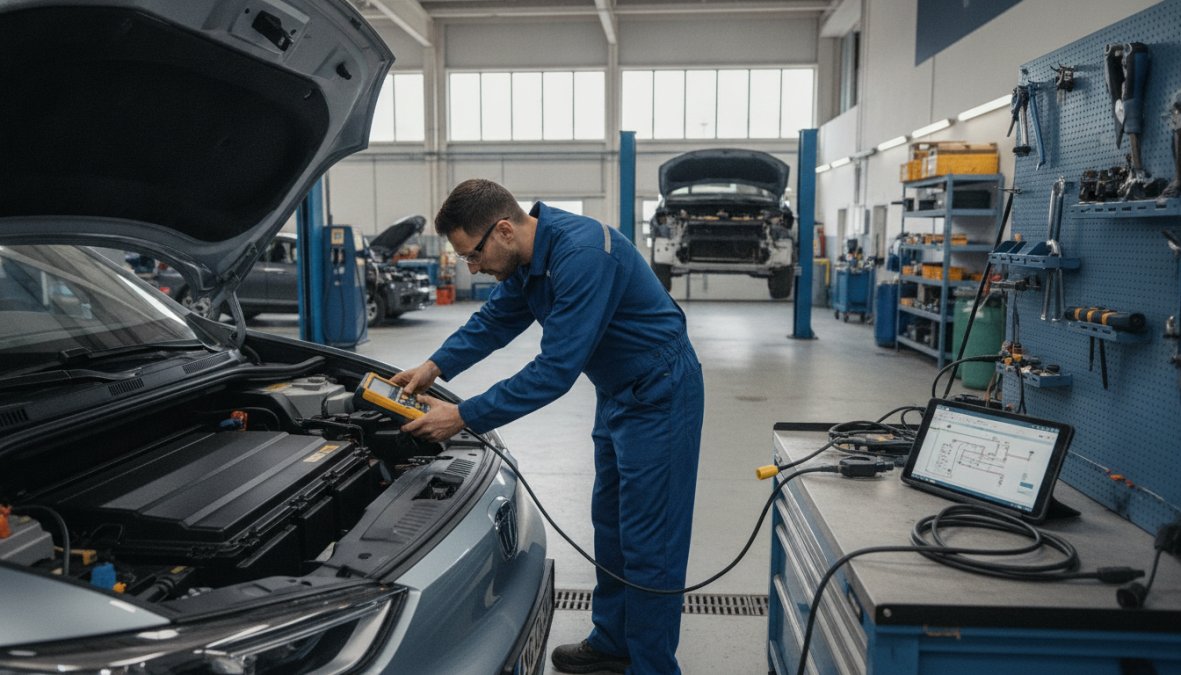
A technician in a professional workshop using a large diagnostic tablet connected to an electric vehicle via an OBD-II port, with the car's bonnet open and high-voltage warning labels clearly visible under workshop lighting
Professional-Grade Tools: Autel MaxiSYS Ultra EV and TOPDON EV Kit
The Autel MaxiSYS Ultra EV is the benchmark for independent EV workshop diagnostics. It performs in-vehicle and out-of-vehicle HV battery analysis, reads state-of-charge and state-of-health data at the module level, and supports testing of motors, inverters, compressors, and DC/DC converters across European, Asian, and US EV platforms. The TOPDON EV Diagnostic Kit integrates with Phoenix series tablets, covers over 74 vehicle brands including Tesla, and includes 18 EV-specific connectors alongside two years of free software updates. The Launch X-431 EV Diagnostic Kit adds battery pack diagnostic software, cell balancing functions, and charge/discharge monitoring for workshops already running the X-431 ecosystem.
CAN Bus Communication, OBD-II Access, and Diagnostic Software Transparency
CAN bus communication is the nervous system of a modern EV. Every subsystem, from the BMS to the inverter to the thermal management system, communicates via the CAN bus network. A tool that only reads OBD-II generic codes is reading a summary of a summary; professional tools access raw CAN bus data directly, where the real diagnostic picture lives. Ask your independent specialist which software platform they use and whether the output report is exportable, a credible facility will show you the raw data, not just a verbal summary. As documented in the Society of Automotive Engineers' EV diagnostics technical papers, CAN bus access is essential for accurate fault correlation across multi-ECU EV architectures.
Common Electric Vehicle Problems Diagnosed at Independent Facilities
The most common EV problems arriving at independent facilities fall into predictable patterns: thermal management faults, inverter issues, charging failures, and software-related warning lights that do not correspond to any physical fault.
Thermal Management System Faults and Inverter Troubleshooting
Thermal management system faults are consistently underdiagnosed at general garages because they require reading coolant temperature sensor data, pump performance metrics, and chiller circuit behaviour simultaneously. A coolant flush on an EV is not the same procedure as on a combustion vehicle; the cooling circuit serves the battery pack, motor, and power electronics, and incorrect servicing can introduce air pockets that damage the inverter. Inverter faults present as reduced power output, inconsistent acceleration, or thermal cutback warnings, and diagnosing the root cause requires monitoring inverter temperature, gate driver signals, and phase current data under load.
Tesla-Specific Repair Solutions: Model S, 3, X, and Y
Tesla diagnostics require a different approach because Tesla does not publish OBD-II PIDs in the conventional sense. Accessing Tesla's proprietary CAN bus data requires specialist software and direct knowledge of Tesla's system architecture across model generations. Common Tesla-specific faults include Model S door handle actuator failures, Model 3 and Y drive unit oil degradation, and battery contactor wear on higher-mileage Model X examples. KMC Electric stocks Tesla-specific drivetrain parts including drive train oil and oil filters for Model 3 servicing, and can distinguish between a software artefact and a genuine hardware fault across all four models.
Safety Protocols Every EV Owner Should Expect from Their Diagnostic Provider
Safety is non-negotiable when working with high-voltage automotive systems and is the first thing to evaluate when choosing an independent EV diagnostic service.
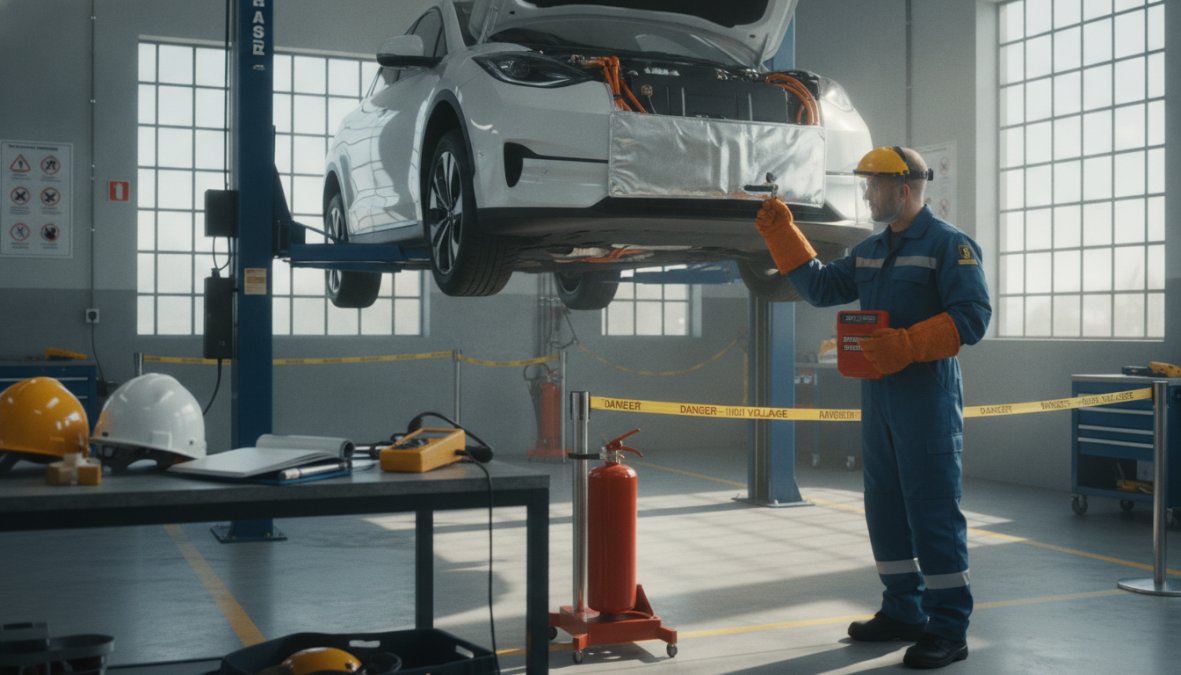
An EV specialist wearing high-voltage insulated gloves and full PPE working on an exposed high-voltage battery pack in a clean, well-lit independent garage workshop, with orange HV cables visible and safety signage on the workshop wall
Any competent independent repair facility should meet these minimum standards before touching your vehicle's HV system:
HV isolation verification: The high-voltage system must be confirmed isolated using insulation resistance measurement equipment before any physical access.
PPE compliance: Class 0 or Class 1 insulated gloves, rated to at least 1,000V AC, are mandatory for HV work.
Equipotential bonding checks: The vehicle chassis and workshop earth must be verified before work begins.
Written risk assessment: Any facility performing HV battery work should have a documented procedure, not an ad hoc approach.
Technician certification: The operative should hold at minimum IMI Level 3 Award in Electric/Hybrid Vehicle System Repair.
Risk escalates when physical access to the HV battery is required, precisely when certification and PPE standards become critical, not optional. According to the Health and Safety Executive's guidance on electric vehicle repair, employers and self-employed technicians working on high-voltage vehicle systems are legally required to ensure competence and appropriate safety controls are in place.
EV-Specific Maintenance Schedules: What Dealers Don't Tell You
The assumption that EVs require almost no maintenance is one of the most expensive myths in modern motoring. EVs have their own maintenance requirements that dealers rarely communicate clearly, particularly once the vehicle is out of warranty. A practical EV-specific maintenance schedule covers:
Annual battery health check: State-of-health assessment to track degradation trajectory and identify early cell failures.
Brake fluid replacement (every 2 years): Regenerative braking reduces pad wear, but brake fluid still absorbs moisture and degrades on schedule.
Thermal management system service: Coolant condition check and replacement on the battery cooling circuit, typically every 4-5 years.
Drive unit fluid inspection: Applicable to Tesla Model 3, Y, and S, where drive unit lubricating fluid degrades under load.
Software update verification: Ensuring all available OTA updates are applied and no pending updates are causing fault code suppression.
Tyre rotation and inspection: EVs are significantly heavier than equivalent combustion vehicles; tyre wear rates are higher and alignment checks are more critical.
For Kettering and Northamptonshire EV owners, an annual independent service check makes particular sense given the region's mix of A-road and motorway driving, which places consistent load on the drivetrain and thermal management systems.
Key TakeawayThe most overlooked EV maintenance item is the thermal management coolant circuit. Degraded coolant reduces battery cooling efficiency, accelerates cell degradation, and can cause inverter thermal faults. Schedule a coolant condition check every four years regardless of mileage.
How to Find a Certified EV Technician for Independent Diagnostic Service in Kettering
Finding a qualified EV technician near you requires knowing which certifications actually matter and what questions to ask before booking.
ASE-Certified and Level 4 Master Technician: What Qualifications Matter
In the UK, the relevant framework is the IMI (Institute of the Motor Industry) Awards in Electric/Hybrid Vehicle system repair and replacement, running from Level 2 (awareness) through to Level 4 (Master Technician). Level 4 means the technician can diagnose, repair, and sign off work on the full HV system, including battery pack intervention, motor repair, and power electronics, distinguishing a genuine EV specialist from a general technician who has attended a one-day awareness course. ASE certification, more commonly referenced in the US context, covers similar ground under the ASE L3 Light Duty Hybrid/Electric Vehicle Specialist designation; for UK owners, IMI Level 4 is the equivalent benchmark. KMC Electric holds Level 4 Master Technician status with EV qualifications dating to 2016, well ahead of most independent garages that have only recently begun upskilling for EV work.
Pre-Purchase EV Inspections: Protecting Your Investment Before You Buy
A pre-purchase EV inspection is one of the highest-value services an independent specialist can provide. The used EV market in 2026 contains significant numbers of vehicles with undisclosed battery degradation, previous HV fault history, or outstanding software issues invisible to a standard visual inspection. A thorough pre-purchase inspection covers:
Full battery state-of-health report with cell-level data
Fault code history, including cleared codes the seller may not disclose
Charging system integrity check
Drivetrain and motor health assessment
Software version verification and outstanding update check
Physical inspection of HV connectors, cabling, and battery enclosure
The used EV buyer guidance from the AA recommends an independent inspection for any used electric vehicle purchase over £10,000, specifically citing battery health verification as the single most important check.
Conclusion: Choosing the Right Independent EV Diagnostic Partner
The used and out-of-warranty EV market is growing faster than the pool of genuinely qualified technicians, making the risk of a shallow diagnostic from an underqualified garage real and rising. KMC Electric offers a credible alternative: over 25 years of automotive experience, Level 4 Master Technician status in electric vehicles since 2016, and specialist knowledge of Tesla systems across all models. Whether you need a pre-purchase battery health check, a thermal management fault traced to its root cause, or a cost-effective alternative to a main dealer repair quote, the team at KMC Electric in Kettering, Northamptonshire is equipped to deliver transparent, technically rigorous results. Submit your enquiry and get a clear picture of your EV's true condition before committing to any repair.
Frequently Asked Questions
Can independent mechanics work on electric vehicles?
Yes, qualified independent specialists can fully service and diagnose electric vehicles, provided they hold the appropriate high-voltage safety certifications and use professional-grade diagnostic software. Independent EV technicians with qualifications such as Level 4 Master Technician status and ASE-certified training often have access to the same diagnostic tools as franchised dealerships, and in many cases offer more transparent, cost-effective independent electric vehicle diagnostic service without the overhead of a main dealer network.
What does an EV diagnostic service include?
A thorough independent electric vehicle diagnostic service typically covers high-voltage battery health checks reporting state-of-charge and state-of-health, OBD-II and CAN bus fault code scanning, charging system diagnostics, thermal management system inspection, regenerative braking system evaluation, drivetrain and inverter analysis, and a software update check. Some specialists also include a pre-purchase EV inspection report and a written battery degradation assessment, giving buyers and sellers independent verification of vehicle condition.
Is it cheaper to use an independent EV diagnostic service than a dealership?
In most cases, yes. Independent repair facilities typically offer flat-rate pricing with no manufacturer markup on labour, and they are not incentivised to recommend unnecessary work. For out-of-warranty vehicles in particular, an independent electric vehicle diagnostic service can represent significant savings on both diagnostic fees and subsequent repairs, especially for complex jobs like hybrid battery rebuilds, inverter troubleshooting, or Tesla-specific software diagnostics where dealer labour rates tend to be considerably higher.
How often should I get my electric vehicle diagnosed?
As a practical guideline, an EV battery health check and full system diagnostic is worth scheduling once a year or every 10,000-15,000 miles, whichever comes first. Additionally, a diagnostic is strongly recommended before your manufacturer warranty expires, after any charging fault or range drop, and as part of any pre-purchase EV inspection. Regular EV maintenance diagnostics help identify battery degradation, thermal management faults, and CAN bus communication errors before they become costly failures.
Do independent shops have access to the same EV diagnostic software as dealerships?
Many do. Professional independent facilities invest in tools such as the Autel MaxiSYS Ultra EV, TOPDON EV Diagnostic Kit, and Abrites AVDI, which provide deep-level access to battery management systems, power electronics, and CAN bus communication across most EV brands including Tesla. While some OEM proprietary functions remain dealer-exclusive, a well-equipped independent electric vehicle diagnostic service can resolve the vast majority of faults and perform software updates without needing to refer to a franchised network.