Knowing how to identify EV battery degradation is one of the most practical skills any electric vehicle owner can develop, and the team at KMC Electric, based in Kettering, Northamptonshire, works through this process with owners every week. Battery degradation is the gradual loss of a lithium-ion battery pack's ability to hold and deliver energy, resulting in reduced range, slower performance, and higher running costs over time. Understanding the signs early can mean the difference between a timely, affordable fix and an expensive post-warranty replacement.
Battery degradation is a continuous process driven by chemistry, heat, and usage patterns. Most owners notice it only when range drops noticeably, often too late for preventative action. The right approach is to monitor State of Health (SOH) regularly, understand what the numbers mean, and adjust charging habits accordingly.
What Is EV Battery Degradation and Why It Matters
EV battery degradation is the reduction in usable energy capacity of a lithium-ion battery pack over time, measured as a percentage of its original kilowatt-hour (kWh) rating. A battery that started at 75 kWh and now holds 67.5 kWh has degraded to 90% SOH, a loss that translates directly into shorter range, more frequent charging stops, and reduced resale value. Battery packs remain one of the most expensive components in any electric vehicle, and their condition is the single biggest factor in a used EV's value.
Calendar Aging vs Cycle Aging: The Two Degradation Paths
Degradation runs as two distinct processes in parallel.
Calendar aging occurs through time alone. A lithium-ion cell stored at high State of Charge (SOC) in warm conditions will degrade even if the vehicle is never driven, a vehicle left parked at 100% SOC in a hot car park for months will show measurable capacity loss with zero charge cycles added.
Cycle aging is driven by charging and discharging. Every time current flows through the cell, mechanical stress causes microscopic structural changes in the anode and cathode, compounded by heat from deep discharges and DC fast charging.
The practical implication: two vehicles with identical mileage can have very different SOH readings depending on how they were stored and charged. Mileage alone is a poor proxy for battery health.
How to Identify EV Battery Degradation: Reading State of Health (SOH)
SOH is expressed as a percentage of the battery's original rated capacity, where 100% represents a new pack and anything below 80% is generally considered significant degradation. The Battery Management System (BMS) calculates SOH continuously by tracking cell voltages, temperature, and charge cycles against the factory baseline.
What a Healthy SOH Reading Looks Like
A well-maintained EV typically sits above 90% SOH within the first three to four years. An SOH reading below 80% within the warranty period is grounds for a warranty claim with most manufacturers, making independent verification particularly valuable before warranty expiry. Note that dashboard range estimates are not the same as SOH, range fluctuates with temperature and driving style, while SOH is a stable, chemistry-based measurement.
Manufacturer-Specific Diagnostic Menus for SOH Data
Accessing SOH data varies significantly by manufacturer:
Tesla (all models): The Energy app provides charge and range data, but detailed SOH and cell-level data requires Tesla's proprietary diagnostic software or a third-party tool such as Scan My Tesla.
Nissan LEAF: The dashboard capacity bar shows health in increments. Raw kWh data requires a compatible OBD-II scanner with LEAF-specific firmware.
Renault ZOE: A battery health indicator is accessible under "Vehicle Information." Detailed SOH percentages require dealer-level access or a compatible third-party scanner.
Hyundai/Kia (e-Niro, Ioniq, EV6): SOH is accessible via compatible OBD-II tools. The BlueLink app provides some health data remotely.
BMW i-series: The iDrive system shows a battery health overview under "Vehicle Status." Granular data requires BMW's diagnostic software or a compatible third-party scanner.
Dashboard displays provide approximations; OBD-II tools and manufacturer diagnostic software provide the actual SOH figures the BMS calculates internally.
Pro TipFor Tesla owners approaching the end of their warranty period, booking an independent battery health verification with a Level 4 Master Technician before expiry is one of the most cost-effective things you can do. [KMC Electric](/page/kmc-electric) provides exactly this service from Kettering, giving you documented SOH data to support a warranty claim if degradation thresholds have been breached.
EV Battery Health Check Tools You Should Know About
The right tool depends on your vehicle, technical confidence, and how much data you need. There are three practical categories.
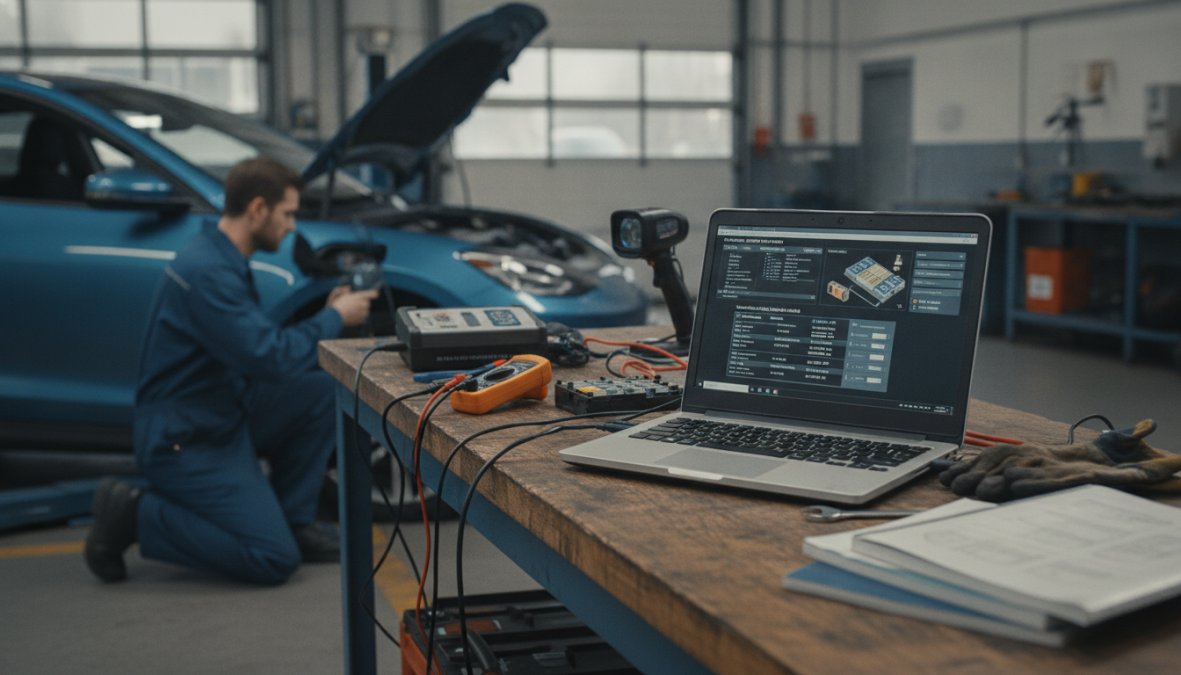
A technician in a clean automotive workshop connecting a professional OBD-II scanner to the diagnostic port beneath an electric vehicle's dashboard, with a laptop open on a nearby workbench showing battery cell voltage readings and State of Health percentage data, under bright workshop lighting
Manufacturer apps and connected services are the starting point for most owners, Tesla's app, Hyundai's BlueLink, and Renault's My Renault app provide convenient but surface-level data, showing charge level and estimated range rather than true SOH percentages.
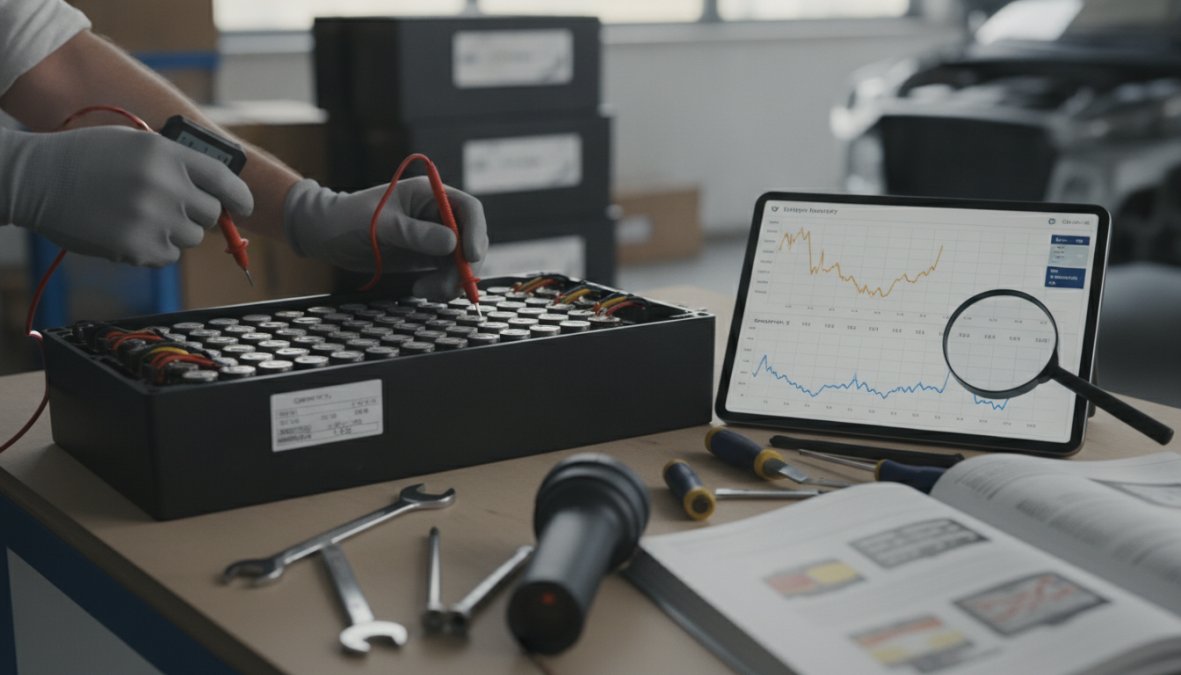
Consumer OBD-II scanners with EV-specific firmware offer the next level of detail. Tools such as LeafSpy, Scan My Tesla, and ABRP with OBD-II integration can pull raw BMS data including SOH, cell voltage delta, cycle count, and temperature history.
Professional diagnostic equipment used by independent specialists provides the most comprehensive picture, combining manufacturer-specific software with the expertise to interpret data in context.
Interpreting OBD-II Data for Battery Performance Metrics
SOH percentage: Anything above 90% is excellent. 80-90% is normal for a vehicle with meaningful mileage. Below 80% warrants investigation and may trigger a warranty claim.
Cell voltage delta: The difference between the highest and lowest individual cells. A healthy pack shows less than 20 millivolts at rest; above 50-100 millivolts indicates a cell imbalance problem.
Capacity in kWh: Compare reported usable capacity against the manufacturer's original specification, the most direct measure of real-world degradation.
Temperature history and cycle count: Repeated high-temperature events predict accelerated future degradation. A low cycle count does not guarantee high SOH, because calendar aging operates independently.
Watch OutDo not rely on a single OBD-II reading taken immediately after charging or a long drive. Battery data is most accurate when the vehicle has been resting for at least two hours at a moderate ambient temperature. Readings taken in extreme cold or immediately after DC fast charging can misrepresent true SOH by several percentage points.
Signs of Electric Car Battery Failure to Watch For
Some of the most important signs are visible without any diagnostic tool:
Range that no longer matches the predicted estimate even after a full charge in moderate temperatures
Inconsistent charge speeds, where the vehicle accepts DC fast charging at significantly lower rates than its specification
Sudden drops in the state of charge reading while driving, particularly at low SOC levels
Longer time to reach full charge than when the vehicle was new, at the same charging rate
Warning lights or BMS fault codes referencing battery temperature or cell imbalance
Reduced regenerative braking effectiveness, indicating the battery is rejecting energy recovery at certain SOC levels
Noticeable performance loss in cold weather beyond what is normal for lithium-ion chemistry
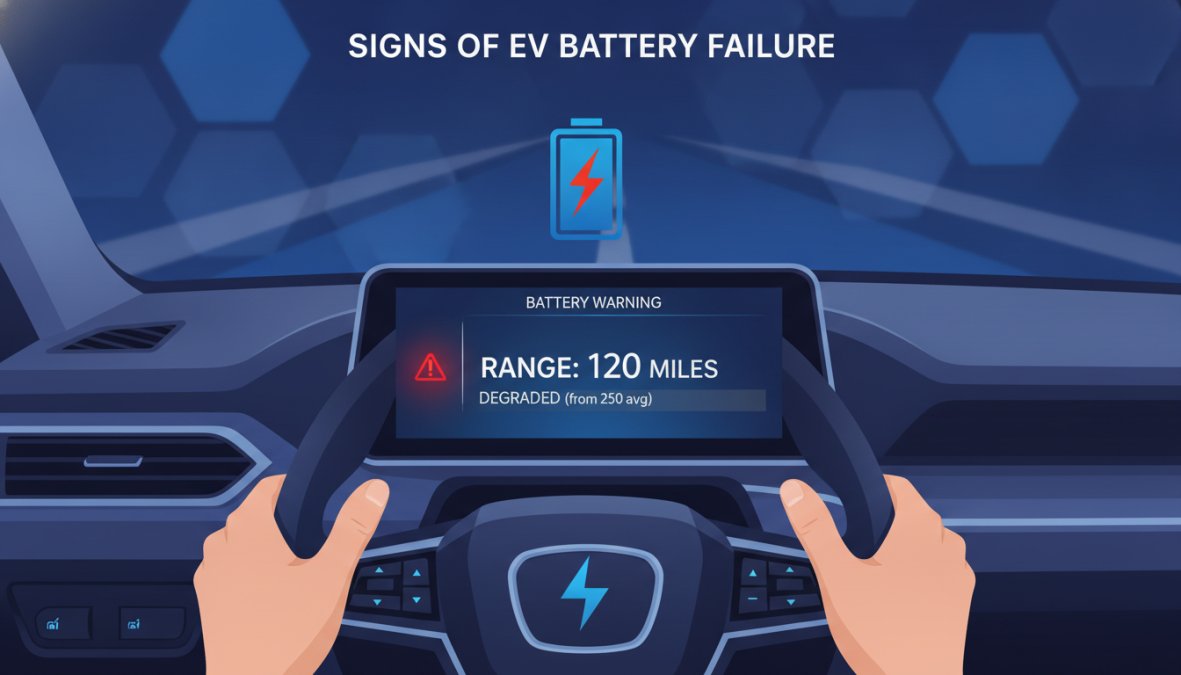
Close-up of an electric vehicle dashboard showing a reduced range estimate of 87 miles alongside an amber battery warning indicator light, with a driver's hands resting on the steering wheel and early evening light coming through the windscreen
The most commonly missed sign is gradual range reduction over months. Owners adapt unconsciously, charging more frequently without registering that usable capacity has dropped. Tracking real-world range against a baseline from when the vehicle was new is one of the simplest early warning systems available.
Factors Affecting EV Battery Degradation You Can Control
Several of the most significant degradation factors are directly within an owner's control, and the difference between a well-managed battery and a poorly managed one can amount to years of additional service life.
The Role of DC Fast Charging on Long-Term Capacity Retention
High-rate DC charging generates heat inside the cells, and heat is the primary accelerant of both calendar and cycle aging. Occasional DC fast charging on a vehicle with functioning thermal management causes limited additional degradation, the problem is frequency. According to Geotab's EV battery degradation research, fleet data across thousands of vehicles consistently shows that frequent DC fast charging correlates with accelerated capacity loss in older battery architectures.
The practical guidance: use AC charging for daily top-ups and reserve DC fast charging for long journeys where it is genuinely necessary.
Thermal Management and State of Charge Habits
Lithium-ion cells degrade fastest when hot and at high SOC simultaneously. Parking a fully charged vehicle in direct sunlight on a hot day is one of the worst things you can do for long-term capacity retention.
Practical SOC habits that extend battery service life:
Keep daily charge level between 20% and 80% SOC for routine use
Only charge to 100% SOC before a long journey, and depart promptly rather than leaving the vehicle sitting at full charge
Avoid regular deep discharge below 10% SOC
Pre-condition the battery in cold weather using scheduled heating before driving, not while driving
Park in a garage or shaded area during hot weather
How to Identify EV Battery Degradation When Buying Used
Buying a used EV without understanding battery degradation is a significant financial risk. The battery pack is the most expensive component, and its condition is not visible from a standard visual inspection.
Here is a practical pre-purchase battery health checklist:
Request a full OBD-II diagnostic report showing SOH percentage and cell voltage delta
Check the vehicle's charging history if available through connected services logs
Ask for documentation of any previous battery warranty work or cell replacement
Verify the remaining manufacturer battery warranty period and the capacity retention threshold it covers
Test DC fast charging acceptance rate against the manufacturer's published specification
Confirm the BMS shows no active fault codes related to battery temperature or cell balance
Cross-reference the dashboard range estimate against independent range data for that model at the same SOH level
KMC Electric offers independent battery health verification for buyers and sellers in Kettering and across Northamptonshire, providing a documented SOH report that gives both parties an objective, technically verified basis for the transaction.
Key TakeawayA used EV purchase without an independent battery health check is equivalent to buying a used petrol car without checking compression. The cost of the check is trivial relative to the cost of discovering post-purchase that the battery needs replacement.
Battery Warranty, Capacity Retention, and Post-Warranty Replacement Costs
Most EV manufacturers offer a battery warranty covering both defects and capacity retention below a specified threshold, typically 70% SOH over eight years or a set mileage limit. The capacity retention threshold is the critical detail: a warranty covering degradation below 70% SOH means the manufacturer will only act if your battery has lost more than 30% of its original capacity, while many owners experience meaningful range loss well before that point.
Independent SOH monitoring throughout the warranty period matters for this reason. If your battery reaches 71% SOH at year six, you have two years of warranty remaining to document further decline and support a claim.
Post-warranty replacement costs can run into several thousand pounds for a full pack. Partial replacements, where individual module groups are replaced rather than the entire pack, are available for some models and represent a more cost-effective route for localised cell failure. According to the Society of Motor Manufacturers and Traders EV data, the used EV market in the UK is growing rapidly, making battery condition transparency increasingly important for buyers, sellers, and fleet operators alike.
For out-of-warranty vehicles, independent specialists like KMC Electric in Kettering provide practical alternatives to main dealer costs, including diagnosis of whether a full replacement is genuinely necessary or whether a targeted repair can restore acceptable performance.
Practical Tips to Slow EV Battery Degradation and Extend Service Life
Informed, proactive management extends battery service life significantly. Here is a consolidated set of actions that make a real difference.
Charging habits:
Set your charge limit to 80% for daily use and adjust to 100% only before long trips
Avoid leaving the vehicle at 100% SOC for extended periods
Use AC charging as your primary method; treat DC fast charging as a tool for long journeys
Avoid charging immediately after a long motorway run in hot weather
Storage and parking:
5. Park in a garage or shaded location during hot weather, particularly at high SOC
6. If storing the vehicle for an extended period, target 50% SOC to minimise calendar aging
Monitoring:
7. Record your real-world range monthly under consistent conditions to track gradual degradation
8. Run an OBD-II diagnostic check annually for an objective SOH reading
9. Book an independent battery health check before your manufacturer warranty expires to document SOH and support any warranty claim
Driving:
10. Use regenerative braking consistently to reduce net cycle stress on the battery
11. Avoid repeated deep discharges below 10% SOC
12. Pre-condition the battery in cold weather before driving to reduce thermal stress from drawing high current from a cold pack
Owners who understand these principles consistently see better SOH figures at equivalent age and mileage than those who do not. For EV owners near Kettering looking for professional diagnostic support, or anyone buying or selling an electric vehicle who needs an independent battery health report, the practical expertise and Level 4 Master Technician qualifications at KMC Electric make a genuine difference in getting accurate, actionable information rather than guesswork.
Identifying and managing EV battery degradation requires the right tools, the right data, and the right expertise to interpret what the numbers actually mean. KMC Electric, serving Kettering and the wider Northamptonshire area, provides independent battery health verification, professional diagnosis, and practical repair options for Tesla and other electric vehicles, backed by over 25 years of automotive experience and Level 4 Master Technician status in EVs since 2016. Whether you are monitoring your current vehicle, approaching warranty expiry, or evaluating a used EV purchase, get a verified battery health report from KMC Electric and make your decision on solid technical ground.
Frequently Asked Questions
What is considered normal EV battery degradation?
Most lithium-ion EV batteries lose a small percentage of usable energy capacity each year. A commonly accepted benchmark is around 2-3% degradation per year under typical use, though this varies by model, climate, and charging habits. A State of Health (SOH) reading above 80% after several years of use is generally considered acceptable. Many manufacturers set their battery warranty threshold at 70-80% capacity retention over a defined period or mileage.
How can I check my EV battery health percentage?
You can check EV battery health using several EV battery health check tools: manufacturer apps or in-car diagnostic menus often display SOH directly. An OBD-II scanner paired with EV-compatible software can read Battery Management System data including kilowatt-hours remaining and voltage delta across cells. Independent specialists like KMC Electric in Kettering can also perform a full diagnostic report, which is particularly useful before purchasing a used electric vehicle or before your warranty expires.
Does fast charging cause EV battery degradation?
DC fast charging can accelerate battery degradation when used frequently, particularly because it generates more heat and stresses cell chemistry at higher charge rates. Occasional use is generally fine, but relying on DC fast charging as your primary charging method over many years can reduce capacity retention more quickly than regular AC home charging. Vehicles with active thermal management systems handle fast charging better, but limiting its frequency remains one of the most practical ways to preserve battery health.
What are the signs of a failing EV battery?
Key signs of electric car battery failure include a noticeably reduced real-world range that no longer matches the vehicle's original specification, inconsistent range estimation on the dashboard, longer charging times to reach the same state of charge, and warning lights related to the Battery Management System. You may also notice the vehicle limiting performance or charging speed as a protective measure. If several of these symptoms appear together, a professional diagnostic report from an EV specialist is strongly recommended.
How much does post-warranty EV battery replacement cost?
Post-warranty battery replacement costs vary significantly by manufacturer and model. For popular models, a full pack replacement can range from several thousand pounds to over ten thousand pounds depending on the vehicle and whether a new, remanufactured, or refurbished pack is used. Independent EV specialists typically offer more cost-effective alternatives to main dealer pricing. Getting an independent battery health verification before warranty expiry can help identify issues while replacement may still be covered.
Can EV battery degradation be reversed?
True capacity loss from calendar aging and cycle aging in lithium-ion batteries cannot be fully reversed. However, some apparent degradation is recoverable, for example, cell imbalance detected through voltage delta readings can sometimes be improved through a full charge and discharge cycle, allowing the Battery Management System to recalibrate. Genuine capacity loss due to chemical changes in the cells is permanent. Focusing on prevention through good charging habits and thermal management is far more effective than attempting recovery.