Why Brake Fluid Still Matters on a Tesla Model 3 or Model Y
Brake fluid is a hydraulic oil that transfers pressure from the brake pedal to the calipers, and on a Tesla Model 3 or Model Y it still does that job every time you press the pedal. This guide from KMC Electric explains how to check tesla brake fluid levels in your own driveway in about ten minutes. Our technicians have worked on Tesla systems since 2016, and we see the same thing again and again: owners assume regenerative braking means the fluid can be ignored. It cannot.
Regenerative braking slows the car by running the motor in reverse. The friction brakes still clamp the discs whenever you brake hard, stop fully, or the battery is too full to accept charge. That means the fluid still absorbs heat, still ages, and still collects water over time.
Below, we walk through the full check, from parking safely to reading the reservoir marks. We also cover the warning messages, the moisture test, and when to book a change.
Watch OutBrake fluid is hygroscopic, meaning it absorbs water from the air. A fluid that looks fine in the reservoir can still be past its best. Skip the moisture test and you risk corroding the internals of the ABS unit, which is a far bigger bill than a fluid change.
What You'll Need Before You Start
Gather everything first so you are not hunting for a torch halfway through. The check itself needs no special tools.
A torch or your phone light
A clean, lint-free cloth
A moisture tester (optional but worth having)
Gloves, because brake fluid damages paint
About ten minutes of daylight
You do not need to jack the car up. Everything you need to see sits under the front bonnet. If you own a Model Y, the layout is similar to the Model 3, though the trim panels differ slightly.
One insider note: never open the reservoir cap unless the level is genuinely low or you are about to top up. Brake fluid pulls moisture from the air the moment it is exposed, so every unnecessary opening shortens its life.
Step 1: Park Safely and Let the Car Cool
Park on flat, level ground and switch the car off. A slope tilts the fluid in the reservoir, so your reading will be wrong. Leave the car for at least fifteen minutes after a drive so the brakes cool and the fluid settles.
Press the brake pedal firmly a few times once the car is off. This releases any stored pressure in the system and gives you a truer level.
Next, open the bonnet using the release inside the cabin. On a Model 3 or Model Y the bonnet catch sits on the driver's side, and the bonnet itself lifts on gas struts.
Pro TipDo the check when the car has been sitting overnight if you can. Cold fluid gives the most accurate reading, and you avoid burning your hands on a warm reservoir.
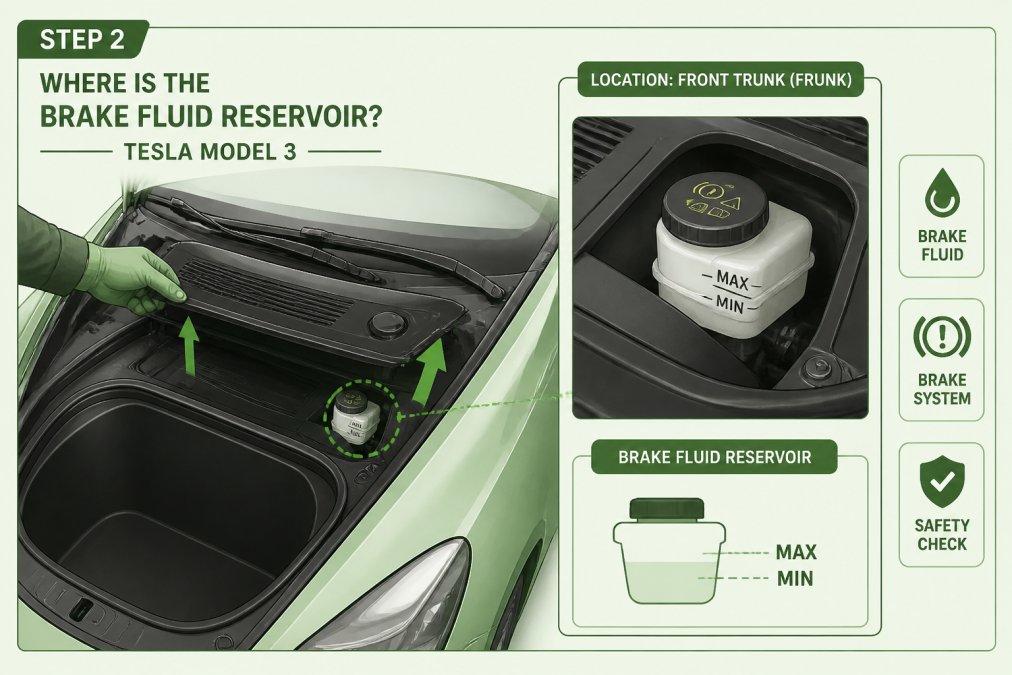
Step 2: Where Is the Tesla Brake Fluid Reservoir?
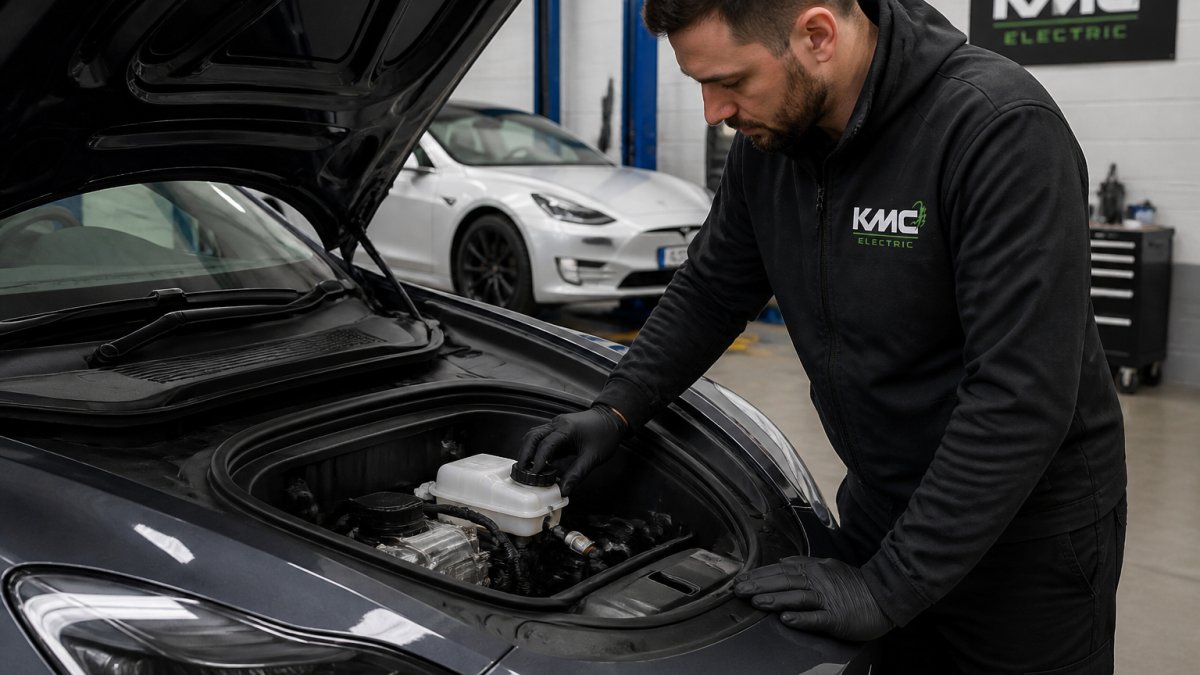
The Tesla brake fluid reservoir sits under the front bonnet on the driver's side, beneath a plastic trim cover near the bulkhead. On a right-hand-drive Model 3 or Model Y you will find it towards the right of the car as you face it from the front.
Lift the cover gently. It is held by clips, not screws, so no tools are needed. Underneath you will see a small translucent plastic tank with a black cap and two raised marks on the side.
Close-up of a technician's gloved hands lifting the plastic frunk cover on a Tesla Model 3 to reveal the brake fluid reservoir cap and MIN/MAX markings
If your car has the OTC heater or air conditioning work done recently, the surrounding pipework may look busy. Do not mistake the coolant reservoir for the brake fluid tank. The brake fluid reservoir is smaller, sits higher, and has a cap marked with a brake symbol.
Step 3: Read the Level Against the MIN and MAX Marks
The level should sit between the MIN and MAX marks when the car is level and the cap is on. Shine your torch through the side of the tank. Fresh fluid looks pale amber; older fluid looks darker.
If the level is below MIN, do not simply top it up and forget it. A dropping level means fluid is escaping somewhere, and that needs diagnosing. Common causes include a worn seal, a weeping caliper, or a leaking line.
Check the cap seal as well. A perished rubber seal lets moisture in and lets fluid weep out. Wipe the area dry and check again after a week to see if the level has moved.
What You See
What It Means
What To Do
Level between MIN and MAX
System is healthy
Recheck in six months
Level below MIN
Possible leak
Book a pressure test
Fluid dark brown or black
Fluid is aged
Book a change
Milky or cloudy fluid
Water contamination
Book a change and flush
Understanding a Tesla Brake Fluid Warning
A Tesla brake fluid warning appears on the touchscreen as a red or amber brake icon, often with a message about low brake fluid. Treat any red brake warning as a stop-driving signal and get the car checked.
The warning can also appear when the fluid level sensor is faulty, which is more common than owners expect. Do not assume the worst, but do not ignore it either.
We have seen owners in Kettering drive for weeks with an amber warning because the car still stopped fine. That is a gamble. The warning exists because the system has detected something outside its normal range, and a proper diagnosis takes the guesswork out.
If your car is still under warranty, a warning is worth investigating early. At KMC Electric we can identify faults before warranty expiry, so you are not left paying for something the warranty should have covered.
The Tesla Brake Fluid Moisture Test Explained
A Tesla brake fluid moisture test measures the water content in the fluid using a small electronic tester that clips onto the reservoir. Brake fluid absorbs water over time, and once water content climbs, the fluid's boiling point drops and corrosion risk rises.
The tester gives a simple pass or fail reading. Most independent garages and many owners keep one in the toolbox because it costs little and takes seconds.
Clean the reservoir cap area first
Dip the tester probe into the fluid
Read the indicator lights
Record the result and the date
A pass means the fluid is still doing its job. A fail means it is time to book a change. Testing every twelve months is a sensible habit, especially on a car used for towing or regular hard braking.
Key TakeawayThe moisture test is the single most useful check you can do at home. It tells you more about fluid condition than colour alone ever will.
Tesla Brake Fluid Change Interval: When to Book It In
Tesla does not publish a fixed brake fluid change interval for the Model 3 or Model Y in the same way it lists tyre rotation. Instead, the recommendation is to check the fluid and replace it when testing shows it is due. In practice, most specialists suggest a change every two to three years.
Your driving style matters. A car that sits for long periods absorbs moisture faster. A car used for track days or heavy towing heats the fluid more, which shortens its life.
Book a change if any of these apply:
The moisture tester fails
The fluid looks dark or cloudy
The level has dropped without explanation
The brake pedal feels soft or spongy
It has been more than three years since the last change
At KMC Electric, we handle brake fluid changes alongside the jobs we see most on Model 3 and Model Y cars: OTC heater faults, air conditioning pump repairs, and suspension work. Our Level 4 Master Technician status in electric vehicles means we know these systems properly, and we will tell you honestly whether a job is needed.
If you are searching for a Tesla brake fluid check near me in the Kettering area, our workshop covers Northamptonshire and Leicestershire. We also work with franchised dealership service managers who need help with complex Tesla fault codes.
Frequently Asked Questions
How do you check the brake fluid level on a Tesla Model 3?
Park on level ground and let the car cool, then open the front bonnet and remove the plastic frunk surround to reach the reservoir on the driver's side near the bulkhead. Wipe the cap clean before opening it, then read the fluid against the MIN and MAX marks on the side of the reservoir. Top up only with the DOT fluid grade specified in your owner's handbook, and if the level sits at or below MIN, have the system checked for a leak rather than simply refilling it.
What does a Tesla brake fluid warning mean?
A Tesla brake fluid warning usually means the level in the reservoir has dropped below the safe threshold, or the car's sensors have flagged a related fault in the braking system. It is not a reminder to book a service at your convenience. Low fluid can point to a leak, worn seals, or air in the system, all of which affect braking performance. Stop in a safe place, check the level, and arrange professional diagnosis before driving any distance.
How often should Tesla brake fluid be checked or changed?
Check the level visually every few months and before any long trip, particularly on a Model 3 or Model Y past its third year. On the change interval, Tesla's own guidance for UK cars is to have the brake fluid tested for moisture and replaced if it fails, rather than on a fixed mileage. A moisture test is quick and tells you whether the fluid still performs under heat. Many independent specialists recommend testing every two years as a sensible baseline.
Can you drive a Tesla with low brake fluid?
You should not drive far with the level below MIN. A small drop over months is normal, but a sudden low reading usually means fluid is escaping somewhere, and the brakes may feel spongy or fade under heavy use. If the warning light is on and the pedal feels different, stop and get the car recovered. If the level is only slightly down and the pedal feels normal, top up to MAX with the correct DOT grade and book a pressure test to find the cause.
Brake fluid is one of the cheapest parts of your Tesla to look after, and one of the most expensive to neglect. If your check raises any doubts, or you would rather have a specialist look at it, KMC Electric can help. We offer independent diagnosis, moisture testing, and fluid changes for the Model 3 and Model Y, backed by over 25 years of automotive experience. Get started with KMC Electric and keep your braking system in the condition it deserves.