Understanding the benefits of regular car diagnostics is one of the most practical things a driver can do to protect their vehicle and their wallet. At KMC Electric, we work with Tesla and electric vehicle owners across Kettering and the wider Northamptonshire area every day, and the pattern is consistent: drivers who schedule routine diagnostic checks catch problems early, spend less on repairs, and keep their vehicles running longer. Below, we'll show you exactly what diagnostics involve, how often to run them, and what the results actually mean for your car's health.
Most people only think about a diagnostic check when the check engine light appears. That's the wrong approach. By the time a warning light triggers, the fault has often been present for weeks, quietly affecting fuel economy, emissions, and component wear. The real value of car diagnostics is preventive, not reactive.
What Are Automotive Diagnostics and How Do They Work?
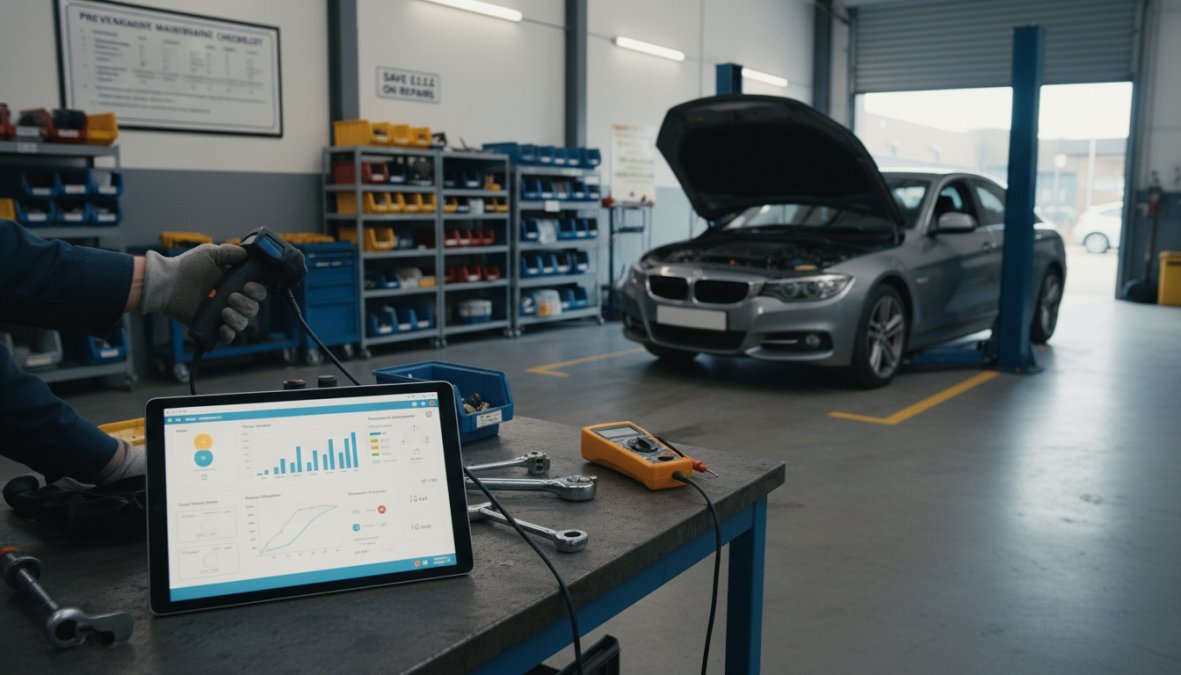
Automotive diagnostics is the process of reading data from a vehicle's onboard computer system to identify faults, monitor sensor performance, and assess the health of key mechanical and electronic systems. A diagnostic scan doesn't just read warning lights; it interrogates dozens of subsystems simultaneously, from engine timing to transmission health to braking system pressure.
Modern vehicles contain an Electronic Control Unit (ECU) that continuously monitors sensor inputs and logs any deviation from expected parameters. When a fault is detected, the ECU stores a trouble code. A diagnostic tool reads those codes and translates them into actionable information for the technician.
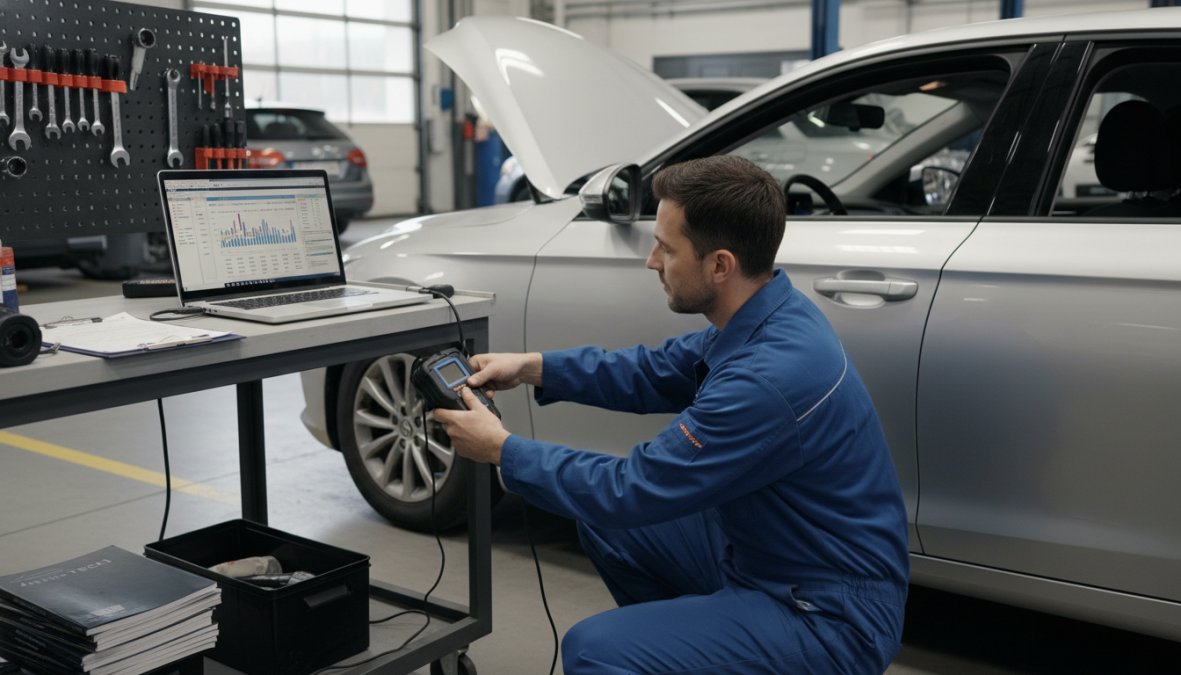
Professional illustration showing OBD for benefits of regular car diagnostics
How the OBD-II Scanner Reads Your Onboard Computer System
The OBD-II scanner is the standard tool used to access a vehicle's diagnostic data. OBD-II (On-Board Diagnostics, second generation) has been mandatory on all petrol and diesel vehicles sold in the UK since 2001, and on EVs and hybrids as well. The scanner plugs into a standardised port, typically located beneath the steering column, and communicates directly with the ECU.
Once connected, the scanner retrieves stored and pending trouble codes, reads live sensor data in real time, and in professional setups, can run active tests on individual components. Entry-level consumer scanners show basic codes. Professional diagnostic software used by specialist garages provides far deeper access: freeze-frame data, sensor waveforms, and system-specific fault trees.
What the Electronic Control Unit (ECU) Actually Monitors
The ECU doesn't just watch the engine. A modern vehicle has multiple control modules covering:
Transmission control (gear selection, fluid temperature, shift quality)
Anti-lock braking system (ABS) and stability control
Oxygen sensor and exhaust system performance
Catalytic converter efficiency
HVAC, airbag systems, and body electronics
For electric and hybrid vehicles, additional modules monitor battery state of health, thermal management, charging systems, and regenerative braking. This is an area where specialist knowledge matters significantly, and it's where generalist garages often fall short.
The Core Benefits of Regular Car Diagnostics Every Driver Should Know
The most important thing to understand about regular car diagnostics is this: they shift your maintenance strategy from reactive to preventive. Problems are identified before they become failures. That single shift changes the economics of vehicle ownership entirely.
Early Detection of Vehicle Problems Before They Escalate
A common mistake is assuming that a car running quietly is a car running correctly. Many faults produce no audible or visible symptoms in their early stages. An oxygen sensor degrading gradually, for example, will reduce fuel economy and increase emissions for months before triggering a warning light. A diagnostic scan catches it as a pending code, before it becomes a confirmed fault and before it damages the catalytic converter downstream.
Early detection is the single biggest financial argument for regular diagnostic checks. Replacing an oxygen sensor costs a fraction of replacing a catalytic converter. The same logic applies to engine misfire detection: catching a misfire early protects the catalytic converter, the fuel injectors, and the cylinder walls from progressive damage.
Pro TipRequest a full system scan, not just an engine scan. Faults in ABS, transmission, and body control modules are equally important but often missed by basic code readers.
Improving Fuel Economy and Engine Performance
Poor engine performance is often invisible to the driver until it becomes severe. A partially blocked fuel injector, a failing mass airflow sensor, or incorrect engine timing can reduce fuel economy noticeably without triggering any warning light. Regular diagnostics catch these efficiency losses early.
Real-time data from a diagnostic scan shows how the engine is actually performing: fuel trim values, throttle response, ignition timing advance, and sensor accuracy. An automotive technician reviewing this data can identify whether the engine is running rich or lean, whether the timing is retarded, and whether sensor malfunction is affecting the air-fuel mixture. These are not problems you can diagnose by feel alone.
Emissions Testing, Catalytic Converter Health, and Environmental Impact
The exhaust system and catalytic converter are directly monitored by the ECU through upstream and downstream oxygen sensors. If the catalytic converter is losing efficiency, the ECU detects the discrepancy between sensor readings and stores a fault code. Regular diagnostics catch this before the vehicle fails its MOT emissions test.
This matters beyond the MOT. A vehicle running with a degraded catalytic converter produces significantly higher levels of carbon monoxide and hydrocarbons. For drivers in Kettering and Northamptonshire who want to reduce their environmental impact, keeping the exhaust system in good health through regular diagnostic monitoring is one of the most direct actions available.
Signs Your Car Needs a Diagnostic Check Right Now
Signs your car needs a diagnostic check are not always obvious, and the check engine light is far from the only trigger. More importantly, not all signs carry the same urgency. Understanding what each symptom likely indicates at a system level helps you make a faster, better-informed decision about whether to drive to a garage, book in for next week, or stop the car immediately.
The table below maps the most common symptoms to their probable system cause and the appropriate urgency level:
Symptom
Most Likely System Affected
Urgency
Check engine light, steady
Engine management, emissions, sensors
Book within 1-2 weeks
Check engine light, flashing
Active engine misfire
Stop driving; book same day
Service engine soon / other warning lamp
Varies by lamp; requires scan to confirm
Book within 1 week
Fuel economy drop (10%+ over several weeks)
O2 sensor, MAF sensor, fuel injectors, fuel trim
Book within 2-4 weeks
Rough idle or hesitation under acceleration
Misfire, ignition system, fuel delivery
Book within 1 week
Sulphur or rotten-egg smell from exhaust
Catalytic converter failure or rich-running engine
Watch OutA flashing check engine light is categorically different from a steady one. A flashing light indicates an active misfire, unburned fuel is entering the exhaust and can destroy a catalytic converter within a short distance of driving. Do not continue driving. A catalytic converter replacement costs several times more than the [repair](/page/tesla-battery-repair) that caused the misfire in the first place.
What Your Symptoms Are Actually Telling You
Each symptom maps to a specific diagnostic pathway. Here is what is actually happening inside the vehicle in the most common cases:
Fuel economy drop without a change in driving pattern This almost always points to a fuelling or sensor fault. The most common causes are a degrading oxygen sensor causing the ECU to run the engine rich (too much fuel), a dirty or failing mass airflow (MAF) sensor giving the ECU incorrect air volume readings, or partially blocked fuel injectors reducing combustion efficiency. None of these trigger a warning light in their early stages. A diagnostic scan will show fuel trim values, if short-term or long-term fuel trim is reading above +10% or below -10%, the engine is compensating for a sensor or fuelling fault.
Rough idle or hesitation This is the classic early misfire pattern. The ECU logs misfire events per cylinder per 200 revolutions. A diagnostic scan will show not just that a misfire is occurring, but which cylinder is affected and how frequently. That information immediately narrows the fault to either the ignition system (coil, plug), fuel delivery (injector), or compression (mechanical fault) for that specific cylinder, saving diagnostic time and repair cost.
Transmission slipping or erratic shifts Automatic transmission faults are among the most expensive to ignore. The transmission control module monitors fluid temperature, gear selection solenoids, and shift timing. Early faults often appear as intermittent slipping or delayed engagement and store as pending codes before becoming confirmed faults. A full system scan, not just an engine scan, is required to access transmission codes, which a basic consumer OBD-II reader will not retrieve.
Braking changes Any change in braking feel, increased stopping distance, vibration through the pedal, or the ABS activating on dry roads, should be treated as urgent. The ABS module and wheel speed sensors store their own fault codes in the chassis (C-code) system. These are invisible to basic scanners and require a full system scan to retrieve.
Pro TipWhen you book a diagnostic check based on any of the symptoms above, tell the garage the specific symptom and when it first appeared. A good technician will use that information alongside the scan data to identify whether the stored code is the cause of the symptom or a secondary effect of a deeper fault.
A Note on Pending vs. Confirmed Codes
The OBD-II system distinguishes between pending codes and confirmed (stored) codes. A pending code means the ECU has detected a fault on one drive cycle but has not yet confirmed it across the required number of cycles to illuminate the warning light. A confirmed code has met that threshold and has triggered the warning lamp.
This matters because pending codes represent the earliest possible detection window, before any warning light appears, before the fault causes secondary damage, and before the repair cost escalates. A regular diagnostic scan catches pending codes. Waiting for the warning light means the fault has already progressed past the earliest intervention point.
For drivers who want to monitor this between professional scans, a basic OBD-II scanner (£20-£50) will display pending codes alongside confirmed ones. It will not interpret them with the depth a professional scan provides, but it gives you a meaningful early-warning layer between annual service visits.
How Often Should You Get a Car Diagnostic Test?
You should get a car diagnostic test at minimum once per year, ideally aligned with your annual service. Many automotive technicians recommend scanning before and after major services to verify that all systems are functioning correctly after work is completed.
Vehicle Age and Mileage Thresholds to Guide Your Schedule
Vehicle age and mileage significantly affect how frequently you should run diagnostic checks. A general framework:
Vehicle Age / Mileage
Recommended Diagnostic Frequency
Under 3 years / under 30,000 miles
Annually, at service
3-7 years / 30,000-70,000 miles
Every 6-12 months
7+ years / 70,000+ miles
Every 6 months minimum
Pre-MOT (any age)
Always run a pre-MOT scan
Post major repair (any age)
Always verify with a full scan
Electric/hybrid vehicles
Every 6 months regardless of age
Older vehicles have more wear across sensors, actuators, and wiring harnesses. Faults accumulate faster, and the cost of missing an early warning increases with age. For electric vehicles specifically, battery degradation monitoring through regular diagnostics is essential for understanding real-world range and resale value.
DIY Car Diagnostic Tools vs Professional Service: Which Is Right for You?
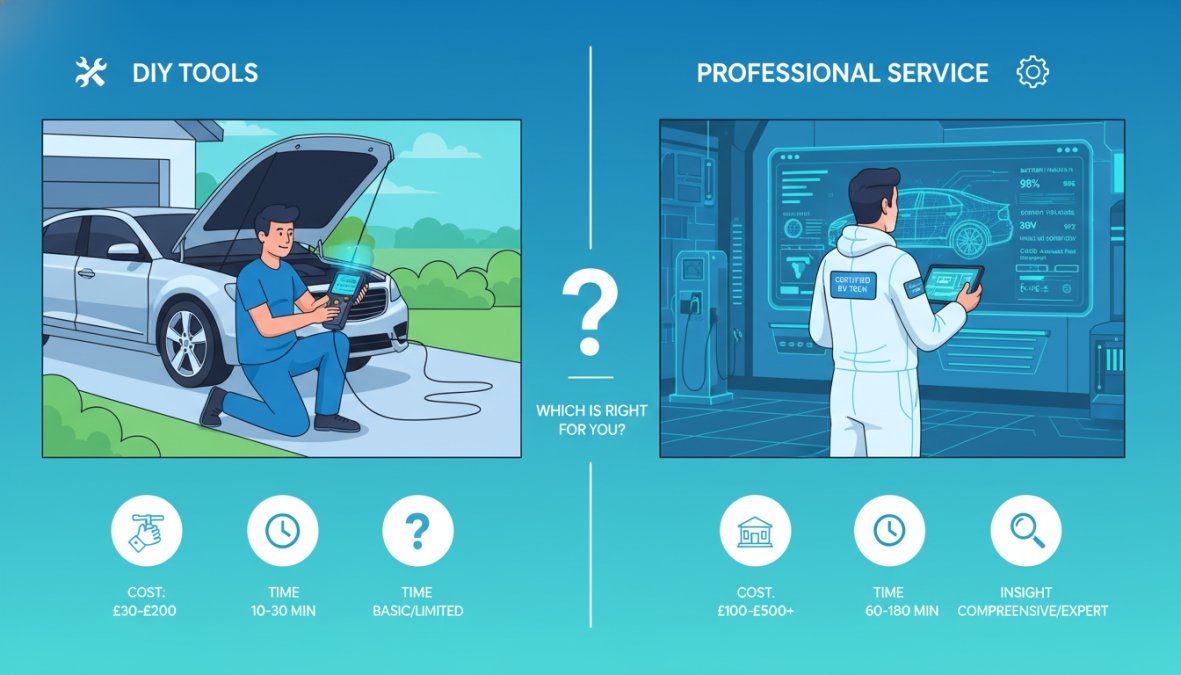
DIY car diagnostic tools have improved considerably, and for a specific use case, they're genuinely useful. A basic OBD-II scanner costing £20-£80 will read and clear trouble codes, show live sensor data for common parameters, and help you understand what a warning light means before visiting a garage. For a confident home mechanic wanting to monitor their own vehicle between services, that's a reasonable tool.
The limitation is significant, though. Consumer-grade scanners access generic OBD-II data. They cannot interrogate manufacturer-specific modules, run active component tests, or access the deeper layers of the ECU where many real faults hide. For Tesla and other electric vehicles, proprietary diagnostic software is required to access battery management systems, motor control units, and charging system data. A generic scanner will show almost nothing useful.
DIY OBD-II scanner: Good for reading basic engine codes, clearing warning lights, monitoring common sensors
Professional diagnostic software: Required for manufacturer-specific faults, EV systems, transmission, ABS, airbag modules, and active testing
Specialist EV diagnostics: Essential for battery state of health, thermal management, charging faults, and motor performance data
Side-by-side comparison of Side, OBD, Level for benefits of regular car diagnostics
Interpreting Common Error Codes: What Trouble Codes Actually Mean
Trouble codes follow a standardised format under OBD-II. Each code begins with a letter indicating the system:
P codes (Powertrain): Engine and transmission faults, e.g., P0420 (catalytic converter efficiency below threshold), P0300 (random engine misfire)
B codes (Body): Airbag, climate control, power windows
C codes (Chassis): ABS, traction control, steering
U codes (Network): Communication faults between control modules
The number following the letter indicates whether the code is generic (0) or manufacturer-specific (1, 2, 3). A P0 code is standardised across all manufacturers. A P1 code is specific to that vehicle's make, and reading it correctly requires manufacturer-level diagnostic software.
A common mistake is clearing codes without diagnosing the root cause. The code returns because the underlying fault remains. Professional diagnostics go beyond the code itself: they examine live data, freeze-frame conditions, and related sensor readings to identify why the code was set.
Key TakeawayA trouble code is the starting point of a diagnosis, not the diagnosis itself. The code tells you which system is affected. Only live data analysis reveals what actually caused the fault.
Car Diagnostic Test Cost: What to Expect and How to Avoid Overpaying
Car diagnostic test cost is one of the most searched questions around vehicle maintenance, and almost no automotive content answers it honestly. The reason is that 'a diagnostic' is not a single, standardised service, it is a spectrum of work ranging from a two-minute code read to a two-hour deep-system investigation, and garages do not always make that distinction clear when quoting.
Understanding what drives the price difference helps you evaluate whether you are getting fair value, or paying for a shallow scan dressed up as a comprehensive check.
What You Are Actually Paying For
A diagnostic charge covers some combination of the following, depending on the garage and the scope agreed:
The scan itself, connecting the diagnostic tool and retrieving stored and pending fault codes across one or more vehicle systems. This takes 5-15 minutes with professional equipment.
Live data analysis, reviewing real-time sensor readings against manufacturer specifications to identify whether a component is operating within tolerance. This requires technician time and expertise, not just the tool.
Freeze-frame and fault history review, examining the conditions under which a fault was logged (engine load, speed, temperature) to understand the context of the fault, not just its presence.
Active component testing, commanding individual components (fuel injectors, EGR valves, cooling fans) to activate through the diagnostic software to verify they respond correctly. This is only possible with professional-grade software and adds significant diagnostic value.
Written report, a documented list of all fault codes found, their status (pending or confirmed), and the technician's interpretation. Not all garages include this as standard.
Typical Price Ranges and What They Mean
Scan Type
Typical Price Range (UK)
What It Usually Includes
Basic code read (consumer tool or quick-fit chain)
£0-£40
Engine codes only; no live data analysis; often no written report
Standard diagnostic check (independent garage)
£45-£80
Multi-system scan; basic live data; verbal or written summary
Comprehensive diagnostic (specialist garage)
£80-£150
Full system scan; live data analysis; freeze-frame review; written report
EV / hybrid specialist diagnostic
£90-£160+
All of the above plus battery management system, charging system, and motor/inverter data requiring manufacturer-compatible software
Pre-purchase inspection with diagnostics
£100-£200
Full scan plus physical inspection; typically includes written report for buyer
These ranges reflect typical independent garage pricing in the UK as of 2025-2026. Main dealer diagnostic rates are often higher, particularly for EVs, because they use brand-specific software and charge accordingly.
Pro TipA £40 diagnostic from a quick-fit chain and a £120 diagnostic from a specialist are not the same service. The cheaper scan typically accesses only the engine management system using a generic OBD-II reader. The specialist scan accesses all modules, transmission, ABS, airbag, body control, and for EVs, the battery management system, using software that can interrogate manufacturer-specific fault codes that a generic tool cannot read.
Why Diagnostic Fees Vary: The Four Real Drivers
1. Software access and licensing Professional diagnostic platforms, such as those used by specialist EV garages, require significant ongoing investment in software licensing and hardware. These tools access manufacturer-specific data that generic OBD-II scanners cannot reach. That cost is reflected in the labour rate.
2. Technician expertise A diagnostic scan run by a Level 4 Master Technician who interprets live data against manufacturer specifications is a fundamentally different service from a scan run by a service advisor who reads the code off a screen. The interpretation is where the value lies, and it is the part that varies most between garages.
3. Vehicle complexity An older petrol vehicle with a single ECU is simpler to scan than a modern hybrid with separate engine, transmission, battery management, and charging control modules. More modules mean more scan time and more data to interpret.
4. Scope of the scan Some garages quote for an engine-only scan and call it a 'diagnostic.' Others scan all available modules. Always confirm the scope before authorising the work.
Five Questions to Ask Before You Pay
These questions take less than two minutes to ask and consistently lead to better outcomes:
Which systems will be scanned? Engine only, or all available modules including transmission, ABS, airbag, and body control?
Will I receive a written report? A professional diagnostic should produce a documented list of all codes found, pending and confirmed, not just a verbal summary.
Does the quoted price include the technician's time to interpret the data? Or just the scan itself?
Do you have manufacturer-compatible software for my specific vehicle? This is essential for EVs, hybrids, and vehicles less than five years old with manufacturer-specific fault codes.
If a fault is found, will the diagnostic fee be offset against the repair cost? Many reputable garages apply the diagnostic fee as a credit if you proceed with the repair.
Key TakeawayThe diagnostic fee is not the cost to worry about, it is the cheapest part of the process. The cost to worry about is the repair bill that results from a fault being missed because the scan was too shallow. A thorough diagnostic that costs £120 and identifies a pending oxygen sensor fault before it damages a catalytic converter is worth several times its price. A £40 scan that misses the same fault because it only accessed the engine management system is not a saving, it is a deferred cost.
According to Which? guidance on car servicing and repair costs, consumers who ask detailed questions before authorising work consistently report better outcomes and fewer unexpected charges. The questions above are the specific ones that matter most in a diagnostic context.
The Benefits of Regular Car Diagnostics for Electric and Hybrid Vehicles
Electric and hybrid vehicles present a diagnostic challenge that conventional petrol-focused garages are not equipped to handle. The benefits of regular car diagnostics are, if anything, more significant for EVs than for internal combustion vehicles, because the consequences of undetected faults are more severe and the systems involved are more complex.
For a Tesla or other EV, regular diagnostics serve several purposes beyond standard fault detection:
Battery state of health monitoring: Identifies cell degradation, capacity loss, and thermal management issues before they affect range or safety
Charging system verification: Confirms that onboard chargers, DC-DC converters, and charging port components are functioning within specification
Motor and drivetrain health: Monitors inverter performance, motor temperature management, and regenerative braking efficiency
Pre-warranty expiry fault identification: Catching faults before the manufacturer warranty expires can save thousands in repair costs
KMC Electric, based in Kettering, holds Level 4 Master Technician status in electric vehicles and has been qualified in EV systems since 2016. With over 25 years of automotive experience and specialist knowledge of Tesla systems across all models, the team provides independent battery health verification that is particularly valuable for buyers and sellers of used EVs. For EV owners near Kettering looking for a cost-effective alternative to main dealer diagnostics, this level of specialist access to vehicle data is difficult to find elsewhere.
For hybrid vehicles, the diagnostic picture spans both the combustion engine and the high-voltage battery system. Both need to be assessed together. A hybrid running on a degraded battery puts additional load on the combustion engine, accelerating wear in ways that a basic service inspection will not reveal.
Conclusion: Make Diagnostics Part of Your Maintenance Schedule
Skipping regular diagnostic checks is one of the most common and costly mistakes vehicle owners make. The faults that cause the most expensive repairs, engine misfires damaging catalytic converters, battery degradation going unmonitored, transmission faults developing into full failures, are exactly the faults that regular diagnostics catch early.
For EV and hybrid owners across Kettering and Northamptonshire, KMC Electric offers specialist diagnostic services backed by Level 4 Master Technician expertise and over 25 years of hands-on automotive experience. Whether you need independent battery health verification, a pre-warranty fault check, or a comprehensive system scan for your Tesla or hybrid vehicle, KMC Electric provides the technical depth that general garages cannot match. Book a diagnostic check with KMC Electric and get a clear, accurate picture of your vehicle's health before small problems become expensive ones.
Frequently Asked Questions
What is included in a car diagnostic test?
A car diagnostic test uses an OBD-II scanner to read trouble codes stored in your vehicle's onboard computer system. It typically checks the engine, transmission health, braking system, exhaust system, oxygen sensor readings, and other sensor data. A professional test at an automotive repair shop will also include a technician's interpretation of the real-time data, helping pinpoint the root cause rather than just identifying a warning code.
How often should you get a car diagnostic test?
Most vehicles benefit from a diagnostic check at least once a year or every 12,000 miles, whichever comes first. Older vehicles or those with higher mileage may need checks every six months. You should also book an immediate diagnostic whenever the check engine light appears, before buying or selling a used vehicle, or after any noticeable change in engine performance, fuel economy, or driving behaviour.
Does a check engine light always mean a major repair?
Not necessarily. The check engine light can be triggered by anything from a loose fuel cap to a faulty oxygen sensor or a more serious engine misfire. Without reading the specific trouble codes via an OBD-II scanner, it is impossible to know the severity. This is why acting quickly on a check engine light is important — catching a minor sensor malfunction early is far cheaper than allowing a small fault to develop into a major mechanical failure.
Is it worth paying for a car diagnostic test?
Yes. The benefits of regular car diagnostics far outweigh the cost. A professional diagnostic test typically costs between £50 and £100 in the UK, while the mechanical failures it can prevent — such as catalytic converter damage, transmission faults, or engine timing issues — can run into hundreds or thousands of pounds. For electric and hybrid vehicles especially, early fault detection through specialist diagnostic software can also protect battery health and extend vehicle longevity significantly.
Can a diagnostic test detect all car problems?
A diagnostic test is highly effective at identifying electronic and sensor-related faults logged by the ECU, including issues with the engine, exhaust system, braking system, and drivetrain. However, it does not replace a full physical inspection. Some mechanical wear — such as worn brake pads or suspension components — may not trigger a trouble code. A thorough diagnostic combined with a visual inspection by a qualified automotive technician gives the most complete picture of your vehicle's health.