Are Independent Electric Car Mechanics Good Enough to Trust?
Asking whether independent electric car mechanics are good is one of the most practical questions an EV owner can raise in 2026. The honest answer: yes, but only if you find the right one. At KMC Electric, based in Kettering, Northamptonshire, we have been working on electric and hybrid vehicles since 2016, and the quality gap between a qualified independent specialist and a poorly equipped general garage is significant.
Most guides treat "independent" as a single category. There is a world of difference between an independent specialist with Level 4 Master Technician status and a general garage that occasionally sees an electric vehicle. This guide helps you tell them apart.
How EV Repair Differs From Traditional ICE Servicing
Electric vehicle maintenance is fundamentally different from ICE servicing. A petrol car relies on hundreds of mechanical components diagnosable through physical inspection. An EV replaces most of that with a high-voltage battery pack, inverter, electric motor, and a powertrain that communicates almost entirely through software.
A mechanic who cannot read proprietary diagnostic software cannot effectively service an EV. Brake servicing requires understanding regenerative braking systems. Coolant flushes address battery thermal management circuits, not a traditional engine loop. The tools, training, and mental model are entirely different.
The Shortage of Qualified EV Technicians and What It Means for You
The EV technician shortage is real. According to IMI's EV skills gap research, the UK automotive industry faces a substantial shortfall in EV-qualified technicians as the electric vehicle parc grows faster than training programmes can supply. Many garages advertising EV servicing have staff with only basic awareness training, not the specialist knowledge required for complex diagnosis or high-voltage battery work.
A properly certified independent EV mechanic often has more hands-on diagnostic experience across a broader range of models than a dealership technician who sees only one brand.
Watch OutAvoid any garage that claims EV capability without naming their technicians' specific qualifications. Vague statements like "we work on all vehicles" are a red flag. High-voltage systems require formal training, not general mechanical aptitude.
What Makes a Certified EV Technician Actually Qualified
A genuinely qualified EV technician holds formal certification covering high-voltage safety, battery health assessment, electric motor diagnosis, and the software systems that tie everything together.
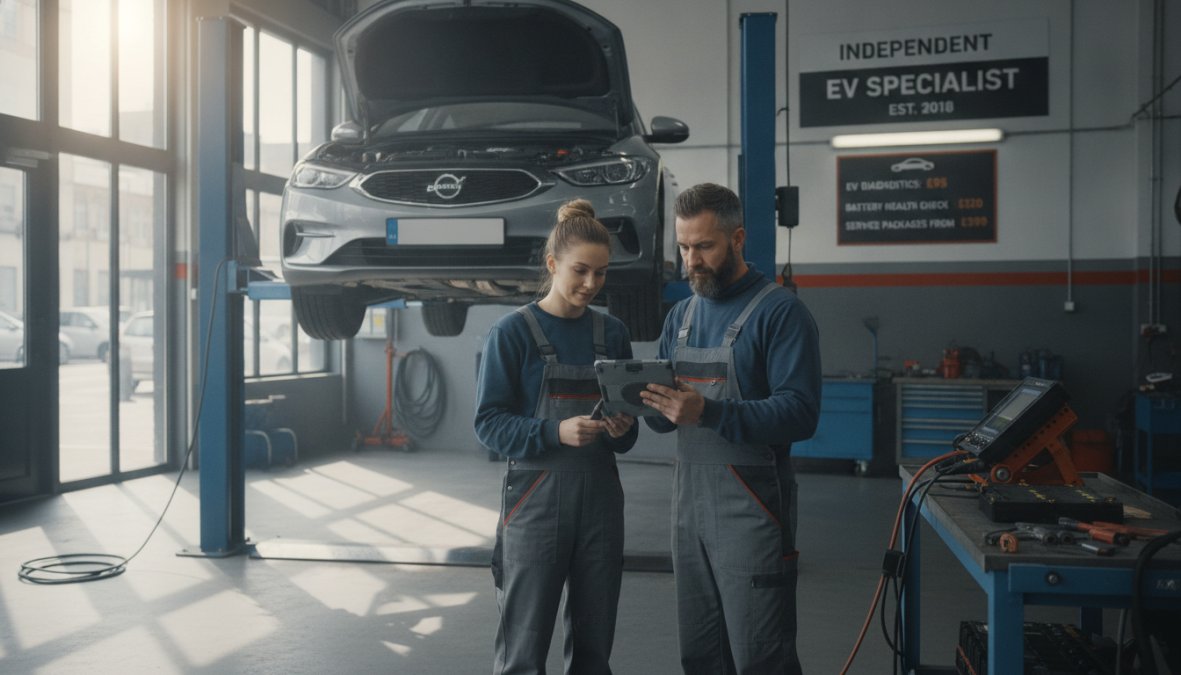
The UK benchmark is the IMI TechSafe EV qualification framework, which grades technicians from basic awareness through to Level 4 Master Technician status. Level 4 covers complex high-voltage system diagnosis, battery pack assessment, and advanced powertrain work, and it is not common. Most garages have staff at Level 2 or 3 at best.
Professional illustration showing are independent electric car mechanics good
Beyond the IMI framework, ASE's L3 Light Duty Hybrid/Electric Vehicle Specialist certification provides a recognised benchmark, particularly relevant for vehicles with North American service histories. Certification alone is not enough, ask how many EVs the shop services per week, not just what certificates are on the wall.
ASE Certification, Level 4 Master Technician Status, and Regional Standards
IMI Level 4 is the UK standard, covering battery pack diagnosis, inverter fault-finding, and thermal management servicing. It requires substantial practical hours, not just an exam. ASE L3 carries particular weight for Tesla owners given Tesla's American engineering heritage. Some UK independent specialists hold both, broadening diagnostic capability across imported models.
KMC Electric holds Level 4 Master Technician status in electric vehicles, with qualifications dating to 2016, making it one of the earlier independent specialists in the Northamptonshire region to achieve that standard.
Pro TipAsk any prospective independent EV garage for the specific qualification held by the technician who will work on your vehicle. A shop can display a certificate on the wall without the relevant technician being present for your job.
EV Maintenance Costs: Dealership vs. Independent Specialist
Cost is a primary reason EV owners explore independent shops, and the savings are often substantial. Main dealer pricing reflects dealer overheads, manufacturer-mandated labour rates, and mandatory OEM parts. A qualified independent specialist can offer equivalent diagnostic capability at meaningfully lower cost, the gap widens for complex jobs involving battery health assessment, software updates, or HVAC diagnostics. Independent shops also tend to itemise work clearly, where dealerships often bundle services in ways that obscure what you are actually paying for.
Cost Comparison Table: Dealership vs. Independent Shop
Service
Main Dealer (est.)
Independent Specialist (est.)
Notes
Annual EV health check
£150-£250
£80-£150
Includes battery health check
Tyre rotation
£40-£80
£25-£50
Standard across both
Wheel alignment
£60-£120
£40-£80
Requires EV-specific calibration
Brake servicing
£150-£300
£100-£200
Regenerative braking systems add complexity
Battery health report
£200-£400
£100-£250
Independent verification is often more thorough
Software diagnostic
£100-£200
£75-£150
Requires proprietary diagnostic software
Coolant flush (battery circuit)
£120-£200
£80-£150
Not the same as ICE coolant service
Estimates based on general UK market pricing. Actual costs vary by vehicle model, region, and specific fault complexity.
Key TakeawayFor out-of-warranty vehicles, the cost argument for a qualified independent EV specialist is compelling. The key is ensuring the shop has the diagnostic software and certification to match dealership capability, not just dealership pricing.
Common Electric Car Repairs and Who Should Handle Them
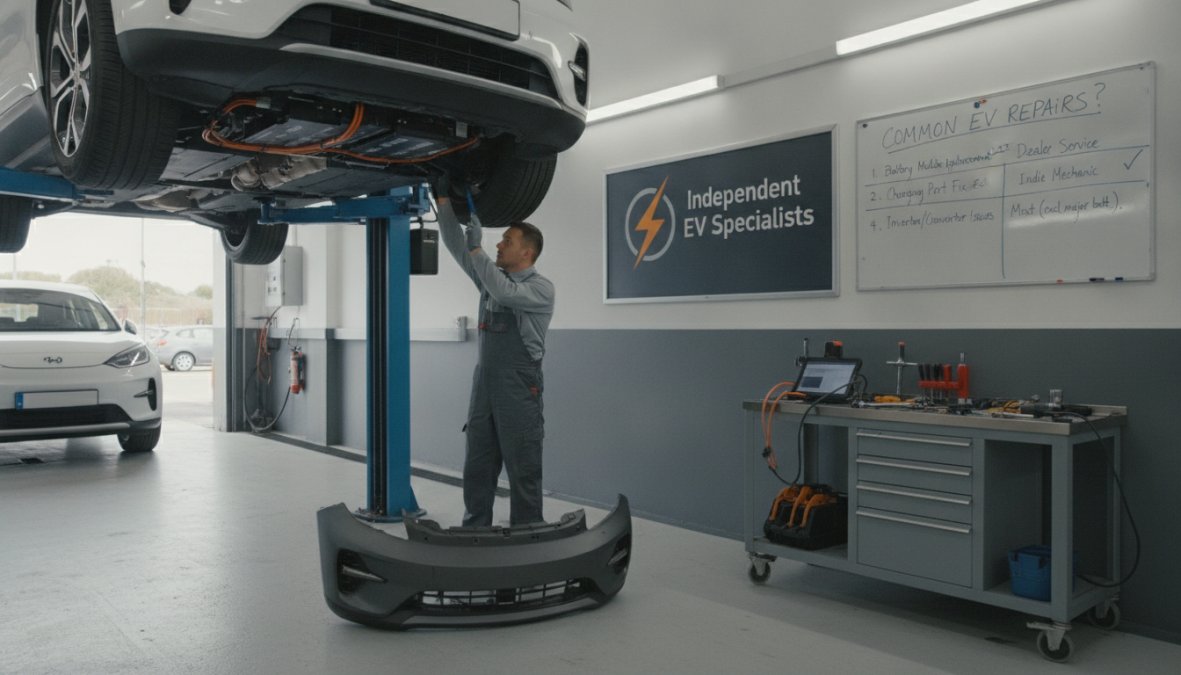
Not every EV repair requires a specialist. Some routine tasks are within the capability of any competent independent garage; others must only be handled by a technician with specific EV qualifications.
Routine Maintenance: Tyres, Brakes, Wheel Alignment, and Coolant
Tyre rotation and wheel alignment can be handled by most independent garages, with one caveat: EVs are significantly heavier than equivalent ICE vehicles, and alignment settings must account for the additional load. ICE-spec alignment on an EV can accelerate tyre wear.
Brake servicing is more nuanced than it appears. Because regenerative braking handles most deceleration, physical brake components on an EV often corrode from underuse. A technician unfamiliar with this pattern may recommend unnecessary pad replacements while missing corroded callipers.
Coolant flush on an EV addresses the battery thermal management circuit. Using the wrong coolant specification can damage battery management components.
Professional illustration showing Close for are independent electric car mechanics good
High-Voltage Systems: Safety Risks and DIY vs. Professional Boundaries
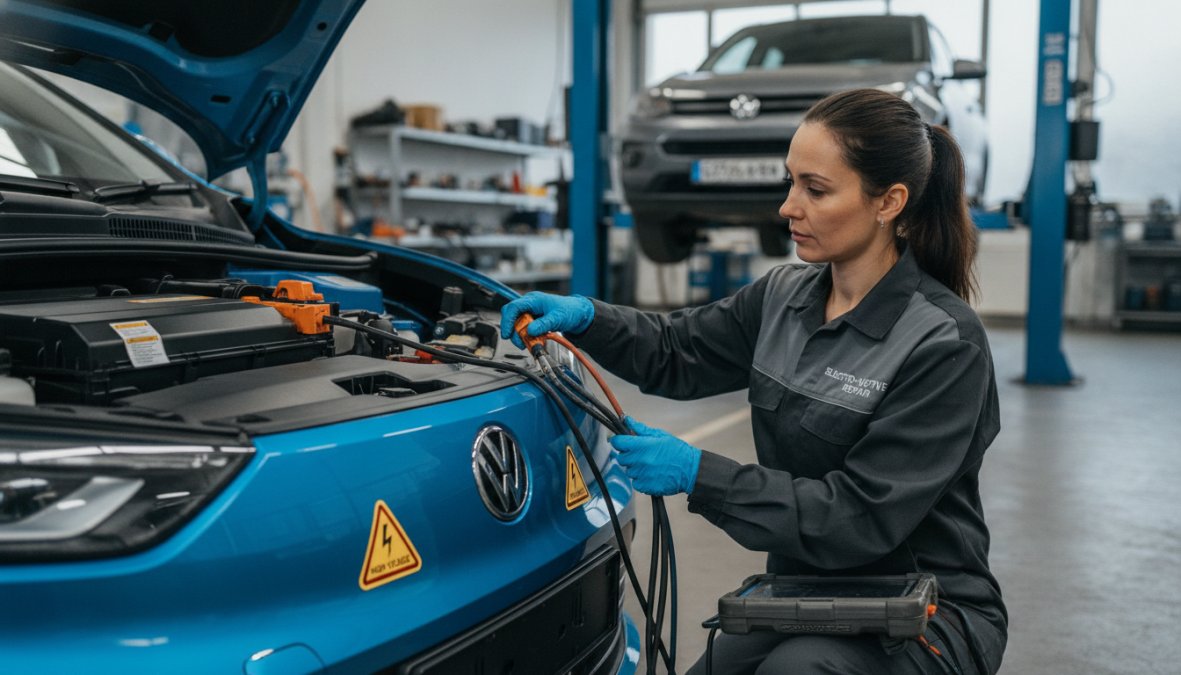
High-voltage battery systems operate at up to 400V, and some newer platforms at 800V. The following tasks must only be performed by a technician with formal high-voltage safety training:
High-voltage battery pack removal or replacement
Inverter diagnosis or replacement
Electric motor removal
Any work requiring disconnection of the high-voltage service disconnect (the pyro fuse)
Thermal management system work that involves opening the battery circuit
The pyro fuse is a critical safety component in Tesla vehicles that disconnects the high-voltage circuit in a collision. Replacing it incorrectly is genuinely dangerous.
DIY work that is generally acceptable: cabin air filter replacement, 12V battery replacement, wiper blades, and tyre inflation checks. According to the Health and Safety Executive's guidance on high-voltage vehicle work, working on high-voltage automotive systems without appropriate training constitutes a serious hazard.
Electric Vehicle Warranty Requirements: What Independent Repairs Actually Affect
EV warranty requirements are widely misunderstood. The Block Exemption Regulation allows vehicle owners to have their cars serviced by any competent independent garage without voiding the manufacturer's warranty, provided the work is carried out to manufacturer specification with appropriate parts.
In practice: routine maintenance by a qualified independent specialist does not void your warranty. A dealer cannot refuse a warranty claim simply because you used an independent garage, but they CAN refuse if independent work was carried out incorrectly and caused the fault being claimed. This is why the quality of the shop matters enormously.
One area requiring care is software updates. Some manufacturers, Tesla included, tie certain warranty provisions to official software updates. An independent specialist with access to the relevant diagnostic software can apply these, but confirm this capability before booking. For vehicles approaching warranty expiry, an independent pre-expiry inspection is particularly valuable for identifying faults while claims are still valid.
Are Independent Electric Car Mechanics Good for Your Specific Situation?
Whether independent electric car mechanics are good for your specific situation depends on three factors: the type of work needed, the qualifications of the shop, and your vehicle's warranty status. For routine maintenance on an out-of-warranty vehicle, a well-qualified independent specialist is almost always the better choice on cost, transparency, and flexibility.
Pros and Cons of Independent Shops vs. Dealership Service Centres
Factor
Independent Specialist
Dealership Service Centre
Cost
Lower labour rates, flexible parts sourcing
Higher overhead, OEM parts mandatory
Qualification
Varies widely; check credentials carefully
Manufacturer-trained, but model-specific
Diagnostic software
Top specialists have full access; others do not
Full OEM access for their brand only
Warranty impact
None if work is correct; risk if unqualified
Zero risk if in-warranty
Turnaround
Often faster, more flexible scheduling
Can be slow, especially for parts
Multi-brand capability
Strong; can work across makes
Limited to one manufacturer
Personal service
Direct access to the technician
Variable; often impersonal
Independent specialist: best for out-of-warranty vehicles, owners who want cost transparency, Tesla owners seeking multi-model expertise, and pre-purchase or pre-warranty-expiry inspections.
Dealership: best for complex warranty claims, vehicles where the manufacturer provides free software updates tied to dealer visits, and brand-new vehicles in their first year.
Vetting Checklist: How to Find a Qualified Independent EV Mechanic
Use this checklist before committing to any independent EV garage:
Can the shop name the specific qualification held by the technician who will work on your vehicle? (IMI Level 3 or 4, ASE L3, or equivalent)
Does the shop have experience with your specific make and model, not just EVs in general?
Can they demonstrate access to the relevant proprietary diagnostic software for your vehicle?
Are they familiar with the battery management system specific to your model?
Do they carry appropriate high-voltage safety equipment (insulated gloves rated to 1000V minimum, isolation tools, HV-safe work area)?
Can they provide a written service record that documents work to manufacturer specification?
Do they offer independent battery health verification with a written report?
Are they transparent about parts sourcing: OEM vs. aftermarket, and why?
Can they confirm their insurance covers high-voltage EV work?
Do they have reviews or references from EV owners specifically, not just general automotive customers?
A shop that cannot answer these questions confidently is not ready for your electric vehicle.
Finding an EV-Savvy Independent Specialist Near You
Searching "EV mechanic near me" returns a mix of qualified specialists and general garages that have added EV servicing to their website without the credentials to back it up. For owners in Kettering and across Northamptonshire, KMC Electric operates as a dedicated independent EV and hybrid specialist with over 25 years of automotive experience and Level 4 Master Technician status in electric vehicles.
Beyond Kettering, the IMI's TechSafe register provides a searchable database of technicians with verified EV qualifications, a more reliable starting point than a general search. According to the IMI's TechSafe technician register, registered technicians have undergone formal assessment, providing a baseline assurance a general garage listing cannot offer.
One practical tip most guides overlook: ask whether the shop has worked on your specific model variant, not just the model family. A Tesla Model 3 Long Range has different battery architecture considerations than a Model 3 Standard Range, and a technician who knows your variant will diagnose faster and make fewer assumptions.
Conclusion
Finding a genuinely qualified independent EV mechanic requires more due diligence than finding a good ICE garage, but the reward is meaningful: lower costs, greater transparency, and specialist knowledge that in many cases exceeds what a single-brand dealership can offer.
For EV owners in Kettering and across Northamptonshire, KMC Electric provides professional diagnosis, repair, and long-term maintenance for Tesla and other electric vehicles, backed by Level 4 Master Technician status, EV qualifications dating to 2016, and over 25 years of hands-on automotive experience. Whether you need a pre-warranty-expiry inspection, independent battery health verification, or a cost-effective alternative to main dealer repairs, get in touch with KMC Electric to discuss your vehicle's specific needs.
Frequently Asked Questions
Can independent mechanics work on electric cars?
Yes, independent mechanics can work on electric vehicles, but only if they hold the appropriate high-voltage safety qualifications and have access to the right diagnostic software and specialist equipment. Not every general garage is equipped for EV work. Look for technicians with recognised certifications such as ASE EV credentials or Level 4 Master Technician status, and confirm they have hands-on experience with your specific make and model before booking any work.
Do I void my EV warranty by using an independent mechanic?
In most cases, using an independent mechanic does not automatically void your electric vehicle warranty requirements, provided the work is carried out to the manufacturer's standard and documented correctly. In the UK, block exemption regulations protect your right to use independent specialists for servicing without losing warranty coverage. However, modifications or non-OEM parts fitted incorrectly could affect specific warranty claims, so always request a full written service record from any independent shop you use.
Is it cheaper to service an EV at an independent shop?
EV maintenance costs at independent specialists are typically lower than at franchised dealership service centres, often by a meaningful margin on labour rates and parts. For routine work such as tyre rotation, wheel alignment, and brake servicing, independent shops can offer significant savings. For complex high-voltage battery or powertrain work, the key is ensuring the independent shop has the correct equipment and certified EV technician on staff — a lower price is only good value if the expertise matches.
What training do EV mechanics need?
EV mechanics need specific high-voltage safety training that goes well beyond standard ICE qualifications. In the UK, this typically includes IMI Level 3 or Level 4 Award in Electric/Hybrid Vehicle System Repair and Replacement. ASE certification covers EV systems in the US context. Technicians also need familiarity with manufacturer-specific diagnostic software, safe isolation procedures for high-voltage batteries, and knowledge of regenerative braking systems, inverters, and electric motor components. Always ask a shop to confirm their technicians' specific EV qualifications.
How do I find a qualified independent EV mechanic near me?
Start by asking the shop directly for proof of high-voltage EV qualifications and whether their technicians hold ASE certification or an equivalent Level 4 Master Technician credential. Check whether they have manufacturer-compatible diagnostic software for your vehicle. Ask about their experience with your specific EV make and model, and request examples of similar repairs they have completed. Reading verified reviews and asking for a written quote that itemises parts and labour will also help you identify a genuinely EV-savvy independent specialist.
What common electric car repairs can an independent shop handle?
Qualified independent specialists can handle a wide range of common electric car repairs, including tyre rotation, wheel alignment, brake servicing, coolant flush procedures, HVAC system maintenance, software updates, and 12V auxiliary battery replacement. More advanced work such as high-voltage battery diagnostics, inverter inspection, and electric motor servicing is also within scope for shops with the right certified EV technician and specialist equipment. Always confirm the shop's specific capabilities before authorising high-voltage system work.