Hybrid battery maintenance determines whether your high-voltage pack lasts a decade or degrades within five years. This guide covers 7 practical steps to protect one of the most expensive components in your vehicle, going beyond basic advice to address battery degradation diagnostics, climate-specific care, and battery management system data interpretation. Reactive maintenance costs far more than preventative maintenance, by the time a warning light appears, damage is often already done.
Step 1: Monitor Battery State of Health Regularly
State of health (SoH) measures your battery's current capacity against its original rated capacity as a percentage. A pack reading 85% SoH has plenty of life; below 70% indicates approaching performance degradation. Most drivers never check this figure until a fault code forces them to.
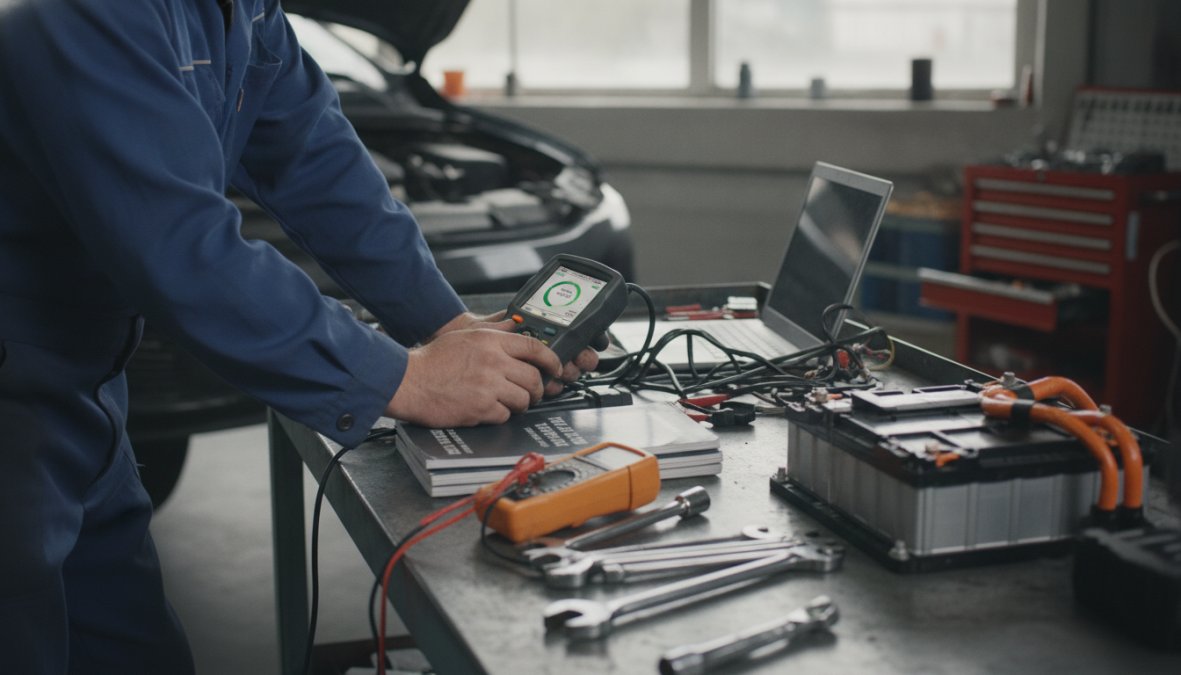
Technician holding an OBDII scanner device connected to a hybrid vehicle's diagnostic port under workshop fluorescent lighting, reading battery health data on the device screen
Using OBDII Scanners for Battery Diagnostics
An OBDII scanner plugged into the OBD2 port (usually beneath the driver's side dashboard) lets you read live battery management system data within minutes. For Toyota and Lexus hybrids, the Dr. Prius app with a Bluetooth adapter offers real-time monitoring of battery block voltages and life expectancy testing. The OBDLink MX+ provides broader compatibility across makes and models with fast data synchronisation.
Pro TipCheck battery block voltages individually, not just overall pack voltage. A pack reading normal overall can still contain weak cells pulling down performance. Cell imbalance is often the first sign of degradation.
Understanding Battery Management System (BMS) Data
The battery management system monitors individual cell voltages, temperatures, and state of charge across the high-voltage pack. Key parameters to monitor include individual cell voltages (look for cells deviating more than 0.05V from the group average), pack temperature at rest and under load, state of charge balance, and charge cycle count. The XTOOL E2 PRO provides cell-by-cell monitoring with bi-directional control for workshops; the OBDeleven offers a guided "Hybrid Battery Check" feature for home users.
Step 2: Optimise Charge Cycles and the 20-80% Rule
The 20-80% rule is one of the most important best practices for hybrid battery care and consistently underestimated by owners.
Why Deep Discharge Damages Lithium-Ion Batteries
Lithium-ion cells degrade faster at charge extremes. Repeatedly draining to near zero or charging to 100% accelerates lithium plating and electrolyte breakdown, causing irreversible capacity loss. According to Battery University, keeping lithium-ion cells between 20% and 80% state of charge significantly extends cycle life compared to full charge-discharge cycling.
Managing Charge Levels for Longevity
For PHEV owners, set the charge limit to 80% for daily use in the infotainment system. Only charge to 100% when you need maximum range for a longer trip. For standard hybrid owners, the BMS manages charge automatically, but frequent short trips ending with very low charge followed by long inactivity are particularly damaging.
Watch OutLeaving a PHEV or hybrid unplugged for several weeks with very low state of charge risks permanent damage to both the high-voltage pack and 12-volt auxiliary battery.
Step 3: Control Thermal Management and Ambient Temperature
Ambient temperature is the single biggest environmental factor affecting battery degradation. High-voltage packs generate heat during charging and discharging; without adequate cooling, cell temperatures rise beyond the operating window, accelerating degradation.
Preventing Overheating in Hot Climates
Most hybrid vehicles use a dedicated battery cooling system with cooling fans. The most common cause of cooling failure is a blocked air intake filter. Dust and debris restrict airflow, causing the pack to run hotter than intended. Replace cooling air particle filters during routine maintenance, a simple, low-cost intervention preventing far more expensive failures. Park in shade or covered car parks when possible, and avoid charging PHEVs in direct sunlight during peak afternoon temperatures.
Cold Weather Battery Maintenance
Cold temperatures reduce available battery capacity temporarily, a normal physical property, not damage. However, charging lithium-ion batteries below approximately 0°C causes irreversible lithium plating on the anode. Many modern BMS units include low-temperature charge inhibit features. In cold climates, allow the vehicle to warm up briefly before long trips, giving the thermal management system time to bring the pack to optimal operating temperature.
Step 4: Maximise Regenerative Braking Efficiency
Regenerative braking converts kinetic energy back into electrical energy during deceleration, feeding it into the high-voltage battery rather than wasting it as heat. This energy recovery reduces the depth of discharge over a typical drive cycle, extending battery life.
Optimising Driving Habits for Battery Health
Practical habits that maximise energy recovery include anticipating stops early and lifting off the accelerator, using the highest regenerative braking mode available (often "B" mode), avoiding hard late braking, and maintaining steady speeds on motorways. Drivers adopting smooth, anticipatory driving styles report noticeably better range and reduced battery temperature fluctuation.
Step 5: Service the 12-Volt Battery and Electrical System
The 12-volt auxiliary battery powers electronics and control systems. Its failure is one of the leading causes of hybrid system faults. Parasitic drain, continuous low-level current draw when the car is off, can discharge a weakened 12-volt battery below the threshold needed to wake the hybrid system, resulting in a completely unresponsive vehicle despite a fully charged high-voltage pack.
Service the 12-volt battery every three to five years. If the vehicle sits unused for more than two weeks, use a trickle charger on the 12-volt terminal to prevent discharge without overcharging.
Step 6: Follow Factory Service Schedule and Software Updates
Adhering to the manufacturer's factory service schedule is essential for hybrid vehicles.
Battery Cooling System Maintenance
Cooling fans accumulate wear and can develop reduced airflow without triggering a fault code. During scheduled servicing, a technician should inspect cooling ducts for blockages, verify cooling fans activate correctly under load, and check that the BMS logs temperature data within expected ranges.
Air Filters and Preventative Maintenance
Battery cooling air filters (separate from cabin and engine filters) are often located beneath the rear seat or boot area. A blocked filter does not trigger an immediate warning light but raises operating temperatures incrementally, accelerating cell degradation. Replace these filters according to manufacturer intervals or annually in dusty environments.
Key TakeawaySoftware updates from the manufacturer often include BMS calibration improvements that refine battery management. Always accept available software updates, as they can genuinely improve battery longevity without hardware changes.
Signs of Hybrid Battery Failure to Watch For
Early warning signs give you options; waiting until the system forces the issue removes them. Common indicators include noticeable reduction in electric-only range or fuel economy, the internal combustion engine running more frequently than usual, battery charge gauge fluctuating rapidly, "Ready" light taking longer to illuminate, fault codes related to battery module voltage imbalance or temperature sensors, and reduced cabin heating performance in PHEVs using battery-powered heat pumps. Any of these warrants an OBDII diagnostic check as a first step.
Understanding Hybrid Battery Lifespan and Degradation
With correct maintenance, many hybrid batteries remain serviceable well beyond 150,000 miles. Without it, significant degradation can occur within 80,000 miles.
Battery Degradation Diagnostics and Cost-Benefit Analysis
Thorough diagnostics include individual cell voltage readings under load, temperature distribution across the pack, charge and discharge rate capability, and historical fault code data. Full high-voltage battery replacement from a main dealer is expensive, but modular repair, replacing individual battery modules rather than the entire pack, is a substantially cheaper alternative for many vehicles.
Maintenance Action
Frequency
Primary Benefit
OBDII battery health check
Every 6 months
Early fault detection
Battery cooling filter replacement
Annually or per schedule
Thermal management
12-volt battery service
Every 3-5 years
System reliability
Software/BMS updates
As available
Charge optimisation
Trickle charge during inactivity
Any period over 2 weeks
Prevents deep discharge
Professional SoH assessment
Annually or before sale
Degradation diagnostics
For hybrid owners considering battery repair versus replacement, an independent battery health assessment provides objective data without relying on main dealer estimates. Independent specialist inspection is increasingly common for out-of-warranty hybrid owners seeking cost-effective solutions.
The real difference between a hybrid battery lasting twelve years and one needing replacement at seven comes down to whether the owner treated maintenance as a scheduled discipline or an afterthought. These 7 steps are not complicated, they are consistent.
Hybrid battery degradation rarely happens overnight, and most failures are preceded by months of warning signs that go unnoticed without proper diagnostic tools and knowledge. If you own a hybrid vehicle and want an objective assessment of your battery's current condition, KMC Electric offers professional diagnosis, independent battery health verification, and practical repair options as a cost-effective alternative to main dealer pricing. With over 25 years of automotive experience and specialist EV expertise since 2016, the team identifies faults before they become expensive and provides real-world fixes that extend vehicle service life. Contact KMC Electric to book a hybrid battery health assessment in Kettering.
Frequently Asked Questions
What are the 7 steps to maintain my hybrid battery effectively?
The seven steps are: monitor battery state of health regularly using diagnostic tools, optimise charge cycles using the 20-80% rule, control thermal management and ambient temperature exposure, maximise regenerative braking efficiency, service the 12-volt battery and electrical system, follow the factory service schedule and software updates, and recognise early signs of battery failure. Each step addresses a critical aspect of hybrid battery longevity and performance.
How often should I check my hybrid battery health and what signs of hybrid battery failure should I watch for?
Check your battery state of health every 6-12 months using an OBDII scanner or professional diagnostic tool. Warning signs include reduced driving range, slower acceleration, the battery management system warning light, inconsistent charge levels, and unusual noises from the battery cooling system. Early detection through regular monitoring can prevent costly replacement and extend battery lifespan significantly.
Does the 20-80% charging rule really extend hybrid battery lifespan?
Yes, the 20-80% rule is one of the most effective practices for lithium-ion battery longevity. Keeping your battery between 20% and 80% state of charge reduces stress on individual cells and slows degradation. Avoiding deep discharge and full charges minimises charge cycles and thermal stress. Most hybrid manufacturers recommend this practice, and independent testing confirms it can add years to battery life.
What should I do if my hybrid battery shows signs of degradation before warranty expiry?
Contact your vehicle manufacturer or a specialist independent technician immediately. Document any performance changes and have the battery diagnostically tested to establish current state of health. If still under warranty, you may qualify for repair or replacement at no cost. If approaching warranty expiry, understand the cost-benefit analysis: some batteries can be reconditioned through module replacement rather than full replacement, offering significant savings whilst maintaining reliability.