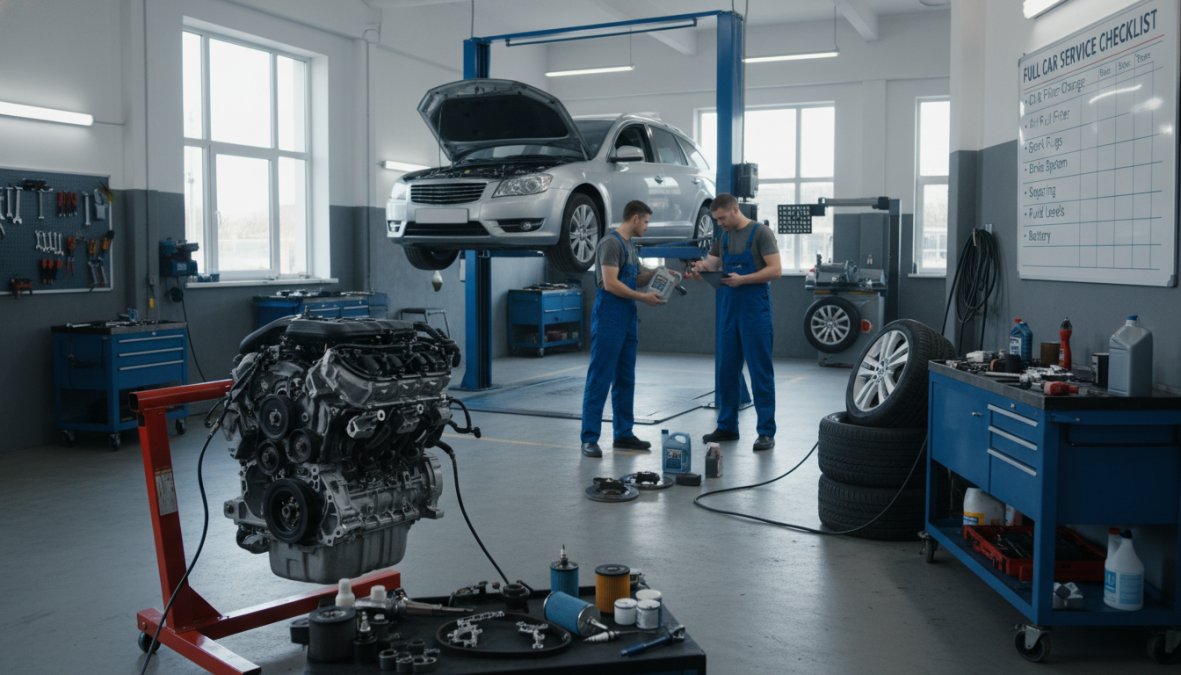
Knowing what is included in a full car service is one of those things most drivers assume they understand until they're handed an itemised invoice and realise they have no idea what half of it means. This guide from KMC Electric covers every element of a full service in plain terms, from the oil change and oil filter swap to brake fluid checks, tyre pressure assessments, and onboard diagnostics scans. Below, we'll show you exactly what separates a full service from an interim or major service, what the whole process costs, and why your service history matters far more than most people realise.
Here's what most guides get wrong: they treat a full service as a single, fixed checklist. It isn't. The scope varies by manufacturer schedule, vehicle age, and whether you drive a traditional internal combustion engine (ICE) vehicle or an electric one. Getting clear on those differences is where the real value lies.
What Is a Full Car Service and Why Does It Matter?
A full car service is a comprehensive inspection and maintenance procedure that covers a vehicle's major mechanical, electrical, and safety systems, typically carried out every 12 months or every 12,000 miles, whichever comes first.
This is not the same as an MOT test. An MOT checks whether your vehicle meets the legal minimum safety standard on a single day. A full service goes further: it replaces consumable components, checks fluid levels, inspects wear and tear on critical parts, and flags issues before they become failures. Think of the MOT as a pass/fail exam and the service as ongoing preventative maintenance.
Regular servicing also protects your warranty. Many manufacturers require evidence of logbook service at the correct intervals to honour warranty claims. Skip a service, and you may find yourself without cover precisely when you need it most.
According to the UK Government's official MOT and vehicle safety guidance, vehicle maintenance failures remain a leading cause of roadside breakdowns, with fluid-related and tyre-related faults consistently among the most common. Staying on top of your service interval directly reduces that risk.
Key TakeawayA full car service is preventative maintenance, not a repair. Its purpose is to catch problems early, replace worn components on schedule, and keep your vehicle running safely between MOT tests.
What Is Included in a Full Car Service: The Complete Checklist
A full service covers significantly more ground than an interim service. The checklist below reflects what a qualified technician should inspect, test, or replace during a standard full service on a petrol or diesel vehicle.
Software tools interface for professional and mechanic and clean concepts for what is included in a full car service
Engine and Fluid Checks
The engine bay is where most of the scheduled replacement work happens. A full service will typically include:
Engine oil drain and refill - using the correct grade of synthetic oil or mineral oil as specified by the manufacturer
Oil filter replacement - a blocked filter forces the engine to work harder and accelerates wear
Air filter inspection or replacement - a clogged air filter reduces fuel efficiency and affects combustion
Coolant levels check - low coolant can cause overheating; some services include a coolant flush
Brake fluid check - brake fluid absorbs moisture over time, which lowers its boiling point and reduces braking performance
Power steering fluid - checked for level and condition
Windscreen washer fluid - topped up as standard
Transmission fluid - inspected on vehicles where it is accessible
The choice between synthetic oil and mineral oil matters here. Synthetic oil performs better at temperature extremes, lasts longer between changes, and is specified by most modern manufacturers. Using the wrong grade can void your warranty.
Pro TipIf your vehicle uses a long-life oil specification (common on German marques), make sure your garage uses the correct low-SAPS synthetic oil. Standard supermarket oil will not meet the spec, and the difference shows up in engine health over time.
Brakes, Tyres, and Suspension
Safety-critical systems get close attention during a full service. Technicians will inspect:
Brake pads - measured for remaining thickness; most manufacturers recommend replacement below 3mm
Brake discs - checked for scoring, warping, and minimum thickness
Brake fluid - tested for moisture content using a specialist tester
Tyre pressure - adjusted to the manufacturer's recommended PSI (front and rear pressures often differ)
Tread depth - the legal minimum in the UK is 1.6mm across the central three-quarters of the tyre, but many technicians recommend replacing at 3mm
Tyre condition - sidewall cracks, bulges, and uneven wear patterns are flagged
Suspension components - shock absorbers, bushes, and anti-roll bar links are checked for wear
Steering alignment - a visual check is standard; a full four-wheel alignment is usually a separate charge
A common mistake drivers make is assuming tyre pressure is only checked at the petrol station. Incorrect pressure accelerates tread wear unevenly, reduces fuel efficiency, and affects handling. Getting it set correctly during a service is a baseline expectation, not an extra.
Electrical Systems and Onboard Diagnostics
Modern vehicles generate diagnostic data continuously. A full service should include a scan of the vehicle's onboard diagnostics (OBD) system to read any stored fault codes, even those that haven't triggered an instrument warning light yet.
Additional electrical checks include:
Battery testing - measured for cold cranking amps and state of charge
Alternator output - checked to confirm the battery is charging correctly
Lights - headlights, brake lights, indicators, and reversing lights
Windscreen wipers - condition and operation
Horn - function check
The OBD scan is particularly valuable. Many faults sit in the system as pending codes before they become active warning lights. Catching them early is the difference between a minor fix and a significant repair.
Interim vs Full Service: Which One Do You Actually Need?
The popular advice here is to always get a full service, but that's not quite right. The correct choice depends on your mileage and how long it's been since your last service.
Service Type
Typical Interval
Key Inclusions
Best For
Interim Service
Every 6 months or 6,000 miles
Oil and filter change, fluid top-ups, visual safety check
High-mileage drivers covering 12,000+ miles per year
Full Service
Every 12 months or 12,000 miles
Full checklist including brakes, tyres, electrics, diagnostics
Most drivers as annual maintenance
Major Service
Every 2 years or 24,000 miles
Full service plus spark plugs, fuel filter, cabin filter, belts
Older vehicles or those approaching high mileage
Drivers who cover fewer than 8,000 miles per year may find that a full service every 12 months is sufficient without an interim. Drivers covering 15,000 miles or more should consider an interim service at the six-month mark to keep engine oil in good condition between full services.
The key distinction is that an interim service is not a replacement for a full service. It's a mid-year check that keeps wear and tear in check between the more comprehensive annual appointment.
How Long Does a Full Car Service Take?
A full car service typically takes between two and four hours, depending on the vehicle, its condition, and whether any additional work is identified during the inspection.
Straightforward services on well-maintained vehicles at the lower end of that range. If the technician identifies worn brake pads, a failing battery, or a blocked cabin filter, the additional work adds time. It's worth asking the garage to contact you before carrying out any work beyond the agreed service scope.
Some garages offer a while-you-wait service for full services on common vehicles. Others prefer to keep the car for a half or full day. If you're in the Kettering area, booking first thing in the morning typically means your vehicle is ready by early afternoon.
Average Cost of a Full Car Service Explained
The average cost of a full car service in the UK sits between £100 and £200 for most standard petrol or diesel vehicles, but that headline figure conceals a wide range of variables that determine whether you're getting fair value or being overcharged.
Understanding what drives the price, and what a line-item breakdown should look like, is the most practical thing this section can give you.
What You're Actually Paying For
A full service invoice is made up of three distinct cost categories:
Labour, typically charged at an hourly rate ranging from £50-£80/hr at independent garages to £100-£180/hr at franchised main dealers. A full service takes two to four hours, so labour alone can account for £100-£300 of the total bill depending on where you go.
Parts, the physical consumables replaced during the service. These are the items where the biggest price variation occurs.
Diagnostic time, the OBD scan and report. Some garages include this in the labour rate; others charge it separately at £30-£60.
Individual Part Costs: What to Expect
Knowing approximate part costs lets you sense-check an invoice before you approve it:
Part
Typical Part Cost (UK)
Notes
Engine oil (5 litres)
£20 - £60
Varies significantly by specification; long-life synthetic costs more
Oil filter
£5 - £20
Often bundled into the oil cost in quotes
Air filter
£10 - £30
Cabin filter is separate and costs a similar amount
Cabin/pollen filter
£10 - £30
Frequently omitted from budget service quotes
Spark plugs (set of 4)
£20 - £80
Iridium plugs for modern engines cost more; usually a major service item
Brake fluid (bleed and refill)
£20 - £40 for fluid
Labour to bleed the system is additional
Wiper blades (pair)
£15 - £40
Often flagged but not always included in the base price
Price by Vehicle Type
Vehicle Type
Typical Full Service Cost (UK)
Small hatchback (e.g. Ford Fiesta, VW Polo)
£100 - £140
Mid-size family car (e.g. Ford Focus, Toyota Corolla)
£130 - £180
SUV or 4x4
£160 - £220
Performance or prestige vehicle
£200 - £350+
Electric vehicle (EV)
£80 - £150 (fewer consumables)
Prices at main dealer networks consistently sit at the upper end of these ranges. Independent specialist garages across the UK, including those in Northamptonshire, typically offer comparable or better quality at lower cost for out-of-warranty vehicles, because their lower overheads are passed on in the labour rate.
Why Some Quotes Look Suspiciously Cheap
A full service advertised at £49 or £59 is almost always a loss-leader or a stripped-down version of a real service. The most common ways garages cut costs invisibly:
Using mineral oil instead of the manufacturer-specified synthetic. Mineral oil is significantly cheaper. It also degrades faster and is not suitable for most engines built after 2005. The difference in oil cost to the garage is often £20-£30 per service; the difference to your engine over five years is measurable.
Skipping the OBD diagnostic scan. This takes ten minutes and requires a professional scan tool. Budget services often omit it entirely.
Not replacing the cabin filter. It's a quick job and a cheap part, but it's easy to leave off a cut-price service without the customer noticing.
Charging parts separately after quoting labour only. Always ask: does the quoted price include all parts, or just labour?
Watch OutBefore booking, ask the garage to confirm in writing: (1) the oil specification they will use, (2) whether parts are included in the quoted price, and (3) whether an OBD diagnostic scan is part of the service. Any reputable garage will answer all three without hesitation.
How to Audit Your Invoice
When you collect your vehicle, the invoice should itemise:
Oil grade and quantity used (e.g. 5W-30 fully synthetic, 5 litres)
Part numbers or descriptions for every replaced component
Labour time and rate
Any advisory items identified but not yet actioned
If the invoice shows only a single line reading "Full Service, £X", that is not an itemised invoice. Ask for the breakdown. A professional garage will provide it as standard; one that resists the request is telling you something.
Pro TipFor vehicles still under manufacturer warranty, keep every invoice and ensure the garage stamps your service logbook. The invoice is your evidence that the correct specification parts and fluids were used, evidence you may need if a warranty claim is ever disputed.
The Benefits of Regular Car Servicing for Long-Term Ownership
Regular servicing does more than keep a vehicle running. It compounds. A well-maintained car with a complete service history is worth more at resale, less likely to generate expensive repair bills, and, critically, protected under manufacturer warranty in ways that most drivers don't fully understand until they need to make a claim.
This section covers the operational benefits briefly, then goes deep on the two areas most guides skip entirely: how a full service history affects what your car is worth when you sell it, and exactly how servicing interacts with your manufacturer warranty.
The Operational Benefits (The Short Version)
Fuel efficiency, a fresh air filter, correctly inflated tyres, and clean engine oil all contribute to better MPG. A blocked air filter alone can measurably reduce fuel economy.
Extended engine life, regular oil changes are the single most cost-effective form of engine protection. Oil degrades over time and mileage; degraded oil loses its ability to form a protective film between moving metal surfaces.
Early fault detection, the OBD scan and physical inspection catch developing problems before they become failures. A worn CV boot identified at a service costs a fraction of the joint replacement it prevents.
Reduced repair costs, the relationship between preventative maintenance and repair costs is well established. Small, scheduled replacements prevent large, unscheduled ones.
Roadside safety, brake pad thickness checks, tyre condition assessments, and fluid level verification directly reduce the probability of safety-critical failures between services.
Service History and Resale Value: What a Full Service History Is Actually Worth
This is the part most guides skip over, and it matters more than most drivers realise.
A full service history (FSH) means the vehicle has been serviced at every manufacturer-recommended interval, with each service recorded by a stamp in the physical logbook or a digital service record. Partial service history means some intervals are missing. No service history means no documented evidence of maintenance at all.
The resale value difference between these three categories is significant. When buyers and dealers price a used vehicle, a missing or incomplete service history introduces uncertainty about the vehicle's condition, and uncertainty is priced as risk. That risk discount is applied whether or not the car has actually been neglected; the absence of records is treated the same as evidence of neglect.
In practical terms:
A car with FSH will typically command a higher asking price in private sale than an identical vehicle without records, and will achieve a better trade-in valuation at a dealer.
Dealers buying part-exchange vehicles routinely apply a downward adjustment for missing service stamps, because they know buyers will ask about history and price accordingly.
For higher-value vehicles, prestige brands, performance cars, or low-mileage examples, the FSH premium is proportionally larger because the buyer pool is more informed and more demanding.
The practical implication: the cost of a full service every 12 months is not just a maintenance expense. It is an investment in the documented condition of an asset. Every stamp in the logbook is evidence that reduces the risk discount a future buyer applies to your vehicle.
Key TakeawayA complete, stamped service history is one of the few things you can do during ownership that directly increases what your car is worth when you sell it. The cost of maintaining that history is almost always less than the resale discount you take without it.
Warranty Implications: What Manufacturers Actually Require
This is the area where new car owners are most frequently caught out, and where the gap between what people assume and what the warranty terms actually say is widest.
The core principle: Most manufacturer warranties are conditional on the vehicle being serviced at the correct intervals, using parts and fluids that meet the manufacturer's specification. A missed service, or a service carried out with non-compliant parts, can give the manufacturer grounds to decline a warranty claim, particularly for powertrain or engine-related failures where the link to maintenance is arguable.
The independent garage question: A common misconception is that warranty cover requires servicing at a franchised main dealer. Under UK consumer law and EU Block Exemption Regulation principles that were carried into UK law, manufacturers cannot void a warranty solely because the vehicle was serviced at an independent garage, provided that garage used parts and fluids meeting the manufacturer's specification and kept proper records.
What this means in practice:
An independent specialist can carry out a full logbook service that satisfies the manufacturer's warranty requirements, provided they use the correct oil specification, OEM-equivalent or approved parts, and stamp the service record.
This is sometimes described as a "service in accordance with manufacturer schedule", the key phrase to confirm with your garage before booking.
The garage should be able to provide an invoice showing the oil specification used and the part references for any replaced components. This is your evidence if a warranty claim is ever challenged.
Where the risk actually lies: The warranty risk from independent servicing is not the use of an independent garage per se, it is the use of incorrect specification parts or fluids, or the failure to keep adequate records. A budget service using non-specified mineral oil in an engine that requires a long-life synthetic creates a legitimate basis for a warranty dispute. A properly documented independent service using the correct specification does not.
Pro TipIf your vehicle is still within its manufacturer warranty period, ask your independent garage to provide a detailed invoice showing oil grade, part numbers, and a statement that the service was carried out in accordance with the manufacturer's schedule. File this with your service logbook. It is the documentation that protects you if a warranty claim is ever questioned.
Pre-warranty-expiry inspections: For vehicles approaching the end of their manufacturer warranty, typically at three years for most new car warranties, a pre-expiry inspection by an independent specialist is worth scheduling. The purpose is to identify any latent faults that are still covered under warranty before cover lapses, giving you the opportunity to raise them with the dealer while you still have recourse. This is a low-cost intervention that can prevent significant out-of-pocket repair costs in the months immediately after warranty expiry.
According to the AA's vehicle maintenance and breakdown research, vehicles that miss scheduled service intervals are disproportionately represented in roadside breakdown statistics, but the financial case for regular servicing extends well beyond avoiding breakdowns. The combination of preserved resale value and protected warranty cover means that the return on a properly documented full service history is measurable across the entire ownership period, not just in the immediate term.
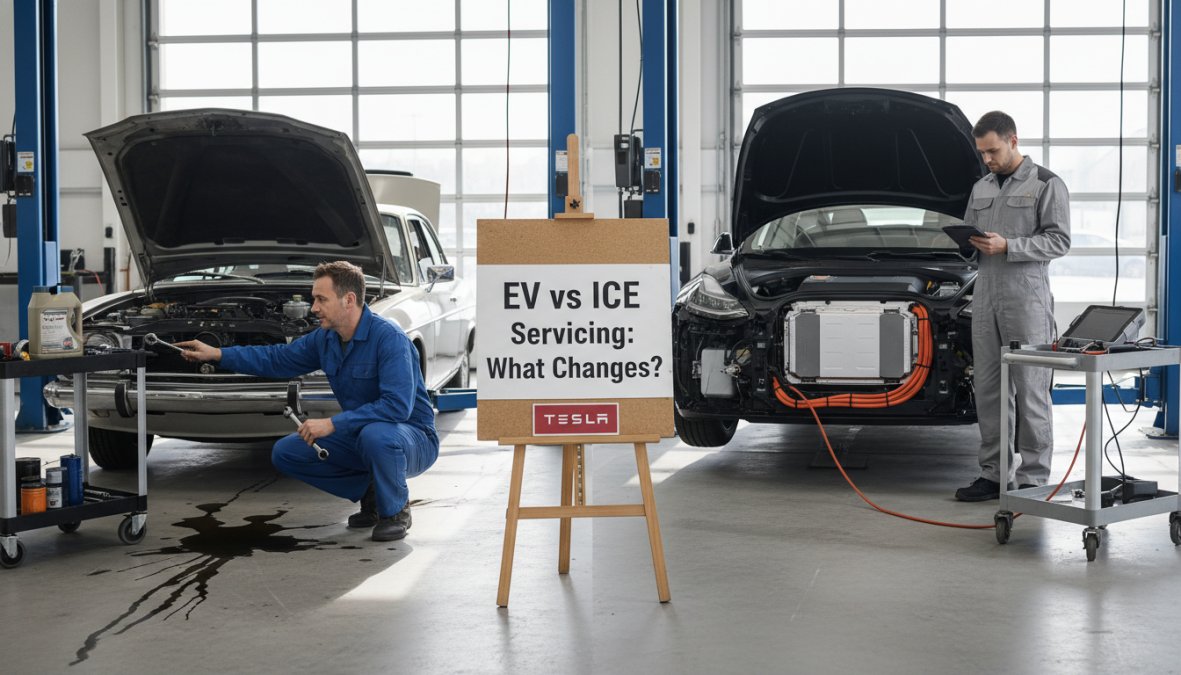
EV vs ICE Servicing: What Changes for Electric and Hybrid Vehicles?
Electric vehicles have a fundamentally different service profile to petrol or diesel cars. This is where the conventional full service checklist needs updating, and where many general guides fall short.
Side-by-side comparison of Tesla for what is included in a full car service
The most significant difference is what an EV doesn't need. There is no engine oil to change, no oil filter to replace, no spark plugs, no timing belt, and no exhaust system to inspect. This reduces the cost and frequency of routine maintenance considerably.
What an EV does need:
Brake fluid - still required; EVs use hydraulic brakes even though regenerative braking reduces wear on brake pads significantly
Coolant levels - the battery thermal management system uses coolant that requires periodic checks
Tyre pressure and tread depth - EVs are typically heavier than equivalent ICE vehicles, which accelerates tyre wear
Cabin air filter - still present and still needs replacing
Battery health assessment - the most EV-specific check; measures state of health (SoH) and remaining capacity
High-voltage system inspection - requires Level 4 qualified technicians with specialist EV training
Drivetrain oil - some EV drivetrains use a separate gear oil that requires periodic replacement
For Tesla owners specifically, the drivetrain oil in the rear and front motor assemblies is a commonly overlooked service item. KMC Electric stocks drive train oil and oil filters for Tesla Model 3 and other models, along with bolts for the oil pump for complete drivetrain service.
Hybrid vehicles sit between the two categories. They require traditional ICE servicing for the combustion engine side, plus EV-specific checks for the high-voltage battery and electric motor systems. The service interval is typically similar to a standard ICE vehicle, but the technical requirements are higher.
As noted in the Society of Motor Manufacturers and Traders EV ownership guidance, EV registrations in the UK continue to grow rapidly, which means the pool of drivers unfamiliar with EV-specific maintenance requirements is expanding just as quickly. Understanding what your EV does and doesn't need is increasingly important.
Pro TipNot all garages are qualified to work on high-voltage EV systems. Always confirm that any garage you use for EV servicing holds the appropriate Level 3 or Level 4 EV qualifications. Working on high-voltage systems without proper training is dangerous and can cause irreversible damage to the battery pack.
DIY vs Professional Servicing: Risks You Should Know
The case for DIY servicing looks straightforward on paper: parts are cheaper, you control the quality, and you learn more about your vehicle. The reality is more complicated.
For basic tasks on older ICE vehicles, such as an oil and filter change, topping up fluids, or replacing a cabin air filter, a competent DIYer with the right tools can do acceptable work. The risks are manageable if you know what you're doing.
The problems start when you move beyond the basics:
OBD diagnostics - consumer-grade OBD readers give you fault codes but not the context to interpret them correctly. A professional scan tool reads live data across all modules, not just the engine ECU.
Brake work - incorrectly bedded brake pads or overtightened caliper bolts create safety-critical failures. This is not the area to learn by trial and error.
EV high-voltage systems - DIY work on EV battery systems or high-voltage components carries a genuine risk of electrocution and permanent battery damage. This work requires specialist training and equipment, full stop.
Service history validity - a DIY service does not generate a stamped logbook entry, which affects resale value and may affect warranty claims.
For drivers in Kettering and across Northamptonshire, the practical advice is this: DIY the simple stuff if you're confident and equipped, but treat anything involving brakes, electrical diagnostics, or EV systems as professional territory. The cost of getting it wrong far exceeds the cost of a professional service.
According to Which? car maintenance and servicing advice, many drivers overestimate their ability to identify developing faults during DIY maintenance because they lack the diagnostic equipment and reference data that professional technicians use as standard.
Conclusion
Understanding what is included in a full car service is the foundation of sensible vehicle ownership, but knowing the checklist is only half the picture. For EV and hybrid owners especially, the shift away from traditional ICE service requirements creates genuine confusion about what actually needs attention and when. KMC Electric, based in Kettering and serving drivers across Northamptonshire, brings over 25 years of automotive experience and Level 4 Master Technician status in electric vehicles to every service and inspection. Whether you need independent battery health verification, pre-warranty-expiry fault identification, or a cost-effective alternative to main dealer servicing, get in touch with KMC Electric and keep your vehicle in the condition it deserves.
Frequently Asked Questions
What is the difference between an interim and full car service?
An interim service is a lighter check typically carried out every 6 months or 6,000 miles, covering essentials like an oil change, oil filter replacement, and basic safety checks. A full car service is more comprehensive, covering fluid levels, brake pads, tyre tread depth, spark plugs, air filter, exhaust system, steering alignment, and onboard diagnostics. A full service is generally recommended annually or every 12,000 miles and provides a much deeper assessment of your vehicle's overall health.
Does a full car service include an oil change?
Yes, an oil change is one of the core elements included in a full car service. The technician will drain the old engine oil — whether synthetic oil or mineral oil depending on manufacturer requirements — replace the oil filter, and refill to the correct level. Keeping fresh oil circulating through the engine is one of the most important aspects of preventative maintenance, directly affecting engine health, fuel efficiency, and long-term wear and tear.
How long does a full car service take?
A full car service typically takes between 3 and 4 hours for a standard internal combustion engine vehicle. However, the exact time depends on the vehicle's condition, the number of additional repairs identified, and whether parts need to be ordered. Electric and hybrid vehicles may take slightly longer if a battery health assessment or high-voltage system inspection is included. It is always worth booking in advance and confirming the expected duration with your garage.
How often should you get a full car service?
Most manufacturers recommend a full car service once a year or every 12,000 miles, whichever comes first — though you should always check your vehicle's logbook service schedule for the exact manufacturer interval. Electric vehicles like Teslas often have longer service intervals due to fewer moving parts, but still benefit from regular inspections covering coolant levels, brake fluid, tyre pressure, and battery health. Following your service interval helps maintain warranty validity and protects resale value.
Is a full car service the same as an MOT test?
No — a full car service and an MOT test are different. An MOT is a legally required annual safety and emissions test that checks whether your vehicle meets minimum road-legal standards. A full service is a preventative maintenance procedure that goes deeper, replacing consumables like filters and fluids and identifying wear and tear before it becomes a problem. A car can pass its MOT but still benefit greatly from a full service, and vice versa. Both are recommended annually.
Does a full car service affect resale value and warranty?
Yes, significantly. A complete, stamped service history with logbook entries from a qualified garage demonstrates that the vehicle has been properly maintained, which can meaningfully increase buyer confidence and resale price. For vehicles still under manufacturer warranty, servicing must follow the manufacturer schedule to avoid voiding warranty terms. Independent garages that use approved parts and follow the correct service intervals are generally permitted to carry out warranty-compliant servicing under UK block exemption regulations.