Is Electric Vehicle Suspension Repair Expensive? The Real Costs Explained
Many EV owners ask whether is electric vehicle suspension repair expensive before committing to ownership, and the honest answer is: it depends on factors most guides never explain. This guide from KMC Electric breaks down the real costs, the unique wear patterns caused by battery weight, and where EV suspension bills can genuinely surprise you.
Here's what most guides get wrong: they lump suspension into the "EVs are cheaper to maintain" narrative without acknowledging that battery weight fundamentally changes how suspension components wear. Electric vehicles are heavier than their ICE equivalents, accelerating stress on struts, shocks, bushings, and alignment geometry in ways that deserve a dedicated explanation.
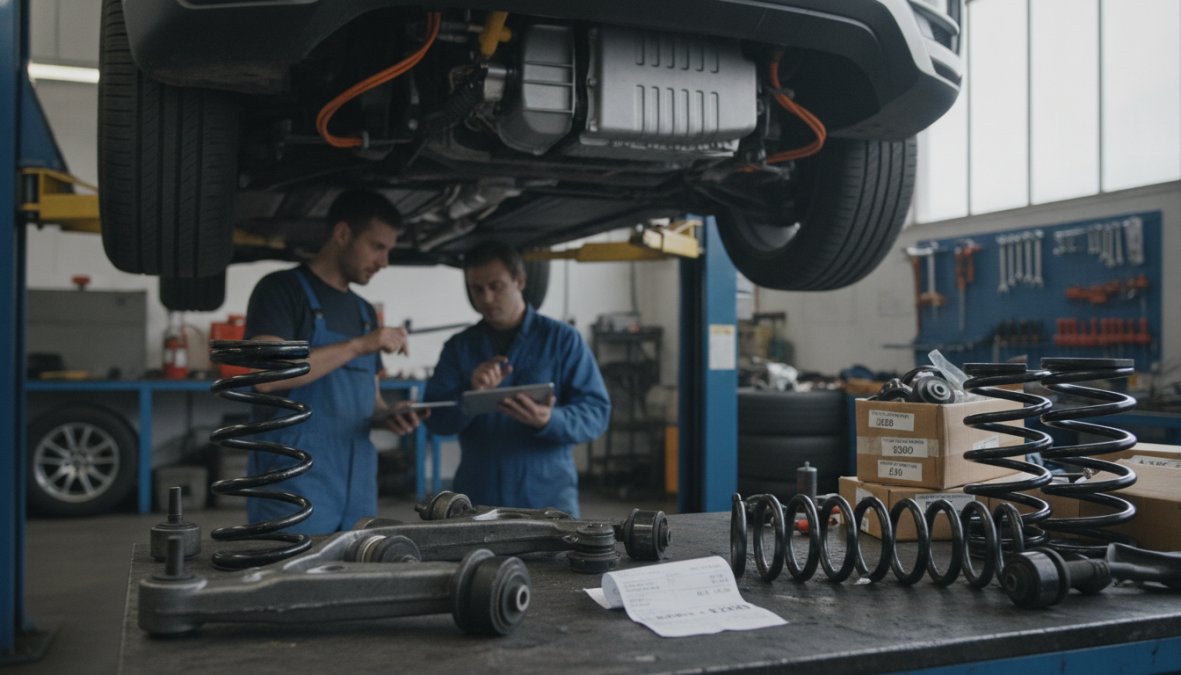
A technician in a professional workshop inspecting the underside of an electric vehicle raised on a hydraulic lift, focusing on the suspension components, workshop lit with bright overhead fluorescent lighting
Typical EV Suspension Repair Cost Ranges in the UK
EV suspension repair costs broadly mirror ICE vehicle costs for the same components, but with important caveats. Expect to pay roughly £80-£150 per shock absorber, £150-£350 per strut assembly, £30-£80 per control arm bushing, and £50-£120 for a four-wheel alignment. Air suspension systems, fitted to some premium EVs, carry significantly higher costs, often £600-£1,200 per corner.
The complication is labour. Many independent garages lack the high-voltage safety training required to work safely around EV battery packs positioned near suspension mounting points, reducing the pool of qualified technicians and pushing labour rates higher than equivalent ICE work.
Repair Type
Typical UK Cost Range
Notes
Shock absorber (per unit)
£80 - £150
OEM vs aftermarket affects price
Strut assembly (per corner)
£150 - £350
Labour-intensive on heavy EVs
Control arm bushing
£30 - £80
Wear faster on heavier platforms
Four-wheel alignment
£50 - £120
Essential after any suspension work
Air suspension corner
£600 - £1,200
Premium EVs only
Full suspension overhaul
£800 - £2,500+
Depends on vehicle and parts source
Dealership vs Independent Specialist Pricing
Main dealer networks charge a premium for EV suspension work due to overheads and OEM parts pricing. An independent EV specialist with the correct high-voltage qualifications can typically offer the same quality of repair at meaningfully lower cost, using OEM-equivalent or genuine OEM parts sourced independently.
The key is verifying that the independent specialist holds the appropriate EV qualifications. Suspension work on an EV is not inherently more dangerous than on an ICE vehicle, but proximity to high-voltage components during certain procedures requires proper training and equipment.
EV Battery Weight Impact on Suspension: Why EVs Wear Differently
The popular advice that EVs cost less to maintain is broadly true for drivetrain items. Suspension is where that narrative gets complicated.
Weight-to-Suspension Wear Correlation
Battery weight is the defining factor separating EV suspension wear from ICE suspension wear. A large battery pack adds several hundred kilograms to kerb weight, increasing dynamic load on every suspension component with every corner, pothole, and speed bump.
Bushings and dampers are particularly sensitive to this. Rubber bushings compress and flex under load; greater load means faster degradation. According to the Society of Automotive Engineers' technical resources on vehicle dynamics, increased unsprung and sprung mass directly correlates with higher stress on damping and bushing components, measurable wear-rate physics, not theory.
Watch OutIgnoring early signs of bushing wear on a heavy EV accelerates tyre wear and misalignment, which compounds costs rapidly. A £50 bushing left unaddressed can lead to a £200 tyre replacement and a full alignment correction within months.
Specific EV Suspension Components Most Affected
Not all suspension components wear at the same rate. These are the components most likely to need earlier attention on battery electric vehicles:
Front lower control arm bushings: Bear the brunt of the battery's forward weight distribution on many EV platforms
Rear shock absorbers: Work harder on vehicles with rear-mounted battery mass
Anti-roll bar links and bushings: Stressed by higher lateral forces in cornering
Wheel bearings: Increased radial load from battery weight accelerates wear on driven axles
Alignment geometry: Heavy EVs are more sensitive to pothole impact, causing alignment drift that accelerates tyre wear
EV Maintenance Costs vs ICE: What the Total Picture Looks Like
The total cost of ownership argument for EVs is strong, but requires honest accounting of where savings occur and where they do not.
What ICE Vehicles Need That EVs Do Not
The maintenance savings for EV owners are real and significant. ICE vehicles require regular oil and filter changes, coolant flushes, spark plug replacement, catalytic converter maintenance, and transmission fluid changes, none of which apply to a pure battery electric vehicle. As noted in the UK government's EV ownership guidance, reduced servicing requirements are one of the documented financial benefits of electric vehicle ownership.
Where EVs Can Cost More to Maintain
Suspension and tyres are the two areas where EV ownership costs can exceed ICE equivalents. Tyre wear is accelerated by battery weight and instant torque delivery, meaning replacement intervals are shorter for many EV owners. Some EV platforms also use a battery thermal management coolant circuit, so coolant maintenance is not entirely eliminated on all models.
The honest total cost of ownership picture: EVs save significantly on drivetrain maintenance, break roughly even on suspension, and cost more on tyres.
Key TakeawayEV suspension repair costs are comparable to ICE vehicles on a per-component basis, but heavier EVs may reach those repair intervals sooner. The overall maintenance saving still favours EVs, but tyre and suspension budgets deserve more attention than most ownership guides suggest.
Common EV Suspension Problems Every Owner Should Know
The most frequent EV suspension issues follow predictable patterns once you understand the weight and torque characteristics of the platform.
The Role of Regenerative Braking in Suspension and Brake Wear
Regenerative braking changes the wear dynamic for both the brake system and, indirectly, the suspension. Because the electric motor handles most deceleration, physical brake pads and discs are used far less, pads last longer, but discs can develop surface corrosion more quickly. Light surface rust on an underused disc is a common complaint among UK EV owners given the damp climate. From a suspension perspective, regenerative braking transmits deceleration force through the drivetrain and motor mounts rather than the brake callipers, placing different stress patterns on front suspension geometry compared to ICE vehicles.
Common EV suspension problems to monitor include:
Clunking or knocking sounds over speed bumps, indicating worn bushings or anti-roll bar links
Pulling to one side during braking or acceleration, suggesting alignment drift or uneven bushing wear
Vibration through the steering wheel at motorway speeds, often a wheel bearing or balance issue
Uneven tyre wear, frequently the first visible sign of alignment or suspension problems
Squealing or grinding from the brake area unrelated to pad wear, often surface disc corrosion
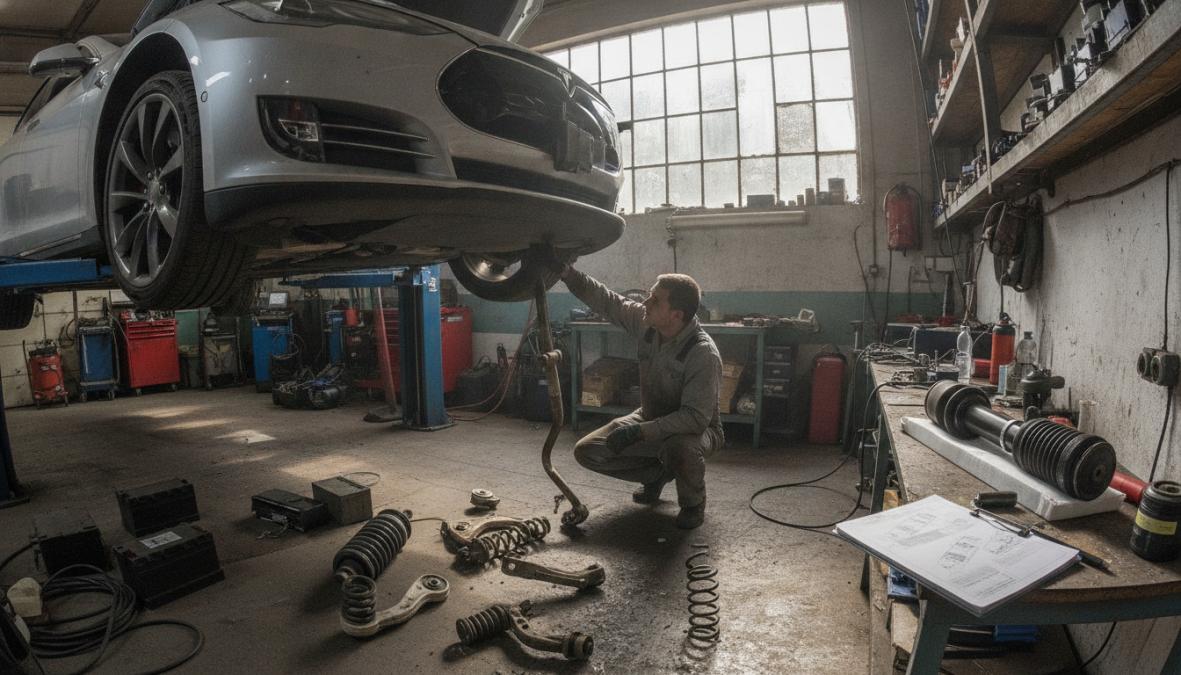
Close-up of worn suspension bushings and a strut assembly removed from an electric vehicle, laid out on a clean workshop workbench under bright workshop lighting, showing rubber degradation and metal wear marks
According to the RAC's guidance on EV maintenance, brake disc corrosion is a documented and growing issue for EV owners in the UK, particularly those who primarily use regenerative braking for low-speed driving.
How to Maintain EV Suspension and Reduce Long-Term Costs
Prevention is far cheaper than repair. EV suspension maintenance does not require specialist knowledge to monitor, it requires consistent attention to a short checklist.
Practical EV suspension maintenance checklist:
Check tyre pressures every two weeks (under-inflation accelerates suspension wear on heavy EVs)
Inspect tyres for uneven wear patterns every 3,000 miles
Book a four-wheel alignment check every 12,000 miles or after any significant pothole impact
Listen for new noises over speed bumps and report them promptly to a qualified technician
Have shock absorbers and bushings inspected at every annual service
On EVs with air suspension, check for uneven ride height, which signals a failing air spring
Ensure brake discs are cleaned periodically if the vehicle sits unused for extended periods
Pro TipOn EVs with regenerative braking, deliberately using the physical brakes during the last few hundred metres of a low-speed journey helps prevent disc corrosion. This is particularly relevant for owners in Kettering and Northamptonshire who do short urban journeys where regenerative braking handles most of the deceleration.
DIY vs Professional Repair: What Is Actually Feasible?
Some EV suspension work is genuinely DIY-feasible; most is not advisable without professional equipment.
What experienced DIY mechanics can reasonably attempt:
Anti-roll bar link replacement (no proximity to high-voltage systems)
Tyre pressure checks and inflation
Visual inspection of bushings and dampers for obvious wear
What requires a professional EV-qualified technician:
Shock absorber and strut replacement (requires correct torque specifications and alignment afterwards)
Control arm bushing replacement (requires press tooling and alignment)
Any work near the battery pack or high-voltage cabling
Wheel bearing replacement on driven axles
Air suspension component replacement
The high-voltage safety aspect is the critical dividing line. A conventional mechanic without high-voltage awareness training risks serious injury if cabling routes near suspension mounting points are disturbed, which is why high-voltage safety certification matters when choosing who works on your vehicle.
Pros and cons of DIY vs professional repair:
Approach
Pros
Cons
DIY
Lower parts cost, immediate
Risk near HV systems, no alignment equipment
Independent specialist
Qualified, cost-effective, aligned after repair
Requires finding a vetted specialist
Main dealer
OEM parts, warranty-aligned
Significantly higher labour costs
Warranty Coverage and What It Means for Suspension Repair Bills
Most EV manufacturer warranties cover suspension components under the general vehicle warranty for the first few years, but bushings, shock absorbers, and anti-roll bar links are typically classified as wear items after a certain mileage threshold, meaning they fall outside warranty coverage even within the warranty period if the manufacturer deems them normally worn.
The practical implication: have your suspension inspected before your manufacturer warranty expires. Identifying a failing front lower control arm bushing at 28,000 miles while still under warranty costs nothing. The same repair at 32,001 miles costs several hundred pounds.
This is precisely the kind of pre-expiry inspection that KMC Electric provides for Tesla and other EV owners across Kettering and the wider Northamptonshire area. Extended warranties and aftermarket warranty products vary significantly in how they treat suspension wear items, read the exclusions carefully before assuming suspension repairs are covered.
Factors That Influence Whether EV Suspension Repair Is Expensive
Whether is electric vehicle suspension repair expensive for any given owner comes down to a combination of interacting factors the headline cost figures do not capture.
Vehicle weight class: Heavier EVs with larger battery packs place greater stress on all suspension components and typically reach repair intervals sooner than smaller city EVs.
Road surface quality: Kettering and many parts of Northamptonshire share the UK's general problem with road surface deterioration. Frequent pothole exposure accelerates alignment drift and bushing wear regardless of vehicle type.
OEM vs aftermarket parts: OEM suspension parts are engineered to the vehicle's specific weight and geometry specifications. Using incorrect specification parts on a heavy EV can shorten the repair's lifespan significantly.
Technician qualification: High-voltage safety competence is non-negotiable for EV suspension work near battery components. Unqualified technicians either refuse the work or create risk, either outcome is expensive.
Air suspension vs conventional: Air springs, compressors, and ride height sensors are more complex and more expensive to replace than conventional coil-over damper assemblies.
Service history and proactive maintenance: Vehicles with consistent alignment checks and timely bushing replacements accumulate less secondary damage. Neglected suspension on a heavy EV can destroy tyres and compromise chassis mounting points over time.
Warranty status: In-warranty repairs cost nothing out of pocket. Out-of-warranty repairs on premium EVs with complex suspension systems can be the most expensive scenario of all.
As documented in the Zap-Map EV ownership cost analysis for UK drivers, total maintenance costs for EVs remain lower than ICE equivalents across the ownership period, but suspension and tyres carry more weight in the EV budget than many owners anticipate.
Conclusion
EV suspension repair costs are not inherently more expensive than ICE equivalents on a per-component basis, but the heavier weight of battery electric vehicles means those components can reach their service intervals sooner. Owners who monitor their suspension proactively, book alignment checks regularly, and catch bushing wear early will keep costs manageable. Those who wait for symptoms to become obvious often face compounded bills.
KMC Electric provides specialist EV suspension inspection, diagnosis, and repair for Tesla and other electric vehicles from its base in Kettering, Northamptonshire. With over 25 years of automotive experience, Level 4 Master Technician status in electric vehicles, and EV qualifications dating to 2016, the team offers a cost-effective and technically authoritative alternative to main dealer pricing. If your EV is approaching warranty expiry or you've noticed early suspension symptoms, get in touch with KMC Electric and protect your vehicle's long-term service life before the costs escalate.
Frequently Asked Questions
Does the weight of EV batteries affect suspension wear?
Yes, EV battery packs add considerable weight, often several hundred kilograms, compared to an equivalent internal combustion engine vehicle. This additional mass places greater stress on shocks, struts, bushings, and wheel bearings over time. The weight is distributed low in the chassis, which helps handling, but components such as control arm bushings and lower ball joints can wear more quickly. Regular alignment checks and prompt replacement of worn parts can help manage the long-term impact on your EV's suspension.
Are EV suspension parts more expensive than those for petrol or diesel cars?
EV suspension repair costs are broadly comparable to those for ICE vehicles for standard components like shock absorbers, springs, and bushings. However, some electric vehicles, particularly those fitted with air suspension or complex adaptive damping systems, can carry higher parts and labour costs due to repair complexity and the need for specialist diagnostic equipment. OEM parts tend to cost more than aftermarket alternatives, and high-voltage safety requirements mean certain repairs must be carried out by a qualified EV technician.
How often should you service your EV suspension?
There is no single universal service interval for EV suspension, but a visual inspection at least once a year or every 12,000 miles is a sensible starting point. Given that heavier electric vehicles can accelerate component wear, it is worth asking for a suspension check at each routine service. Signs to watch for between services include pulling to one side, uneven tyre wear, clunking noises over bumps, or a noticeably harsher ride, all of which suggest it is time to book a professional inspection.
What are the common signs of suspension wear in an electric vehicle?
Common signs of EV suspension wear include uneven or accelerated tyre wear, a pulling sensation when driving straight, knocking or clunking noises over speed bumps or potholes, a bouncy or unstable ride, and the steering feeling vague or imprecise. Because EVs are heavier than comparable ICE vehicles, these symptoms can develop more gradually. Catching them early through regular alignment checks and visual inspections helps avoid more costly suspension repair work down the line.
Is it more expensive to repair an EV after an accident involving suspension damage?
Collision repair on an electric vehicle can be more costly than on an ICE vehicle, particularly if the impact affects areas near the battery pack or high-voltage components. Suspension damage from a collision may require additional safety checks, specialist tooling, and technicians trained in high-voltage safety procedures. Air suspension systems or advanced driver-assistance sensor recalibration can also add to the total repair bill. Using an independent EV specialist rather than a main dealer can help reduce costs without compromising on quality.
Does regenerative braking reduce brake maintenance costs on EVs?
Regenerative braking does reduce wear on traditional friction brakes, meaning brake pads and discs typically last longer on an electric vehicle than on a comparable ICE car. However, because the brakes are used less frequently, brake calipers can occasionally seize and discs may develop surface corrosion. Regular light use of the friction brakes, particularly at low speeds, and periodic inspection of the brake system helps prevent these issues and keeps maintenance costs manageable over the vehicle's lifetime.