The question of independent ev repair vs main dealer splits EV owners into two camps, and the wrong choice can cost you hundreds of pounds or, worse, your warranty. This guide from KMC Electric, an independent EV specialist based in Kettering, Northamptonshire, breaks down exactly what each option delivers, where each falls short, and how to make the right call for your vehicle and circumstances. Below, we cover everything from warranty implications and software diagnostics to battery health certification and insurance nuances that most guides completely ignore.
Here's what most EV owners get wrong: they assume the dealership is always the safer option. The reality is more nuanced, and for out-of-warranty vehicles especially, that assumption can be expensive.
Independent EV Repair vs Main Dealer: The Core Differences
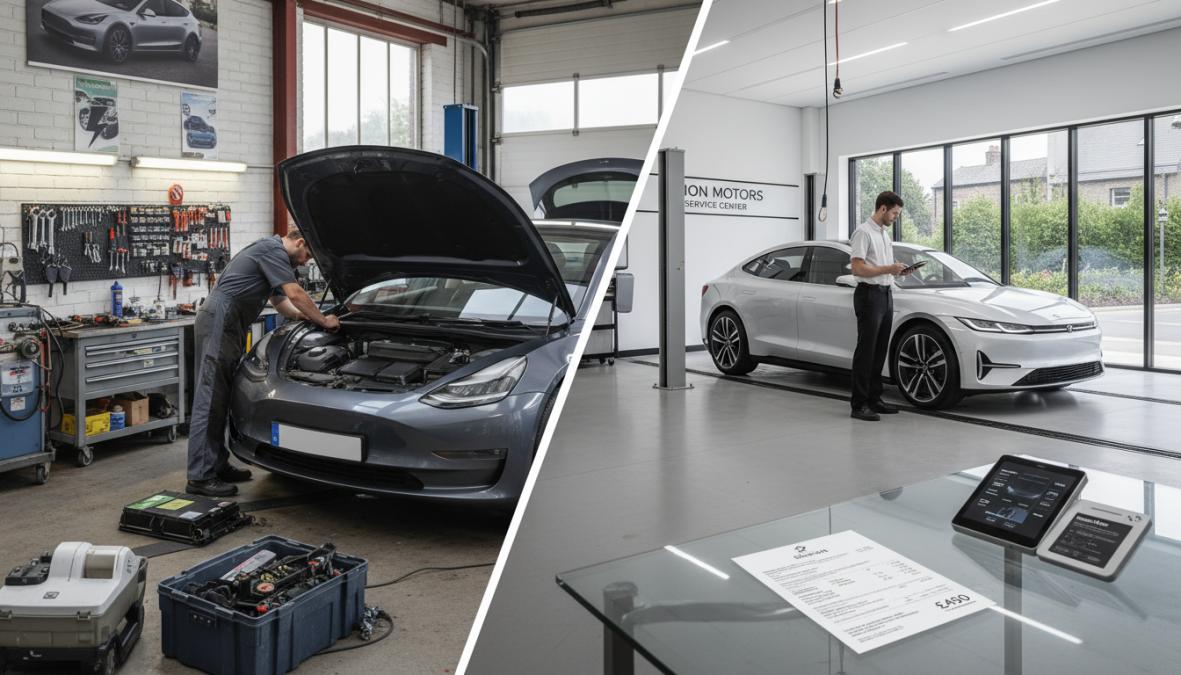
Independent EV repair vs main dealer is a choice between two fundamentally different service models, each with distinct trade-offs in cost, technical capability, and accountability. Main dealer service centres are franchised operations tied directly to a manufacturer, staffed by factory-trained technicians using proprietary diagnostic tools and OEM parts. Independent repair shops operate outside that network, with varying levels of EV-specific training, third-party diagnostic equipment, and access to aftermarket or sourced OEM parts.
The distinction matters more for electric vehicles than it ever did for internal combustion engines. EV maintenance involves high-voltage battery systems, firmware management, and software updates that require specialist tools and training. Not every independent garage is equipped for this. But the best independent EV specialists, particularly those holding Level 4 Master Technician status, can match or exceed dealership technical capability at meaningfully lower labour rates.
Head-to-Head Comparison Table
Factor
Main Dealer
Independent EV Specialist
Labour rates
Higher
Generally lower
OEM parts access
Direct
Sourced (OEM or quality aftermarket)
Proprietary software access
Full
Varies by brand/tool
Factory-trained technicians
Yes
Varies; check qualifications
Warranty work
Yes
Only if approved repairer
EV diagnostic tools
Manufacturer-specific
Third-party (e.g., Autel MaxiSYS Ultra EV)
Battery health certification
Limited
Available from specialists
Flexibility on service intervals
Low
Higher
Recalls and manufacturer campaigns
Handled directly
Referred to dealer
Customer satisfaction
Consistent but impersonal
Varies; often more personal
The table above is a starting point, not a verdict. Context determines the right choice, and we cover that in detail below.
Dealership EV Service Centres: Pros and Cons
Dealership service centres offer something no independent shop can fully replicate: a direct line to the manufacturer. That matters for specific scenarios, but it matters less often than dealers would like you to believe, and the practical experience of using a main dealer service centre involves trade-offs that most 'pros and cons' lists gloss over.
The genuine advantages:
Recall and manufacturer campaign handling. Only authorised dealers can perform recall work and warranty claims covered by the manufacturer. This is non-negotiable, no independent shop, however qualified, can process a manufacturer recall on your behalf.
Proprietary software updates and firmware. Some manufacturers push over-the-air updates, but certain diagnostic functions and module programming require dealer-level access. For brands like Volkswagen Group vehicles (ID.3, ID.4, Audi e-tron), dealer-specific ODIS software handles functions that third-party tools cannot fully replicate.
Factory-trained technicians. Technicians at franchised dealers complete manufacturer-specific EV training programmes, which keeps them current on model-specific technical service bulletins (TSBs) and known fault patterns.
Warranty coverage protection. Using an approved dealer for in-warranty work removes any ambiguity about warranty voiding, particularly important in the first two to three years of ownership.
Loaner car provision. Most franchised dealer service centres offer courtesy vehicles for repairs that require an overnight stay or longer. For EV owners who depend on their vehicle daily, this is a concrete operational advantage that independent shops often cannot match at scale.
The honest limitations:
Labour rates are consistently higher. Dealer service centres carry significant overhead, manufacturer franchise fees, branded facilities, and large service teams, and those costs are passed to the customer. For routine wear items like brake system inspections, 12-volt battery replacements, or tyre alignment, the cost difference versus a qualified independent can be substantial.
Booking lead times. Busy dealer service centres in urban and suburban areas frequently operate with two-to-four week lead times for non-urgent work. Independent specialists often offer faster scheduling, which matters when a fault is affecting your daily use.
Breadth over depth. Technicians at a franchised dealer service dozens of different models across a manufacturer's full range. A specialist working exclusively on one brand or a narrow group of models often builds deeper model-specific diagnostic knowledge than a dealer tech rotating across an entire lineup.
Inflexibility on repair approach. Dealer service centres follow prescribed repair procedures and parts sourcing. There is limited room for discussion about alternative approaches, repair-versus-replace decisions, or parts sourcing options that might reduce your bill.
Insurance-mandated repairer conflicts. This is a nuance most guides miss entirely. Following an accident or fault, your insurer may specify an approved repairer network. If that network routes your EV to a general bodyshop or a dealer service centre that lacks specific competence in your vehicle's high-voltage architecture, the quality of the repair may not reflect the complexity of the work. It is worth reviewing your policy's approved repairer provisions before you need them, not after an incident.
Watch OutIf your insurer's approved repairer list does not include EV-qualified specialists, you have the right to request one. Insurers are not obligated to automatically assign you an EV-competent repairer; you need to ask explicitly. For high-voltage system damage following an accident, this distinction is safety-critical, not just a quality preference.
The loaner car reality for independent shops:
The loaner car gap between dealers and independents is real but narrowing. Many independent EV specialists have arrangements with local hire companies or can schedule work around your availability to minimise downtime. When evaluating an independent shop, ask directly: 'What happens if my vehicle needs to stay overnight?' A professional operation will have a clear answer. If the response is vague, factor that into your decision, particularly if you have no alternative transport.
The honest summary: main dealer service centres are the right choice for in-warranty work, recalls, and brand-specific software programming. For everything else, the premium you pay for the dealer badge is rarely justified by a corresponding premium in service quality.
Independent EV Mechanics: Pros, Cons, and What to Look For
The independent repair sector for electric vehicles has matured considerably since 2016, but it remains uneven. The gap between a well-qualified EV specialist and a general mechanic who has "done a few EVs" is enormous, and it is not always visible from the outside.
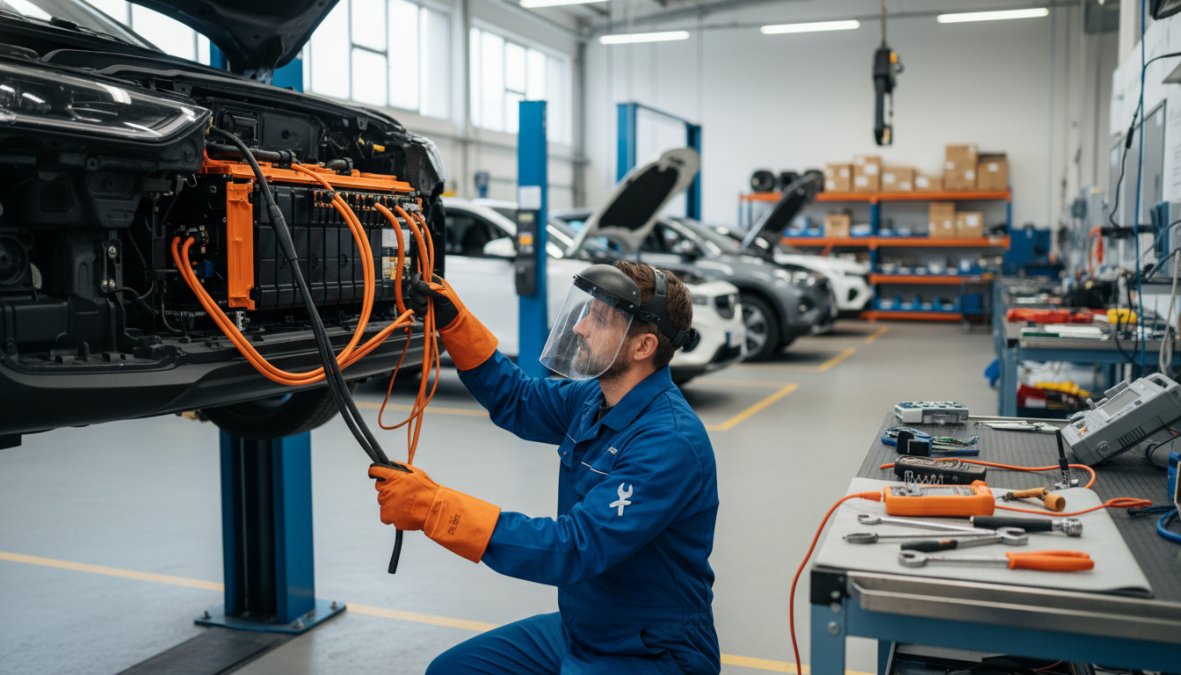
Professional illustration showing qualified and ev and technician concepts for independent ev repair vs main dealer
What a quality independent EV specialist offers:
Lower labour rates on routine and complex work alike
Genuine flexibility on parts sourcing, repair approaches, and scheduling
Often deeper model-specific knowledge for the brands they specialise in
Independent battery health verification, which dealers rarely offer as a standalone service
More direct communication with the technician actually working on your vehicle
Where independent shops can fall short:
Cannot perform recall work or in-warranty manufacturer campaigns
Some lack access to manufacturer-level proprietary software for certain programming functions
Quality varies significantly; the sector has no universal accreditation standard
Finding Certified EV Technicians: What Qualifications Actually Matter
Finding certified EV technicians requires knowing which qualifications actually signal competence rather than just marketing. The key credentials to look for in the UK market are:
IMI Level 3 or Level 4 EV qualifications - Level 4 represents Master Technician status, the highest tier for EV-specific training
HEVRA membership - According to HEVRA's independent garage vetting standards, member garages are vetted for correct tools, qualifications, and repair procedures, making this a reliable trust signal
High-voltage system safety training - Any technician working on EV battery systems must hold valid high-voltage safety certification
Demonstrated brand-specific experience - Years working on specific models matters more than generic EV exposure
KMC Electric holds Level 4 Master Technician status in electric vehicles, with EV qualifications dating to 2016 and over 25 years of broader automotive industry experience. That combination of depth and longevity is what separates a genuine EV specialist from a garage that recently added EVs to its service menu.
Cost of EV Servicing vs ICE: What You'll Actually Pay
The cost of EV servicing versus ICE vehicles is frequently misunderstood in both directions. EVs have fewer moving parts and no oil changes, which eliminates some recurring costs entirely. But high-voltage system work, battery diagnostics, and software-related repairs introduce cost categories that have no ICE equivalent, and the gap between dealer and independent pricing on these items is where real money is at stake.
What disappears when you go electric:
Engine oil and filter changes (a recurring ICE cost with no EV equivalent)
Spark plugs, timing belts, and associated engine service items
Exhaust system maintenance
Transmission fluid changes on single-speed EV drivetrains
These eliminations reduce the frequency of routine service visits and the baseline cost of each one. Routine EV maintenance, brake system checks, tyre alignment, 12-volt battery replacement, cabin filter changes, is generally comparable to or cheaper than equivalent ICE servicing when performed by a qualified independent.
Where the cost divergence appears:
Work Type
Main Dealer Tendency
Independent Specialist Tendency
Routine service (brakes, tyres, cabin filter)
Higher labour rate applied to straightforward work
Lower labour rate; meaningful saving over time
Battery diagnostic and health assessment
Often bundled into wider service packages; rarely offered standalone
Available as a standalone service from specialists
High-voltage system repair
Manufacturer labour times applied at dealer rates
Qualified independent rates; same certified technician standard
Software/firmware fault investigation
Dealer-level tools; dealer-level pricing
Third-party diagnostic tools; lower hourly rate
12-volt battery replacement
Standard dealer labour charge
Often lower; straightforward work priced accordingly
The labour rate gap and why it compounds:
Main dealer labour rates reflect the overhead structure of a franchised operation, manufacturer fees, branded facilities, and large service teams. Independent specialists carry lower overhead and typically charge lower hourly rates for the same certified work. For out-of-warranty vehicles, this difference compounds across every service visit over the vehicle's life. Owners who switch to a qualified independent specialist after warranty expiry commonly find the savings on routine and mid-complexity work are meaningful over a two-to-three year period.
The compounding effect is most pronounced on vehicles that require more frequent attention, older battery packs, high-mileage vehicles, or models with known recurring fault patterns. For these vehicles, the choice of service provider is a genuine cost-of-ownership decision, not just a convenience preference.
High-voltage system work: where cost and qualification intersect:
High-voltage battery and powertrain repairs are labour-intensive regardless of where you take your vehicle. The certified technician requirement is the same at a dealer and at a qualified independent, the difference is the hourly rate applied to that certified labour. For complex battery work, the parts cost typically dominates the total bill, which means the labour rate differential between dealer and independent has proportionally less impact on the final figure. For diagnostic work and lower-complexity high-voltage repairs, the rate difference is more significant.
Pro TipBefore authorising any high-voltage system repair, ask for a written breakdown separating parts cost from labour. This lets you assess whether the labour charge is proportionate and gives you a basis for comparison if you want a second opinion. A professional independent specialist will provide this without hesitation.
OEM Parts vs Aftermarket: Impact on Cost and Quality
OEM parts are manufactured to the original vehicle specification and carry manufacturer backing. Aftermarket parts vary from near-OEM quality to significantly lower standards, and the difference matters more on safety-critical components than on consumables.
For high-voltage components, pyro fuses, and brake system parts, quality sourcing is non-negotiable. A pyro fuse is a safety-critical component; fitting a substandard replacement creates real risk. Similarly, electric hand brake motors for Tesla Model 3 and Model Y must meet precise specifications to function correctly within the vehicle's brake system architecture.
The practical cost implication: OEM parts sourced through an independent specialist are often available at lower cost than the same parts purchased through a dealer's parts department, because the independent is not applying a dealer parts margin. For owners of out-of-warranty vehicles, this is a genuine saving on higher-cost components.
A reputable independent specialist sources OEM or verified-quality parts and is transparent about the supply chain. If a garage cannot tell you the part number and supplier before authorising a repair, treat that as a red flag.
Pro TipAsk any independent shop for the part number and supplier before authorising a repair. A confident, transparent answer signals a professional operation. Hesitation or vagueness on parts sourcing is worth probing further, particularly for any component connected to the high-voltage system.
Battery health and resale value: the hidden cost of not knowing:
One cost category that owners consistently underestimate is the financial impact of battery degradation on resale value. A used EV with no documented battery health history is harder to sell and commands a lower price than one with a verified State of Health report. An independent battery health assessment, covering SOC, SOH, and cell-level analysis, is a relatively low-cost service that can materially affect the value you recover when selling. Main dealer service centres rarely offer this as a standalone service; specialist independents do. For owners approaching the end of a finance term or planning a sale, this is a cost-of-ownership consideration worth factoring in well in advance.
EV Warranty Voiding Rules: What Independent Repair Actually Means for Your Cover
EV warranty voiding rules are frequently misunderstood, and the misunderstanding often benefits dealers. The legal position in the UK is clearer than most people realise.
Under UK consumer law and the principles established by EU Block Exemption Regulations (which continue to influence UK practice post-Brexit), manufacturers cannot void your warranty simply because you used an independent garage for servicing, provided that:
The service was carried out to the manufacturer's specification
The correct parts (OEM or equivalent quality) were used
The work was documented with a verifiable service history
The UK Competition and Markets Authority guidance on vehicle warranties supports the principle that consumers have the right to choose their service provider without automatically forfeiting manufacturer warranty. Manufacturers can, however, void warranty for specific faults directly caused by non-compliant work.
Practical implications:
Routine maintenance at a qualified independent does not void your EV warranty
High-voltage battery work or software modifications are higher-risk territory; document everything
Keep a complete service history regardless of where you service
Software Updates, Firmware, and Proprietary Diagnostic Tools
Software updates and firmware management are where the independent vs dealer debate gets genuinely complicated. Some manufacturers, Tesla being the most prominent example, push most updates over the air. Others require a physical dealer connection for certain programming functions.
Professional-grade third-party diagnostic tools like the Autel MaxiSYS Ultra EV provide independent shops with State of Charge (SOC) and State of Health (SOH) battery analysis, advanced topology mapping, and high-voltage system diagnostics that come close to OEM-level capability for many brands. The gap between dealer tools and top-tier independent diagnostic equipment has narrowed considerably.
Where the gap remains: certain brand-specific module programming, key coding, and manufacturer-exclusive diagnostic protocols. For these specific functions, a dealer visit remains necessary. A good independent specialist will tell you this upfront rather than attempt work outside their tool capability.
Battery Health Certification, Insurance Claims, and Right-to-Repair
Battery health certification is one of the most underserved areas in EV ownership, and it is an angle most dealer service centres do not proactively offer. An independent battery health assessment gives you a verified State of Health reading, degradation profile, and cell-level analysis that is invaluable for three specific situations:
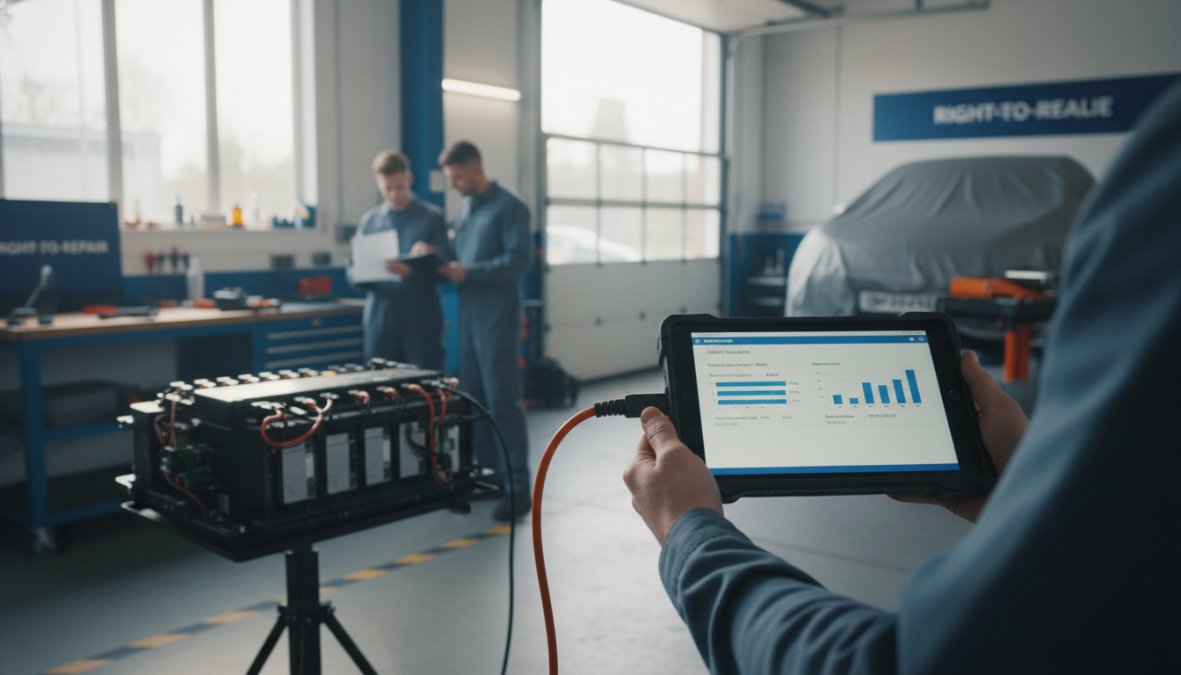
Professional illustration showing independent ev repair vs main dealer
Pre-purchase inspection - Buying a used EV without independent battery verification is a significant financial risk
Pre-sale certification - A verified battery health report increases buyer confidence and supports resale value
Pre-warranty-expiry audit - Identifying potential faults before the warranty period closes gives you the opportunity to raise claims while cover still applies
Insurance claim nuances are a genuinely overlooked complexity. Following an accident or fault, insurers may specify approved repairers. If your insurer's approved repairer network does not include EV specialists, you may receive a repair from a general bodyshop without the EV-specific competence the job requires. It is worth checking your policy's approved repairer provisions and, if necessary, requesting an EV-qualified repairer.
Right-to-Repair is an evolving legal area. According to Right to Repair legislation progress in the UK, there is growing regulatory pressure to ensure independent repairers have access to the technical information and tools needed to service modern vehicles, including EVs. This is a positive trend for independent EV repair quality and consumer choice.
Loaner Car Policies and Practical Considerations
Loaner car policies favour main dealers on paper. Most franchised dealer service centres offer courtesy vehicles for longer repairs, a benefit independent shops often cannot match at scale. For EV owners who depend on their vehicle daily, this is a real practical consideration.
That said, many independent EV specialists in the Kettering area and across Northamptonshire have arrangements to mitigate this, including relationships with local hire companies or flexible scheduling to minimise vehicle downtime. It is worth asking directly before booking.
DIY vs Professional EV Maintenance: Where the Line Falls
DIY maintenance on electric vehicles is viable for a narrower range of tasks than on ICE vehicles. The high-voltage systems present genuine safety risks that make amateur intervention on battery or powertrain components genuinely dangerous, not just inadvisable.
Tasks where DIY is reasonable:
Cabin air filter replacement
Wiper blade replacement
Tyre pressure monitoring and inflation
Exterior and interior cleaning, including sensor surfaces
Tasks requiring a qualified professional:
Any work involving the high-voltage battery system
Brake system inspection and repair (including electric hand brake motor replacement)
Software diagnostics and fault code investigation
Coolant system maintenance on liquid-cooled battery packs
12-volt battery replacement on vehicles where the process involves disabling high-voltage systems
The IMI's EV technician safety standards are explicit that high-voltage system work must be performed by trained, certified technicians. This is not regulatory caution for its own sake; high-voltage EV systems can deliver fatal current levels.
Key TakeawayThe DIY boundary on EVs is not about complexity; it is about voltage. Anything connected to the high-voltage architecture requires a certified technician. Everything else follows normal DIY logic: if you are confident and have the right tools, proceed carefully.
When Independent EV Repair vs Main Dealer Is the Right Call
Choosing between independent ev repair vs main dealer comes down to four variables: warranty status, the nature of the work, the qualification level of the independent shop, and your personal priorities around cost, convenience, and service relationship.
Choose a main dealer when:
Your vehicle is in warranty and the fault may be a warranty claim
The work involves a manufacturer recall or safety campaign
You need brand-specific software programming that requires proprietary dealer tools
Your insurer's policy mandates an approved repairer network
Choose a qualified independent EV specialist when:
Your vehicle is out of warranty and cost of ownership matters
You want an independent battery health assessment before buying, selling, or warranty expiry
You are seeking a long-term service relationship with a specialist who knows your vehicle
You need practical, real-world repairs without dealer-level overhead costs
You are based near Kettering or elsewhere in Northamptonshire and want a local specialist with genuine EV credentials
The key word in that second list is "qualified." The independent ev repair vs main dealer decision is only a safe one when the independent shop has the training, tools, and transparency to back it up. Checking for IMI Level 4 status, HEVRA membership, and documented EV experience is not optional diligence; it is the minimum standard.
Choosing the right place to service your electric vehicle is one of the most consequential decisions you will make as an EV owner, and getting it wrong either costs you money or jeopardises your warranty. KMC Electric offers a proven alternative to main dealer networks, combining Level 4 Master Technician status in electric vehicles, over 25 years of automotive experience, and specialist knowledge of Tesla systems across all models. For EV owners in Kettering and across Northamptonshire, KMC Electric provides independent battery health verification, pre-warranty-expiry fault identification, and cost-effective repairs for out-of-warranty vehicles. Get started with KMC Electric and protect the long-term service life of your electric vehicle with expert independent care.
Frequently Asked Questions
Does using an independent EV mechanic void my warranty?
In the UK, using an independent repair shop does not automatically void your EV warranty, provided the work is carried out to the manufacturer's standard and documented correctly. Under block exemption regulations, manufacturers cannot insist on dealer-only servicing during the warranty period for routine wear items. However, if an independent shop causes damage through incorrect work — particularly to the high-voltage battery or software systems — that specific damage may not be covered. Always ensure your independent EV specialist keeps a full service history record.
Are independent EV repair shops cheaper than dealerships?
Independent EV repair shops typically charge lower labour rates than main dealer service centres, often making them a more cost-effective option for out-of-warranty vehicles. The cost of EV servicing vs ICE vehicles is already lower due to fewer moving parts, and an independent specialist can reduce bills further on repairs like brake system work, 12-volt battery replacement, and diagnostics. Parts costs vary — some independents source quality OEM-equivalent parts at better prices, though certain proprietary components may still need to come through official channels.
Do independent mechanics have access to EV diagnostic software?
Qualified independent EV specialists can access professional-grade diagnostic tools — such as the Autel MaxiSYS Ultra EV — that provide comprehensive analysis of high-voltage battery systems, firmware status, and fault codes. While some manufacturer proprietary software remains dealer-exclusive (notably for over-the-air software updates and certain recalls), a well-equipped independent shop can perform the vast majority of EV diagnostics. Always ask a prospective independent garage what specific EV diagnostic tools they use before booking.
How do I find a qualified independent EV repair shop?
When finding certified EV technicians at an independent shop, look for Level 4 Master Technician status in electric vehicles, membership of recognised bodies such as HEVRA (Hybrid and Electric Vehicle Repair Alliance), and verifiable EV-specific training credentials. Ask how long they have been working on EVs, which brands they specialise in, and whether they carry appropriate high-voltage safety equipment. Check for documented service history practices and ask specifically about their experience with your vehicle model to ensure genuine EV specialist expertise.
What are the risks of taking an EV to a non-specialist?
Taking an electric vehicle to a general garage without EV-specific training carries real risks. High-voltage battery systems require specialist safety protocols — incorrect handling can cause serious injury or vehicle damage. Non-specialists may also lack the diagnostic tools needed to read EV-specific fault codes accurately, leading to misdiagnosis and unnecessary parts replacement. Poorly documented repairs can also affect resale value and complicate future warranty claims. For anything beyond routine wear items like tyres and wiper blades, always use a shop with verified EV qualifications.