Deciding between a hybrid and a petrol car often comes down to one question: which costs less to keep on the road? The debate around hybrid vehicle maintenance vs petrol cars is more nuanced than most buyers expect, and at KMC Electric, we work with hybrid and electric vehicles every day from our workshop in Kettering, Northamptonshire. The short answer is that hybrids generally cost less to maintain over time, but the reasons why, and the exceptions, are worth understanding before you commit. Below, we break down every major maintenance category so you can make a genuinely informed decision.
Here is what most guides get wrong: they compare sticker prices and fuel costs, then declare a winner. The real story lives in the service intervals, brake wear patterns, battery longevity, and drivetrain complexity that quietly shape your total cost of ownership over five to ten years.
Hybrid Vehicle Maintenance vs Petrol Cars: The Core Differences
A hybrid vehicle is a car that combines an internal combustion engine with one or more electric motors and a battery pack, using regenerative braking and intelligent power management to reduce fuel consumption and mechanical wear. A petrol car relies entirely on its internal combustion engine for propulsion, which means every component in that powertrain works harder, more often.
The practical difference shows up in maintenance frequency. Hybrids run their petrol engine less aggressively because the electric motor shares the load. This translates to reduced wear on engine components, longer oil change intervals in many models, and significantly extended brake pad life thanks to regenerative braking. Petrol cars, by contrast, demand more frequent attention across nearly every system.
Hybrid vs Gas Engine Components: What Changes Under the Bonnet
The most visible difference between a hybrid and a petrol car is what you find under the bonnet. A petrol vehicle carries a full internal combustion engine, an alternator, a starter motor, a conventional transmission, and a standard braking system. A hybrid replaces or supplements several of these with electric motor units, a high-voltage battery pack, and an inverter system.
Gone in most hybrids: the traditional alternator and starter motor, both of which are common failure points in petrol vehicles. The electric motor handles starting duties and energy recovery. This reduces the number of components that need periodic replacement, which is a genuine long-term saving that rarely appears in headline cost comparisons.
What is added: a high-voltage system requiring specialist diagnostic tools, a battery management system, and in plug-in hybrid (PHEV) configurations, an external charging circuit. These additions do not require frequent servicing, but when they do need attention, they require a certified technician with appropriate EV qualifications.
Drivetrain Complexity: Parallel Hybrid and PHEV Systems Explained
A parallel hybrid is a system where both the internal combustion engine and the electric motor can drive the wheels independently or together, depending on demand. A PHEV (plug-in hybrid electric vehicle) adds a larger battery pack that can be charged from an external source, allowing extended electric-only driving.
Drivetrain complexity is genuinely higher in a hybrid than in a petrol car. You have two powertrains to manage rather than one. However, this complexity does not translate directly into higher maintenance costs because the electric drivetrain components are largely sealed, require no oil changes, and have no clutch wear in most configurations. The complexity matters most when something goes wrong, which is why choosing a workshop with proper hybrid and EV qualifications is not optional.
Hybrid Car Maintenance Cost: A Full Breakdown
Hybrid car maintenance cost tends to run lower than equivalent petrol vehicles across a typical ownership period, primarily because of reduced brake wear, extended oil change intervals, and the elimination of several conventional components. This is not a universal rule, but it holds for most mainstream hybrid models driven in typical conditions.
The areas where hybrid owners save consistently include: brake system servicing, engine oil and filter changes, and starter motor or alternator replacement. The areas where costs can be higher include: high-voltage battery replacement (though this is rare within the first ten years), specialist diagnostic labour, and coolant systems that serve both the engine and battery thermal management.
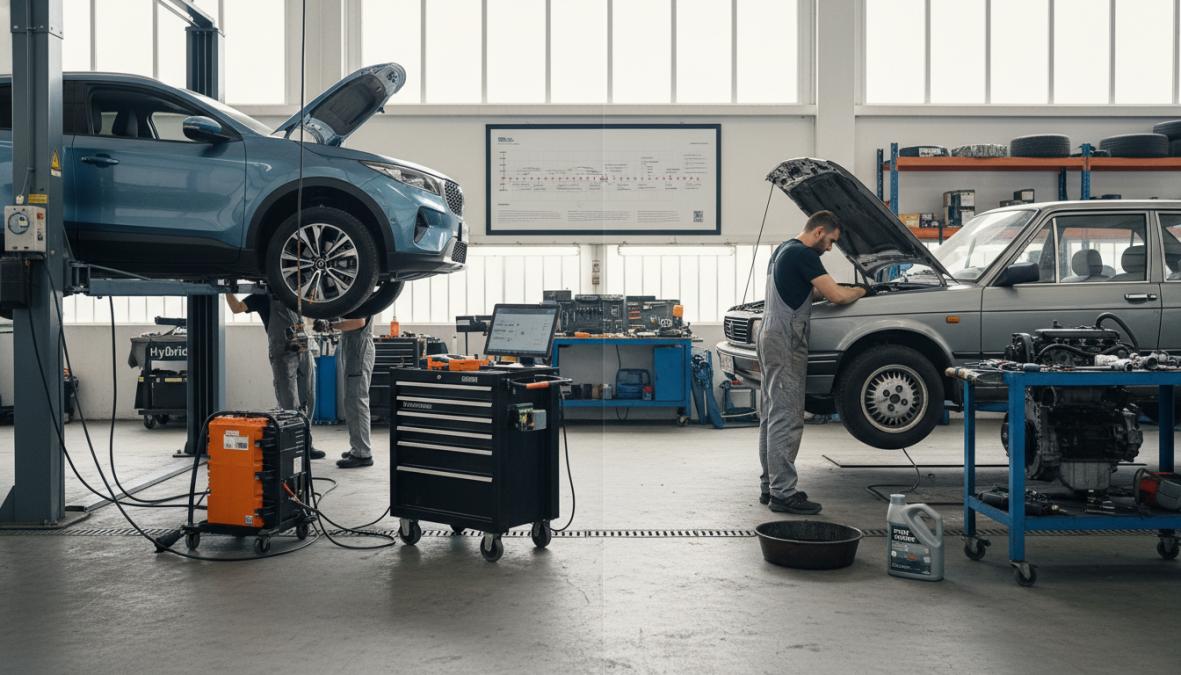
Software tools interface for certified and technician and workshop concepts for hybrid vehicle maintenance vs petrol cars
Maintenance Cost Comparison Table: Hybrid vs Petrol
Service Item
Hybrid (Approx.)
Petrol (Approx.)
Notes
Oil change
Less frequent
Every 10,000-12,000 miles
Hybrids often extend intervals
Brake pads (front)
Longer life
Standard life
Regen braking reduces wear
Starter motor replacement
Rarely needed
Periodic
Electric motor replaces function
Alternator replacement
Rarely needed
Periodic
Generator integrated into system
Transmission service
Less frequent
Standard intervals
Many hybrids use e-CVT
Battery replacement
10-15 year lifespan
Not applicable
Covered under warranty initially
Annual service
Comparable
Comparable
Labour rates may differ
Coolant system
Dual system cost
Single system
Engine and battery circuits
Key TakeawayHybrids save most on brake servicing and the elimination of starter motors and alternators. Petrol cars save on diagnostic simplicity. The net saving over five years typically favours the hybrid, particularly for higher-mileage drivers.
How Often to Service a Hybrid Car vs a Petrol Vehicle
How often to service a hybrid car depends on the manufacturer, the model, and your driving pattern, but most modern hybrids follow annual or mileage-based service intervals broadly similar to petrol vehicles. The difference appears in what gets done at each service, not necessarily how often you visit a workshop.
What almost no comparison guide provides is a concrete, milestone-by-milestone breakdown of what actually happens at each service interval and how that differs between the two drivetrains. The table below fills that gap. Figures are based on typical manufacturer schedules for mainstream parallel hybrids (such as the Toyota Yaris Cross, Honda Jazz, and Ford Kuga PHEV) versus equivalent petrol models. Always verify against your specific model's handbook, as intervals vary.
Side-by-Side Service Interval Table: Hybrid vs Petrol (by Mileage Milestone)
Milestone
Hybrid, Typical Tasks
Petrol, Typical Tasks
Key Difference
Annual / 10,000 mi
Engine oil & filter change, visual safety check, tyre rotation, cabin air filter inspect, 12V auxiliary battery check, brake fluid moisture test
Engine oil & filter change, visual safety check, tyre rotation, cabin air filter inspect, 12V battery check, brake fluid moisture test
Broadly identical at this stage; hybrid engine oil may be extended to 10,000-12,000 mi on some Toyota models vs 9,000-10,000 mi for petrol equivalents
20,000 mi
Oil & filter, tyre rotation, brake inspection (pads often still within spec due to regen braking), air filter inspect
Oil & filter, tyre rotation, brake inspection (pads may already show wear in urban use), air filter inspect
Brake pad wear diverges noticeably here for urban drivers; hybrid pads frequently pass inspection where petrol equivalents are approaching replacement
30,000 mi
Oil & filter, cabin & engine air filters replace, coolant inspect (engine circuit), brake fluid replace if moisture threshold exceeded, hybrid battery health check recommended
Oil & filter, cabin & engine air filters replace, coolant inspect, brake fluid replace, spark plugs inspect on some models
Hybrid adds battery health check as a proactive item; petrol may begin spark plug inspection depending on plug type
60,000 mi
Oil & filter, air filters, brake fluid, coolant top-up or replace (engine circuit), e-CVT fluid inspect (many sealed-for-life units require no change), brake pads likely first replacement around this point for urban drivers
Oil & filter, air filters, brake fluid, coolant replace, automatic transmission fluid change (30,000-60,000 mi depending on type), brake pads likely already replaced once or twice for urban drivers
Transmission servicing is a meaningful cost divergence: conventional automatics need fluid changes; most hybrid e-CVT units do not. Brake pad replacement timing gap is most visible here
90,000 mi
Oil & filter, air filters, brake fluid, spark plugs replace (hybrids still have an ICE), coolant replace (engine circuit), battery coolant circuit inspect, 12V auxiliary battery likely replacement
Oil & filter, air filters, brake fluid, spark plugs replace, coolant replace, transmission fluid change, alternator and starter motor condition assess
Hybrid avoids alternator and starter motor costs; petrol owner may face alternator or starter replacement as a probability item by this mileage
100,000+ mi
All 90k items, independent hybrid battery health assessment strongly recommended, brake disc inspect (likely first replacement around this point for mixed driving)
All 90k items, alternator and/or starter motor replacement probable, brake discs likely already replaced once
Hybrid battery health assessment is a unique cost at this stage but replaces several petrol-specific items; net cost position still typically favours hybrid
Key TakeawayThe clearest pattern in the table: hybrid owners defer or eliminate brake pad replacements, transmission fluid changes, alternator servicing, and starter motor costs. Petrol owners benefit from simpler [diagnostics](/page/tesla-drive-unit-diagnostics-and-repair) and no battery health monitoring requirement. For a driver covering 12,000 miles per year, the hybrid's maintenance cost advantage becomes most pronounced between the 40,000 and 80,000 mile range, where brake and transmission savings accumulate without yet reaching the battery health assessment milestone.
Oil Change Frequency and Transmission Service Intervals
Oil change frequency is one of the clearest advantages of hybrid ownership. Because the internal combustion engine in a hybrid shuts down during low-speed driving and electric-only operation, it accumulates fewer operational hours per mile than a petrol engine running continuously. Many hybrid manufacturers specify oil change intervals that are meaningfully longer than equivalent petrol vehicles, though you should always follow the manufacturer's schedule rather than assume.
Transmission service intervals also differ. Most parallel hybrids use an electronically controlled continuously variable transmission (e-CVT) that requires less frequent fluid changes than a conventional automatic or manual gearbox. Some hybrid transmissions are sealed for life, eliminating transmission service as a recurring cost entirely. Petrol cars with traditional automatic transmissions typically require fluid changes every 30,000 to 60,000 miles.
The practical upshot: over 100,000 miles, a hybrid owner is likely to spend noticeably less on engine oil, oil filters, and transmission servicing than their petrol counterpart.
Pro TipIf you are buying a used hybrid and the service history shows oil changes at petrol-car intervals (every 6,000-8,000 miles) rather than the manufacturer's hybrid-specific schedule, that is not a red flag, it is actually conservative and beneficial. The concern is the opposite: a used hybrid with no documented oil changes beyond 15,000-mile gaps, which may indicate the owner assumed the hybrid engine needed no attention at all.
Regenerative Braking, Brake Pad Life, and Tyre Wear
Regenerative braking is one of the most tangible maintenance advantages a hybrid offers over a petrol car. The system uses the electric motor as a generator during deceleration, converting kinetic energy back into electricity and slowing the vehicle without engaging the mechanical brakes. This means brake pads and discs experience far less friction wear in everyday driving.
In practice, hybrid owners commonly report brake pad life that is significantly longer than on equivalent petrol vehicles. This is not a minor saving: brake pad and disc replacement is one of the more frequent maintenance costs on a petrol car, particularly in urban stop-start driving where hybrids do most of their regenerative work.
Tyre wear, on the other hand, is broadly comparable between hybrids and petrol cars. Hybrids tend to be heavier due to the battery pack, which can marginally increase tyre wear. Regular tyre rotation remains as important for hybrids as for petrol vehicles. Some hybrid owners on low-rolling-resistance tyres find that tyre costs are slightly higher per set, though fuel savings offset this.
Watch OutA common mistake with hybrid brake systems is assuming they never need inspection because the pads last longer. The hydraulic brake components still require periodic checks. Brake fluid absorbs moisture over time and should be tested or replaced on schedule regardless of pad condition.
Hybrid Battery Replacement Cost and Longevity
Hybrid battery replacement cost is the figure that makes many buyers hesitate, and understandably so. A full high-voltage battery pack replacement on a mainstream hybrid can be a significant expense. The reassuring reality is that most hybrid batteries are engineered to last the life of the vehicle under normal use, and many models have accumulated well over 150,000 miles without requiring battery replacement.
Battery longevity depends on thermal management quality, charging habits (for PHEVs), and operating climate. Most manufacturers design hybrid battery packs to degrade gradually rather than fail suddenly. Capacity loss of around 20-30% over a decade is common, which affects fuel economy more than driveability.
Hybrid Battery Warranty: What Owners Should Know
Hybrid battery warranty coverage in the UK typically extends to eight years or 100,000 miles on new vehicles, though this varies by manufacturer. This warranty covers defects and significant capacity loss beyond a defined threshold. Owners buying used hybrids outside the warranty period should arrange an independent battery health assessment before purchase.
KMC Electric provides independent battery health verification for buyers and sellers of hybrid and electric vehicles, which is particularly valuable when the manufacturer warranty has expired. Knowing the true state of a battery pack before a purchase prevents expensive surprises and gives buyers genuine negotiating information.
According to Which? consumer guidance on hybrid car running costs, battery degradation on well-maintained hybrids is generally modest, and replacement outside warranty periods is far less common than popular perception suggests.
DIY vs Professional Service: What Hybrid Owners Can and Cannot Do
The DIY vs professional service question is where hybrid ownership diverges most sharply from petrol car ownership. Many routine tasks remain accessible to a competent home mechanic: cabin air filter replacement, wiper blades, tyre pressure checks, and visual inspections. These carry no additional risk on a hybrid compared to a petrol car.
What changes is the boundary around the high-voltage system. The battery pack, inverter, electric motor connections, and associated wiring operate at voltages that are genuinely dangerous without proper training and equipment. Attempting to service these components without appropriate qualifications is not a cost-saving measure; it is a serious safety risk.
For hybrid-specific diagnostics, tools such as the OBDeleven diagnostic platform can access hybrid battery health data and emissions readiness checks, making them useful for informed owners who want visibility into their vehicle's condition without full workshop intervention. Similarly, BlueDriver's professional OBD2 scanner reads and clears codes across most hybrid systems, including ABS and transmission modules, giving DIY-oriented owners a meaningful window into their car's health.
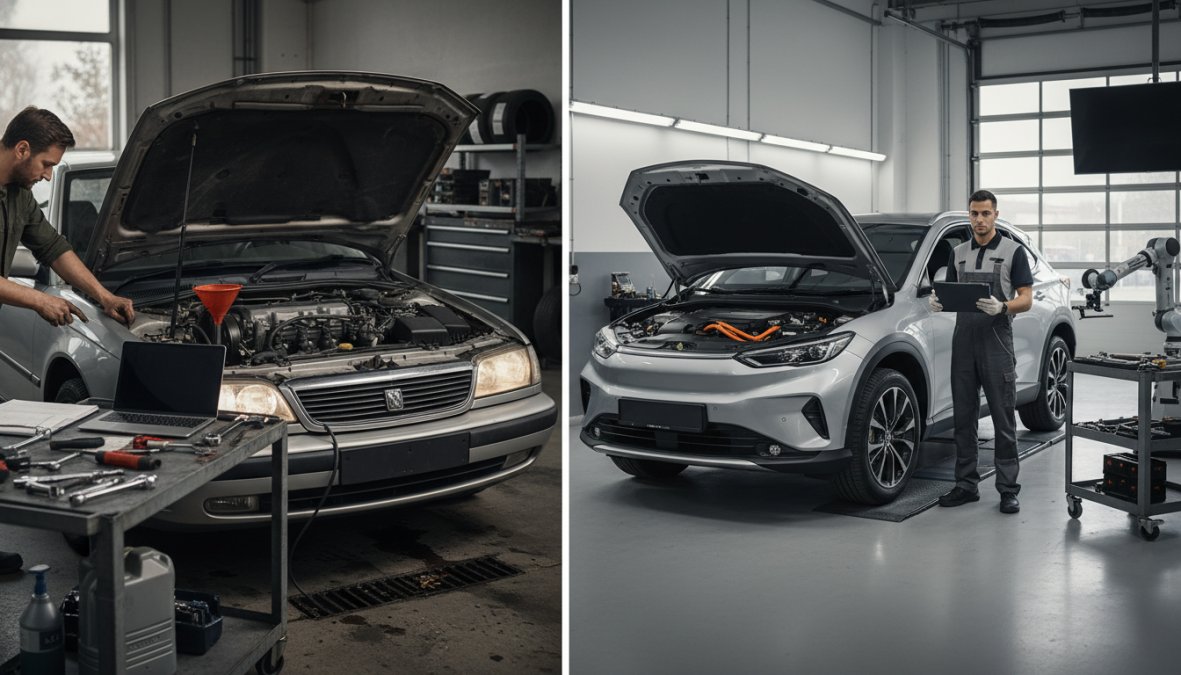
Side-by-side comparison of Close for hybrid vehicle maintenance vs petrol cars
Pro TipFor hybrid owners who want to monitor battery health between services, an OBD2 tool with hybrid-specific modules is worth the investment. It will not replace a workshop inspection, but it gives you early warning of developing faults before they become expensive.
The practical rule: anything above the 12V auxiliary battery requires a certified technician. For hybrid and EV owners near Kettering, KMC Electric holds Level 4 Master Technician status in electric vehicles and has carried EV qualifications since 2016, which means the high-voltage work is handled correctly and safely.
Geographic and Climate Impact on Hybrid Maintenance
Climate affects hybrid maintenance in ways that petrol car owners rarely need to think about. Cold temperatures reduce battery pack efficiency, which means the internal combustion engine runs more frequently in winter, partially reducing the fuel and wear savings that make hybrids attractive. In very cold climates, this effect is pronounced enough to narrow the maintenance cost gap with petrol vehicles during winter months.
Northamptonshire's temperate climate sits in a favourable middle ground: cold enough in winter to see some battery efficiency reduction, but rarely cold enough to cause the sustained performance drops seen in Scandinavian climates. For most drivers in the Kettering area and across the East Midlands, the climate impact on hybrid maintenance is modest.
High-temperature environments present a different challenge. Sustained heat accelerates battery degradation over time, particularly in PHEVs with larger packs that are regularly charged to capacity. Hybrid battery thermal management systems are designed to handle this, but owners in consistently hot regions should be more attentive to battery health monitoring.
Urban driving, common in and around Kettering town centre, is where hybrids perform best. Stop-start traffic maximises regenerative braking energy recovery, reduces engine wear, and produces the greatest gap in brake pad life compared to petrol equivalents.
Fuel Efficiency, Resale Value, and Total Cost of Ownership
Total cost of ownership is the only metric that genuinely matters when comparing hybrid vehicle maintenance vs petrol cars over the long term. It combines purchase price, fuel costs, insurance, servicing, repairs, and resale value into a single figure, and it is the figure that most comparison articles fail to model with any specificity.
Fuel Efficiency: Where the Savings Actually Come From
The fuel economy advantage of a hybrid over a petrol equivalent is largest in the driving conditions where hybrids are most commonly used: urban and suburban stop-start traffic. In this environment, the electric motor handles low-speed propulsion, the regenerative braking system recovers energy that a petrol car wastes as heat, and the internal combustion engine shuts down at standstill rather than idling.
On a motorway at a steady 70 mph, the fuel economy gap between a hybrid and a petrol equivalent narrows considerably, because the electric motor's advantage is smallest at sustained high speeds where the ICE is running efficiently anyway. This is a practical point for buyers: if the majority of your mileage is motorway commuting, the fuel saving case for a hybrid is weaker than if you drive primarily in town.
For a driver covering a typical UK annual mileage of around 7,000-10,000 miles in mixed urban and suburban conditions, the fuel saving over a petrol equivalent can be meaningful across a five-year ownership period, but the exact figure depends on the specific models compared, local fuel prices at the time, and actual driving patterns. The saving is real and consistent in direction; the magnitude varies.
Resale Value: The Maintenance Connection Most Buyers Miss
Resale value is where the hybrid maintenance story connects directly to financial return, and it is the angle almost no comparison guide explores in depth.
Hybrid vehicles have historically held their value well relative to petrol equivalents in the used market, for two reinforcing reasons. First, fuel economy is an increasingly prominent factor in used car purchasing decisions as running costs become more visible to buyers. Second, and less discussed, a hybrid with a documented, specialist-verified service history commands a premium that a petrol car with equivalent history does not, because the battery pack's condition is an unknown that buyers price in as risk.
This creates a direct financial incentive for proactive hybrid maintenance that does not exist in the same way for petrol cars:
A hybrid with a full service history from a qualified EV technician, including documented battery health checks, removes the single largest uncertainty for a used buyer.
A hybrid without that documentation, even if the battery is in good condition, will be discounted by cautious buyers who cannot verify it.
The discount applied to an undocumented hybrid battery can exceed the cost of the health assessments that would have prevented it.
In practical terms: spending on a battery health verification at 60,000 miles and again at 100,000 miles is not just a maintenance cost, it is a resale value protection measure. The documentation itself has monetary value at point of sale.
Pro TipIf you are planning to sell a hybrid privately rather than part-exchanging it, an independent battery health report from a certified EV technician is one of the most cost-effective investments you can make in the months before listing. It removes the buyer's primary objection and supports a higher asking price. KMC Electric provides independent battery health verification for exactly this purpose.
Modelling Total Cost of Ownership: A Framework for Your Situation
Because fuel prices, insurance rates, and individual driving patterns vary too much to produce a single reliable figure, the most useful approach is a framework you can apply to your specific situation rather than a headline number that may not reflect your reality.
The five variables that determine whether a hybrid or petrol car wins on total cost of ownership for you specifically are:
Annual mileage, Higher mileage amplifies both fuel savings and maintenance savings. Below around 6,000 miles per year, the case for a hybrid on pure cost grounds weakens.
Driving environment, Urban and suburban driving maximises hybrid efficiency and regenerative braking benefit. Predominantly motorway driving reduces both.
Ownership duration, The hybrid's cost advantage compounds over time. Over three years, the saving may be modest. Over seven to ten years, it is typically substantial.
Purchase price premium, New hybrids carry a purchase price premium over petrol equivalents. The maintenance and fuel savings need to close that gap. For used hybrids, the premium is often smaller and the payback period shorter.
Battery condition at purchase (used vehicles), A used hybrid with degraded battery capacity delivers lower fuel economy and reduced regenerative braking benefit, which erodes both the fuel saving and the maintenance saving simultaneously. This is why battery health verification before purchase is not optional, it is the variable that most affects whether the total cost of ownership calculation works in your favour.
Pros and Cons: Hybrid vs Petrol Vehicle Maintenance
Hybrid maintenance advantages:
Extended brake pad and disc life through regenerative braking
Longer oil change intervals in many models
No alternator or starter motor to replace
Reduced transmission service frequency in e-CVT models
Lower fuel costs reduce overall running expenses
Documented battery health history supports resale value
Hybrid maintenance disadvantages:
High-voltage system requires specialist certified technician for relevant work
Dual coolant systems (engine and battery) add a maintenance circuit
Battery replacement cost if required outside warranty
Specialist diagnostic tools needed for full system access
Fewer independent garages qualified to work on the high-voltage system
Undocumented battery condition creates resale risk if health checks are skipped
Petrol maintenance advantages:
Simpler drivetrain with wider technician availability
Lower diagnostic complexity for most faults
No battery pack longevity concern
Established parts availability across all price points
Petrol maintenance disadvantages:
More frequent brake servicing, particularly in urban driving
Regular oil changes at shorter intervals
Alternator and starter motor replacement over vehicle life
Resale value increasingly pressured as fuel economy becomes a buyer priority
According to the Energy Saving Trust's guidance on low-emission vehicle running costs, the combination of fuel savings and reduced maintenance frequency makes hybrid ownership genuinely cost-effective for most UK drivers over a five-year period. The key qualifier in that finding, and in every honest total cost of ownership analysis, is that the result depends on mileage, driving environment, and the quality of ongoing maintenance. A hybrid serviced by unqualified technicians, or purchased used without battery verification, can underperform a well-maintained petrol car on total cost. The drivetrain is only part of the equation; the service history behind it is the other.
Conclusion: Which Is Cheaper to Maintain in the Long Run?
Hybrid vehicle maintenance vs petrol cars ultimately resolves in favour of the hybrid for most drivers, most of the time. The savings on brakes, oil changes, and eliminated components outweigh the added complexity of the high-voltage system, provided the vehicle is serviced by a qualified technician. The longer you own the vehicle and the more urban your driving pattern, the more pronounced that advantage becomes.
The one genuine caveat: the quality of your servicing provider matters more with a hybrid than with a petrol car. A workshop without proper EV qualifications cannot safely or accurately service the high-voltage system, which means deferred problems and potential safety risks.
Finding a qualified hybrid specialist near you is the single most important step a hybrid owner can take. KMC Electric, based in Kettering, Northamptonshire, offers professional diagnosis, repair, and long-term maintenance for hybrid and electric vehicles, backed by over 25 years of automotive experience and Level 4 Master Technician status in electric vehicles. The team provides independent battery health verification, cost-effective alternatives to main dealer servicing, and practical fault identification before warranty expiry. Contact KMC Electric to book a hybrid health assessment and get a clear picture of your vehicle's true condition.
Frequently Asked Questions
Do hybrid cars require more maintenance than petrol cars?
In most cases, hybrid vehicle maintenance vs petrol cars works out to less frequent servicing overall. Hybrids skip certain tasks petrol cars need regularly — such as alternator and starter motor replacements — and benefit from regenerative braking that extends brake pad life significantly. However, the high-voltage battery pack and electric motor add complexity that requires specialist diagnostic tools and a certified technician, which can increase labour costs when specialist work is needed.
What is the typical hybrid battery replacement cost in the UK?
Hybrid battery replacement cost varies widely depending on the vehicle make, model, and whether you choose a new, remanufactured, or refurbished battery pack. Costs can range from roughly £1,500 to over £6,000 including labour. Many manufacturers offer a hybrid battery warranty of 8 years or 100,000 miles, so it is worth checking your coverage before paying out of pocket. An independent specialist can often provide more cost-effective options than a main dealer.
How often should you service a hybrid car?
How often to service a hybrid car depends on the manufacturer's recommended service intervals, but most hybrids follow a 12-month or 10,000–12,000-mile schedule — similar to petrol vehicles. However, oil change frequency may be lower because the internal combustion engine runs less often, reducing wear. Coolant systems, brake fluid, and cabin air filters still require regular attention. Always follow your vehicle's specific service schedule rather than applying petrol car assumptions.
Is it more expensive to repair a hybrid car than a petrol car?
Routine hybrid car maintenance cost is generally comparable to or lower than petrol cars, thanks to fewer oil changes and longer brake pad life from regenerative braking. Where costs can rise is in specialist repairs — particularly anything involving the high-voltage system, battery pack, or electric motor. These require certified technicians with specialist diagnostic tools. Choosing an independent EV and hybrid specialist over a main dealer can significantly reduce repair costs without compromising quality.
Do hybrid cars use the same oil as petrol cars?
Not always. While some hybrids use standard engine oil grades, many manufacturers specify low-viscosity oils designed for engines that start and stop frequently. Using the wrong grade can affect fuel economy and engine longevity. Always refer to your owner's manual or consult a specialist. Because the internal combustion engine in a hybrid runs less continuously than in a petrol car, oil degradation patterns can differ, which is why some hybrid service intervals are adjusted accordingly.
How long do hybrid car brakes last compared to petrol cars?
Hybrid brake pad life is typically much longer than on petrol cars — often two to three times longer — because regenerative braking does the majority of the slowing work, converting kinetic energy back into electricity for the battery pack. However, because the brake pads are used less, corrosion on brake discs can sometimes become an issue in wet climates like the UK. Regular inspection during service intervals is recommended to catch any disc or caliper issues early.