Knowing how to maintain electric vehicle battery health is one of the most valuable things an EV owner can do to protect their investment. This guide from KMC Electric, based in Kettering, Northamptonshire, covers every practical step you need to take in 2026, from daily charging habits to long-term storage protocols. The battery pack is the single most expensive component in any electric vehicle, and the decisions you make every day directly determine how much capacity you retain over the years.
Why Maintaining Electric Vehicle Battery Health Matters
Battery degradation starts from the moment you drive off the forecourt. The good news is that most factors accelerating it are within your control.
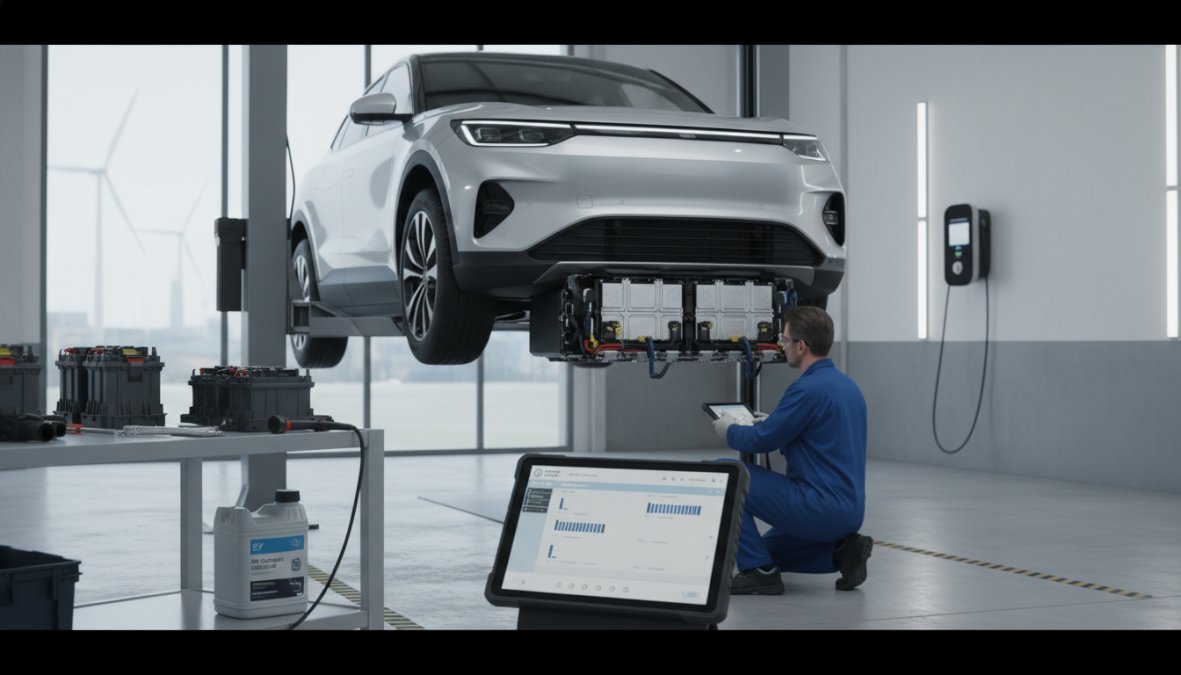
Professional illustration showing how to maintain electric vehicle battery health
EV batteries lose capacity through two processes: cycle aging, which occurs every time you charge and discharge, and calendar aging, driven by time, temperature, and the State of Charge at which the battery sits. Understanding both is the foundation of everything else in this guide.
Replacement costs remain substantial. Protecting capacity retention from the start is far more cost-effective than managing premature degradation later. For EV owners in Kettering and across Northamptonshire, cold winters and variable temperatures mean thermal stress is a real, everyday factor.
Key TakeawayBattery degradation begins immediately after purchase and is shaped by charging habits, temperature exposure, and how long the battery sits at high or low State of Charge. Addressing these early delivers the greatest long-term benefit.
EV Battery Degradation Factors You Need to Understand
Most guides treat degradation as a single phenomenon. The reality is more nuanced, and understanding the distinction changes how you approach every charging decision.
Calendar Aging vs. Cycle Aging: What Is the Difference?
Calendar aging is the chemical degradation that occurs in a lithium-ion battery through the passage of time, independent of use. Heat and high State of Charge accelerate it significantly.
Cycle aging is the degradation caused by repeated charge and discharge cycles, gradually reducing kilowatt-hour capacity through physical and chemical stress on electrode materials.
The practical implication: a vehicle sitting at 100% charge in a hot garage suffers more calendar aging than one driven regularly at moderate charge levels. Many owners assume avoiding heavy use protects the battery, sitting unused at a high SOC is often worse than moderate daily driving.
For Tesla owners, this distinction matters because the onboard Battery Management System logs both cycle count and calendar time. An independent battery health check from a specialist like KMC Electric can read these parameters directly.
How Voltage Stress and Deep Discharge Shorten Battery Life
Voltage stress is the chemical pressure placed on cells when held at the upper or lower limits of their voltage range. Charging to 100% and leaving the vehicle there creates sustained high-voltage stress on the cathode. Allowing the battery to drop near zero creates deep discharge stress on the anode.
Both extremes accelerate capacity loss through lithium plating, electrolyte oxidation, and mechanical stress from electrode expansion and contraction. The fix is straightforward: keep your daily charge between 20% and 80%, and only charge to 100% when you genuinely need full range for a specific journey.
The 20-80% Rule: Managing State of Charge for Longevity
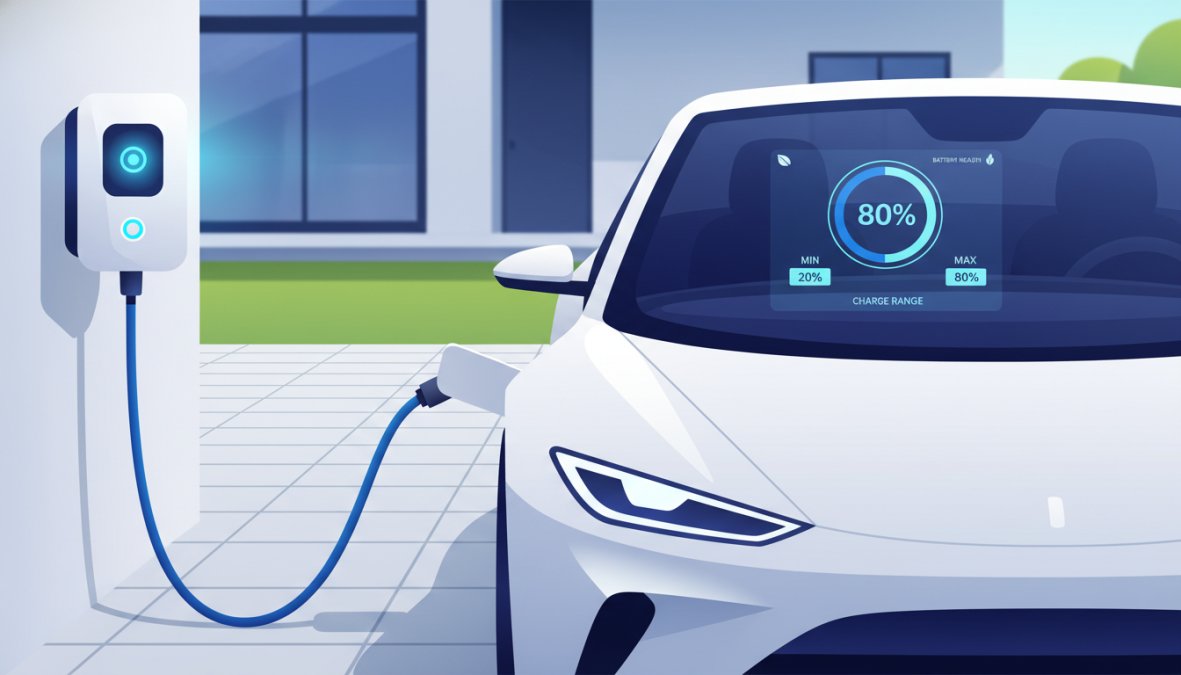
The 20-80% rule is the single most impactful habit for maintaining electric vehicle battery health. Keeping the State of Charge between 20% and 80% minimises voltage stress on both electrodes and significantly slows both calendar and cycle aging.
Most modern EVs let you set a charge limit in the vehicle's settings or companion app. Set your daily limit to 80% and leave it there, overriding only for long-distance journeys. The lower bound matters equally, plug in around 20% to avoid deep discharge stress.
The charging speed you use at home has a direct bearing on battery longevity. Here is how the options compare:
Charging Type
Power Level
Typical Rate
Battery Impact
Best For
Level 1 (3-pin plug)
2.3 kW
8-12 miles/hour
Very low stress
Occasional top-ups
Level 2 (home wallbox)
7-22 kW
25-60 miles/hour
Low stress
Daily charging
DC Fast Charging
50-350 kW
Up to 200 miles/30 min
Higher stress
Long journeys only
Level 2 charging via a home wallbox is the optimal daily solution for most EV owners in Kettering and the wider Northamptonshire area. It charges at a genuinely useful speed without the thermal and chemical stress of DC fast charging.
Pro TipSet your wallbox schedule to begin charging in the early hours of the morning. This takes advantage of lower overnight electricity tariffs and means the battery finishes charging shortly before you leave, which is better for longevity than sitting at 80% for several hours.
The Impact of Fast Charging on EV Battery Degradation
The impact of fast charging on EV battery health is real, though often overstated. DC fast charging pushes high current through the battery quickly, generating heat, accelerating lithium plating at low temperatures, and increasing electrolyte decomposition. Over hundreds of sessions, the cumulative effect on capacity retention is measurable.
That said, occasional fast charging does not ruin a battery, the degradation impact is dose-dependent. The vehicles most affected are those where fast charging replaces home charging entirely. According to research published by the Idaho National Laboratory on EV battery degradation from fast charging, vehicles relying heavily on DC fast charging show accelerated capacity loss compared to those primarily charged at Level 1 or Level 2.
Use Level 2 home or destination charging for the vast majority of your charging, and reserve DC fast charging for motorway journeys where time genuinely matters. A common mistake is assuming that because a vehicle accepts fast charging, it handles it indefinitely without consequence.
How to Maintain Electric Vehicle Battery Health in Extreme Temperatures
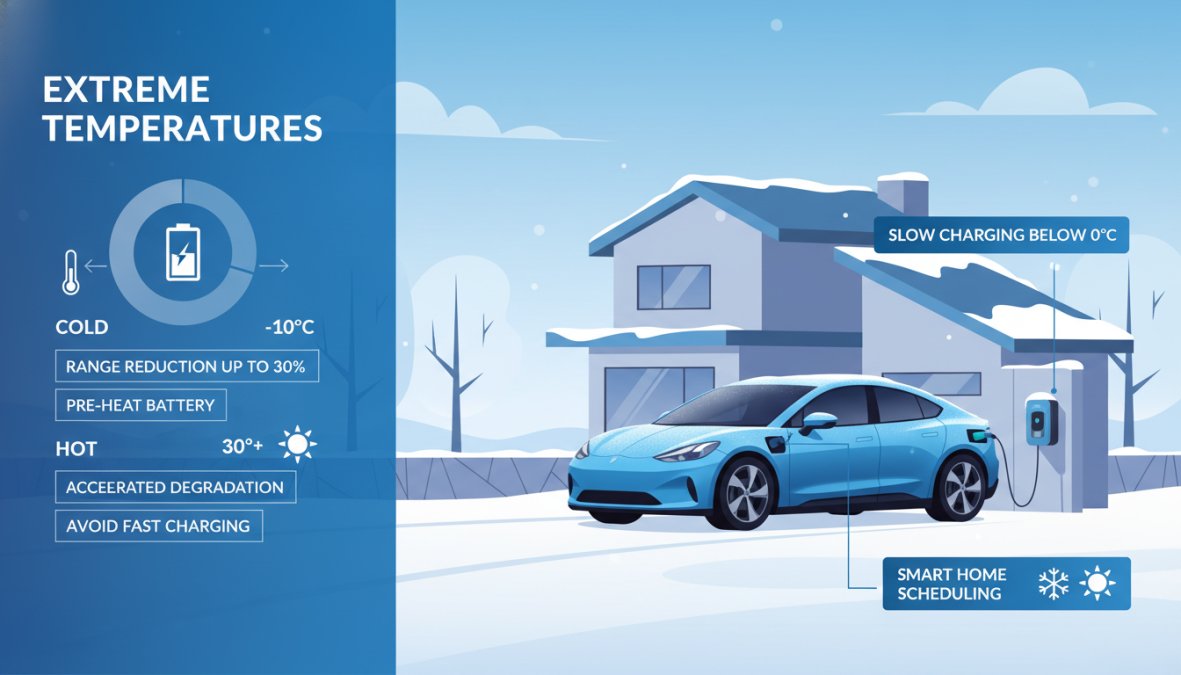
Temperature is the most aggressive external factor affecting EV battery health. Cold reduces the battery's ability to accept and deliver charge efficiently, usable capacity drops temporarily. Heat causes permanent damage, accelerating chemical reactions that degrade electrode materials and break down electrolyte over time.
An electric vehicle parked outdoors in a snowy winter setting in the UK, frost covering the ground and windscreen, the car plugged into a home charge point mounted on the side of a brick house, overcast winter sky in the background
Parking in shade or a garage during summer, and in a covered space during winter, is the simplest passive protection available. For EV owners near Kettering, where winter temperatures regularly drop near freezing, cold-weather strategies deserve specific attention.
Thermal Management Systems and Pre-Conditioning
A thermal management system (TMS) regulates battery temperature during charging, discharging, and storage, typically maintaining the pack between 15°C and 35°C using liquid cooling.
Pre-conditioning brings the battery to its optimal operating temperature before driving or fast charging, using grid power rather than battery energy. Before a winter journey, activate pre-conditioning from the app while the vehicle is still plugged in, you start with full usable capacity and reduce thermal stress on a cold battery. Most Tesla models support scheduled pre-conditioning natively through the app.
Winter-Specific Maintenance Protocols for EV Owners
Winter in Northamptonshire creates specific challenges. Here is a practical protocol for cold-weather operation:
Keep the vehicle plugged in overnight, even if already at your target charge level. This allows the TMS to maintain battery temperature without drawing down the pack.
Use pre-conditioning before every journey below 5°C. This takes 15-30 minutes and makes a measurable difference to both range and battery stress.
Avoid DC fast charging when the battery is cold and has not been pre-conditioned.
Increase your lower SOC threshold to 30% during winter months to buffer against reduced cold-weather capacity.
Regenerative braking is less effective in very cold conditions, the BMS often limits regen to protect a cold battery, so increase your following distance accordingly.
Watch OutCharging a cold battery at high speed without pre-conditioning can cause lithium plating, a form of permanent damage that reduces capacity and, in severe cases, creates safety risks. Always pre-condition before fast charging in temperatures below 5°C.
Battery Management System Updates and Regenerative Braking
Two areas most EV maintenance guides overlook are BMS software updates and regenerative braking, both have a direct and measurable impact on battery health.
The Battery Management System (BMS) monitors cell voltages, temperatures, and State of Charge in real time, controlling charging, limiting power delivery, and balancing charge across cells to prevent voltage stress.
Manufacturers regularly release BMS updates that refine charging algorithms, improve thermal management, and correct issues that could accelerate degradation. Skipping these means your vehicle operates with a less optimised charging strategy. For Tesla owners, over-the-air updates handle this automatically via Wi-Fi. For other brands, updates may require a specialist visit.
According to guidance from the Society of Automotive Engineers on EV battery management systems, software-level optimisations in battery management have become a primary tool for manufacturers to extend battery longevity post-sale. An independent specialist with Level 4 Master Technician status, such as KMC Electric in Kettering, can verify whether your BMS is running current software and flag diagnostic codes indicating cell imbalance before they become expensive problems.
Using Regenerative Braking to Reduce Chemical Stress
Regenerative braking recovers kinetic energy during deceleration and returns it to the battery as electricity. By recovering energy that would otherwise be lost as heat, it reduces the number of charge cycles needed to maintain a given range, meaning less cycle aging over the vehicle's lifetime.
Use the highest regenerative braking setting your vehicle offers for normal driving. One-pedal driving, available on most modern EVs, maximises this recovery and also reduces wear on brake discs and pads, a meaningful secondary saving on maintenance costs.
How to Store an EV for a Long Time Without Damaging the Battery
Storing an electric vehicle for several weeks or months requires a specific approach. The core principle: store the battery at a moderate State of Charge, in a moderate temperature, and avoid leaving it fully charged or fully depleted.
Follow this checklist before long-term storage:
Set the battery charge to between 50% and 60% before storage. This minimises both high-voltage stress and deep discharge risk.
Park in a covered, temperature-stable environment. A garage is ideal.
Disable any scheduled charging or climate control functions that would cycle the battery unnecessarily.
If storing for more than 4 weeks, check the SOC monthly and recharge to 50% if it has dropped below 20%.
Disconnect any third-party devices drawing phantom power from the 12V system.
On return from storage, allow the vehicle to warm up to ambient temperature before driving hard or fast charging.
The damage from poor storage practice is cumulative and often invisible until a battery health check reveals unexpected capacity loss, particularly relevant for owners who travel frequently or have a second vehicle.
EV Battery Warranty, Replacement Cost, and Independent Health Checks
EV battery warranty coverage in the UK typically spans 8 years or 100,000 miles, with a guaranteed minimum capacity retention threshold of commonly 70%. The critical detail most owners miss: warranty claims require proof that degradation is not the result of misuse. Charging habits, temperature exposure history, and BMS data are all logged.
An independent battery health check before your warranty expires gives you documented evidence of your battery's condition and can identify underperforming cells or modules, potentially triggering a warranty claim before coverage lapses. Replacement costs outside warranty remain significant, though the market for remanufactured packs has grown. The most cost-effective strategy remains protecting capacity retention from the start.
For EV owners searching for an independent EV specialist near me in Kettering or across Northamptonshire, an independent check from a qualified technician provides something a manufacturer service centre cannot: an unbiased assessment with no commercial interest in the outcome. KMC Electric offers independent battery health verification for both private owners and dealerships, backed by over 25 years of automotive experience and Level 4 Master Technician status in electric vehicles since 2016.
Read your warranty exclusions carefully, maintain charging habits within recommended parameters, and get an independent health check at the 6-7 year mark, that window is your best opportunity to identify a valid warranty claim before the clock runs out.
Protecting your EV battery requires consistent habits and, at key points, professional verification that your pack is performing as it should. KMC Electric, based in Kettering, provides independent battery health checks, specialist Tesla diagnostics across all models, and practical maintenance support for out-of-warranty vehicles. With Level 4 Master Technician qualifications in electric vehicles and EV expertise dating back to 2016, the team can identify degradation issues, verify BMS software status, and give you a clear, unbiased assessment of your battery's condition. Get started with KMC Electric and protect the long-term value of your electric vehicle with confidence.
Frequently Asked Questions
What is the best state of charge for EV battery longevity?
For most EVs, keeping the State of Charge (SOC) between 20% and 80% is widely recommended to reduce voltage stress and slow battery degradation. Regularly charging to 100% or allowing deep discharge below 10-15% increases chemical stress on the cells over time. For daily use, setting your charge limit to 80% via the vehicle's app or onboard settings is one of the most effective ways to maintain electric vehicle battery health long-term.
Does fast charging damage EV batteries?
Occasional DC fast charging is unlikely to cause significant harm, but frequent reliance on it can accelerate battery degradation over time. Fast charging pushes high current into the cells rapidly, generating heat and increasing chemical stress. For everyday charging needs, Level 2 home charging is gentler on the battery and supports better capacity retention. Reserve DC fast charging for longer journeys where it is genuinely needed rather than using it as your primary charging method.
How does extreme weather affect EV battery health?
Both heat and cold negatively affect EV battery performance and longevity. High temperatures accelerate calendar aging and can cause permanent capacity loss if the battery is left in direct sunlight without active thermal management. Cold weather temporarily reduces available kWh and range but can also cause lasting damage if the battery is charged rapidly when very cold. Using your vehicle's pre-conditioning feature while still plugged into grid power helps protect the battery in both extreme heat and winter conditions.
How long do EV batteries actually last?
Most modern EV batteries are engineered to retain a significant portion of their original kWh capacity over many years of use, and manufacturer warranty coverage typically guarantees a minimum capacity retention threshold, often around 70%, for eight years or more. Real-world degradation rates vary depending on charging habits, climate, and usage patterns. Vehicles kept in moderate climates with disciplined SOC management and regular BMS software updates tend to show the slowest degradation over time.
Are there specific driving habits that preserve EV battery life?
Yes. Using regenerative braking consistently reduces reliance on friction brakes and returns energy to the battery in smaller, controlled amounts rather than through rapid DC fast charging cycles. Smooth acceleration and avoiding sustained high-speed motorway driving also reduce the rate of discharge stress on cells. Keeping the vehicle plugged in when parked for extended periods, rather than leaving it at a low state of charge, further supports long-term battery health, particularly in cold or hot climates.
How should I store an EV for a long time to protect the battery?
When storing an EV for weeks or months, aim to leave the battery at around 50% State of Charge, not fully charged and not depleted. Store the vehicle in a cool, dry environment away from direct sunlight and freezing temperatures where possible. If the car will be stationary for a long period, check the SOC periodically and top up if it drops below 20%. Leaving an EV in deep discharge for extended periods is one of the most damaging things for long-term capacity retention.