Knowing how to find reliable EV mechanics near me is one of the most practical challenges facing electric vehicle owners in 2026, and it is one that KMC Electric hears about constantly from drivers across Kettering and the wider East Midlands. The electric vehicle market has grown rapidly, but the pool of genuinely qualified technicians has not kept pace. Most guides on this topic stop at "check Google reviews", below, we cover the full process: how to verify credentials, what questions to ask, where to look, and how to avoid handing your high-voltage vehicle to someone who is not equipped to handle it.
Here is what most guides get wrong: finding an EV mechanic is not the same as finding a good general mechanic who "also does EVs." The distinction matters enormously, and the consequences of getting it wrong range from voided warranties to genuine safety risks.
Why EVs Need Specialised Mechanics (And Why It Matters)
Electric vehicles are fundamentally different machines from internal combustion engine cars. An EV mechanic is a technician trained specifically to work on high-voltage battery systems, electric drivetrains, inverters, and the software architectures that govern them. A standard automotive qualification does not cover any of this.
High-Voltage Systems Require Specialist Training
The high-voltage battery in a modern EV operates at voltages typically between 400V and 800V. Working on these systems without specialist training and the correct insulated tools is not merely inadvisable, it is dangerous. EV-specific training covers isolation procedures, live system protocols, and the handling of battery modules in ways that general mechanics simply do not encounter. Regenerative braking systems, charging port diagnostics, and electric motor servicing all require a working understanding of electronics that goes well beyond conventional automotive repair.
According to the Institute of the Motor Industry's EV technician framework, there are defined competency levels for working on electrified vehicles, ranging from basic awareness through to full high-voltage system repair. A technician without the appropriate level should not be touching your drivetrain or battery pack.
The Risks of Using an Unqualified Technician
The practical risks are worth naming directly. An unqualified technician may:
Misdiagnose battery health issues, leading to unnecessary replacement costs
Incorrectly handle high-voltage components, creating a safety hazard
Void your remaining manufacturer warranty by using non-approved repair procedures
Miss software-related faults that require EV diagnostics tools to identify
Damage the electric drivetrain through incorrect torque procedures or OEM parts substitution with unsuitable aftermarket alternatives
This is not scaremongering. It is the reality of a technology transition that has outpaced the availability of qualified professionals.
Watch OutUsing a general mechanic for high-voltage EV work can void your manufacturer warranty and, in some cases, invalidate your insurance. Always confirm that any technician holds the relevant EV-specific qualification before authorising work on battery or drivetrain systems.
How to Find Reliable EV Mechanics Near Me: Step-by-Step
The search for a trustworthy EV specialist does not need to be complicated, but it does require more than a quick Google search. A structured approach saves time and protects your vehicle.
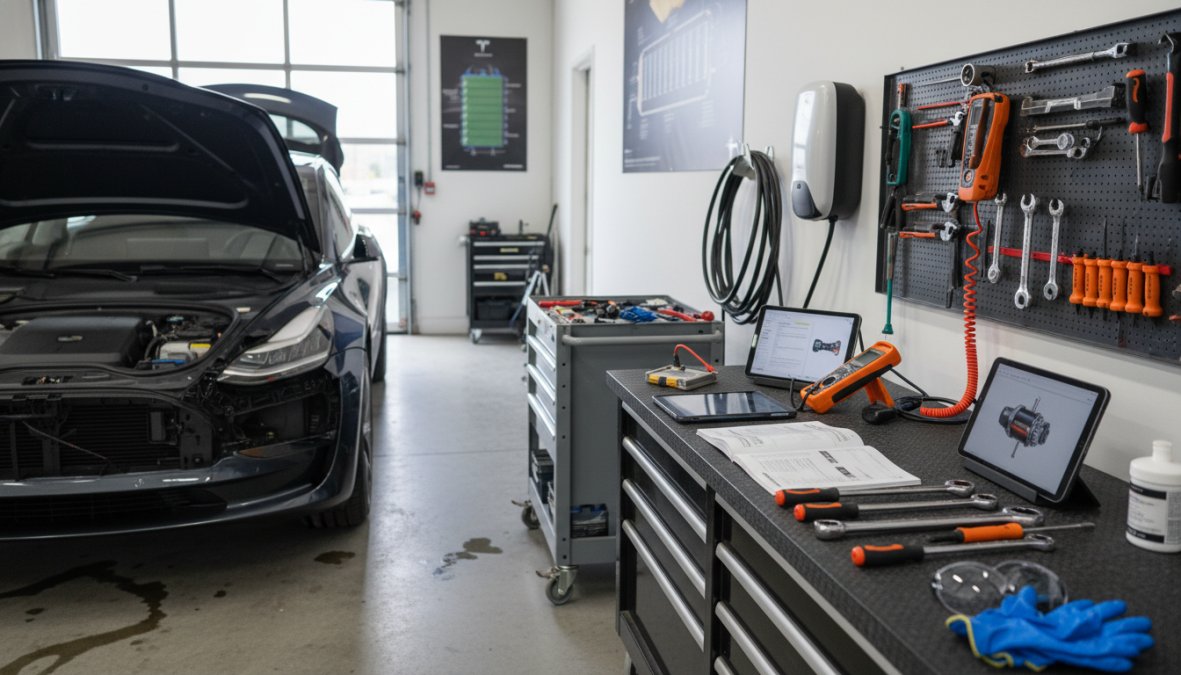
Step-by-step visual guide for Tesla for how to find reliable EV mechanics near me
Step 1: Use Certification Directories and Online Searches
Start with official sources. The Institute of the Motor Industry (IMI) maintains a public register of EV-qualified technicians in the UK, searchable by postcode. This is the most reliable starting point because it filters for verified credentials rather than self-reported claims. When searching for how to find reliable EV mechanics near me, cross-referencing an IMI directory result with a Google Business profile gives you both the credential and the local presence.
Search terms worth trying alongside the directory lookup:
"EV specialist [your town]"
"Tesla independent garage [your region]"
"Level 4 EV technician near me"
"electric vehicle repair Northamptonshire"
Step 2: Check Reviews and Local EV Owner Communities
Online reviews are useful, but they need to be read critically. Look for reviews that mention specific EV work: battery diagnostics, charging port repairs, software updates, or regenerative braking issues. Generic five-star reviews that say "great service, car came back clean" tell you nothing about technical competence.
Local EV owner communities are often more informative. Forums, Facebook groups for Tesla owners, and regional EV networks frequently share first-hand recommendations for independent specialists. Drivers in the Northamptonshire area, for example, regularly discuss local options in regional EV owner groups.
Step 3: Dealer vs. Independent EV Repair Shops
This is a genuine fork in the road, and the right answer depends on your situation.
Factor
Main Dealer
Independent EV Specialist
In-warranty vehicles
Preferred
Check warranty terms first
Out-of-warranty vehicles
Often expensive
Usually more cost-effective
Software updates
Full OEM access
Varies by specialist
Battery diagnostics
Standardised
Specialist tools required
Turnaround time
Can be slow
Often faster
Personalised service
Variable
Typically higher
For out-of-warranty vehicles, an independent EV specialist with the right qualifications is frequently the better choice on both cost and service quality grounds.
How to Verify Mechanic Certifications for Electric Vehicles
Verifying credentials before you book is a non-negotiable step. This is where most EV owners skip ahead too quickly, trusting a website claim without checking the underlying qualification.
ASE Certification and Level 4 Master Technician Status
In the UK context, the most relevant benchmark is the IMI Level 4 Award in Electric/Hybrid Vehicle System Repair and Replacement. This is the highest level of EV qualification available through the IMI framework and covers full high-voltage system repair. A technician holding this qualification has demonstrated competence in battery system work, electric drivetrain servicing, and high-voltage safety protocols.
KMC Electric holds Level 4 Master Technician status in electric vehicles, a qualification achieved in 2016, well ahead of the mainstream EV adoption curve. Combined with over 25 years of automotive industry experience, this represents a depth of EV knowledge that is genuinely uncommon in independent garages.
For reference, the US equivalent is the ASE L3 certification for hybrid and electric vehicle specialist technicians, which covers similar ground under a different framework. If you are researching how to find reliable EV mechanics near me and come across ASE references, these apply primarily to technicians trained in the United States.
What EV-Specific Training Actually Looks Like
Genuine EV-specific training is not a one-day course. It covers high-voltage safety procedures, battery cell chemistry and degradation, thermal management systems, inverter operation, regenerative braking calibration, and EV diagnostics software. A technician who completed a half-day "EV awareness" module is not the same as one who holds a Level 4 qualification.
Ask directly: "What is your highest EV qualification, and when did you achieve it?" A confident, specific answer is a good sign. Vague references to "training" without a named qualification are a warning flag.
Pro TipAsk to see the physical certificate or IMI registration number. Any genuinely qualified technician will have this readily available. You can then verify it directly against the IMI public register at no cost.
Questions to Ask an EV Mechanic Before You Book
Asking the right questions before booking is the single most effective vetting tool available to EV owners, and the one most guides skip entirely. The questions below are designed not just to prompt a response, but to give you a clear basis for evaluating what you hear. For each question, we have included what a confident, qualified answer looks like and what a vague or evasive answer signals.
This checklist works because genuinely qualified EV technicians answer these questions readily and specifically. Technicians who are not qualified, or who have only basic EV awareness training, tend to give hedged, general, or deflecting responses. The contrast is usually obvious.
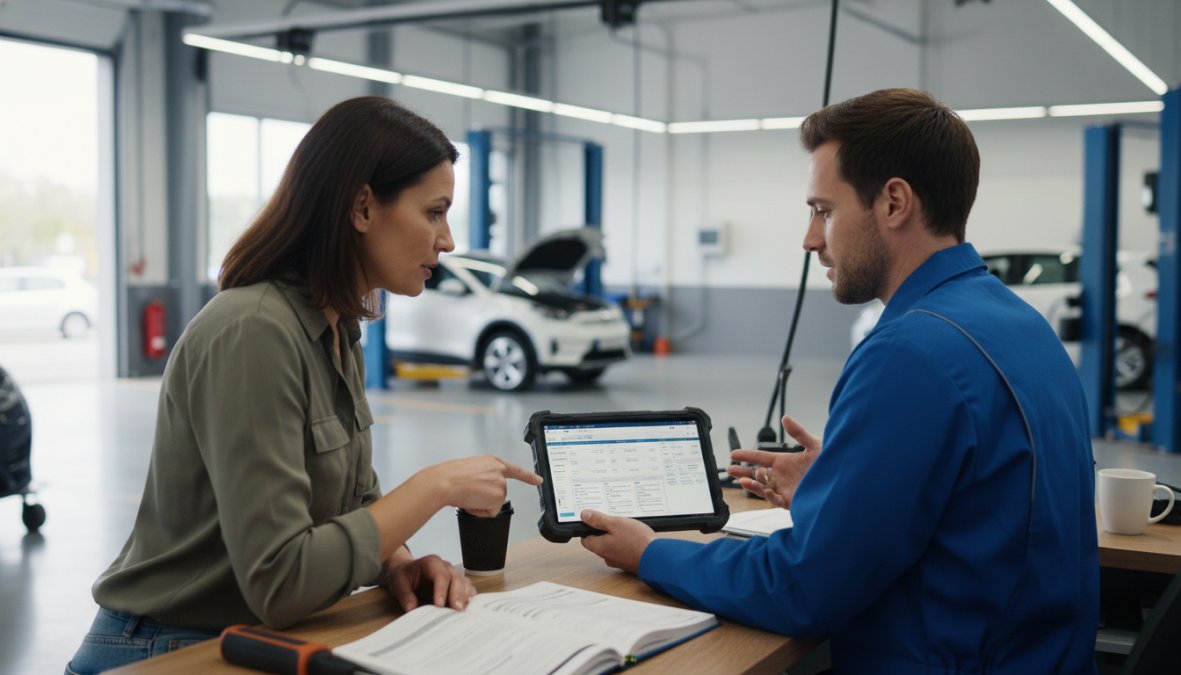
Professional illustration showing how to find reliable EV mechanics near me
The 10-Question EV Mechanic Vetting Checklist
1. What is your highest EV qualification, and who issued it?
What a good answer looks like: A specific qualification name, issuing body, and year. In the UK, this should reference the IMI framework, for example, "IMI Level 3 Award in Electric/Hybrid Vehicle System Repair" or "IMI Level 4 Award in Electric/Hybrid Vehicle System Repair and Replacement." The technician should be able to provide their IMI registration number for independent verification.
What a weak answer looks like: "We've done EV training," "we're up to date on EVs," or references to a manufacturer's one-day awareness course. These are not equivalent qualifications.
2. Can I verify your qualification against the IMI public register?
What a good answer looks like: Yes, without hesitation, followed by their IMI registration number. The IMI TechSafe public register allows anyone to verify a technician's EV qualification level by registration number at no cost.
What a weak answer looks like: Uncertainty about whether they are registered, or a suggestion that you take their word for it. A qualified technician will be registered and will know their number.
3. Have you worked on my specific vehicle make and model before?
What a good answer looks like: Specific experience with your vehicle, including the model year if relevant. Different EV platforms have meaningfully different architectures, a technician experienced with older Nissan Leaf battery systems may not have the same familiarity with a current Tesla Model Y or a BYD Atto 3. General EV experience is a baseline; model-specific experience is the target.
What a weak answer looks like: "We work on all EVs" without any specific examples, or experience limited to hybrid vehicles rather than full battery electric vehicles.
4. What EV diagnostics tools do you use?
What a good answer looks like: Named tools. Professional EV diagnostics require specialist equipment beyond a standard OBD reader. Depending on the vehicle, this might include manufacturer-specific diagnostic software, battery cell-level analysis tools, or high-voltage insulation testers. A technician should be able to name the tools they use for your vehicle type.
What a weak answer looks like: "We have diagnostic equipment" or "the latest tools" without specifics. Any garage has an OBD reader. EV-specific diagnostics are a different category of equipment.
5. How do you handle high-voltage isolation before beginning work?
What a good answer looks like: A clear description of the isolation procedure, disconnecting the service plug or manual service disconnect, verifying zero voltage with a calibrated meter, applying lockout/tagout controls, and waiting the manufacturer-specified discharge period before working near high-voltage components. The technician should reference insulated PPE and the use of Category III or Category IV rated insulated tools.
What a weak answer looks like: A vague reference to "following safety procedures" or "being careful around the battery." This is the most revealing question on the list. A technician who cannot describe their isolation process in specific terms has not been trained to carry it out correctly.
Watch OutHigh-voltage isolation is not optional or variable. If a technician cannot describe a specific, step-by-step isolation procedure, do not authorise any work on your vehicle's high-voltage system. This is a non-negotiable safety requirement, not a preference.
6. Will any of this work affect my manufacturer warranty?
What a good answer looks like: A clear explanation of how they ensure warranty compliance, qualified technician, approved or OEM-equivalent parts, full written service record. A good independent specialist will be familiar with the warranty implications of their work and will document accordingly.
What a weak answer looks like: "It shouldn't" without explanation, or a suggestion that warranty is only the dealer's concern. Any technician doing warranty-adjacent work should understand the documentation requirements.
7. Do you use OEM parts or approved aftermarket equivalents, and can you provide documentation?
What a good answer looks like: A clear policy on parts sourcing, with the ability to provide part numbers and receipts. For high-voltage components, OEM or OEM-specification parts are strongly preferable. For consumables and non-safety-critical items, approved aftermarket equivalents are generally acceptable provided they meet the manufacturer's specification.
What a weak answer looks like: "We use quality parts" without specifics, or an inability to provide documentation. Parts documentation is essential for both warranty protection and insurance purposes.
8. Can you provide an independent battery health report?
What a good answer looks like: Yes, with an explanation of what the report covers, cell-level capacity, balance between cells, thermal performance, and state of health as a percentage of original capacity. A professional battery health report goes significantly beyond the vehicle's built-in battery indicator.
What a weak answer looks like: Offering to "check the battery" using the vehicle's own display, or uncertainty about what a cell-level diagnostic involves. The vehicle's dashboard reading is not an independent assessment.
9. How do you stay current with EV technology developments?
What a good answer looks like: References to ongoing training, manufacturer technical bulletins, IMI continuing professional development, or membership of professional bodies. EV technology is evolving rapidly, a technician who completed their qualification several years ago and has done nothing since is less current than one who actively follows technical updates.
What a weak answer looks like: "We keep up with things" or reliance solely on their original qualification with no mention of ongoing development.
10. Can you provide references or examples of similar EV work you have completed?
What a good answer looks like: Willingness to share verifiable examples, customer reviews that specifically mention EV work, case studies, or direct references. This is particularly relevant for complex work such as battery diagnostics, drivetrain repairs, or charging system faults.
What a weak answer looks like: Redirection to generic reviews, or reluctance to provide EV-specific examples. A garage with genuine EV experience will have customers willing to speak to it.
Key TakeawayYou do not need to ask all ten questions every time. Questions 1, 5, and 8 are the highest-signal filters. A technician who answers all three specifically and confidently is almost certainly qualified. A technician who hedges on any of them warrants further scrutiny before you authorise work.
How to Use This Checklist in Practice
The most effective approach is to ask two or three of these questions by phone or email before you visit. The quality of the response, not just the content, but the confidence and specificity, tells you a great deal about the garage's genuine EV capability. A qualified specialist will welcome these questions. A generalist claiming EV experience will often become vague or defensive.
For complex or high-value work, battery diagnostics, drivetrain repairs, charging system faults, it is reasonable to ask for a written summary of the proposed approach before authorising the work. Any competent EV specialist will be able to provide this.
Electric Vehicle Maintenance Checklist: What Your EV Actually Needs
A common misconception is that EVs need almost no maintenance. The reality is more nuanced: EVs have fewer moving parts than petrol or diesel vehicles, but they have specific service requirements that are easy to overlook.
Battery Health, Diagnostics, and Software Updates
Battery health is the central maintenance concern for any electric vehicle. High-voltage battery degradation is gradual and not always visible through the vehicle's built-in display. An independent battery health assessment using professional EV diagnostics tools gives you a cell-level picture of capacity, balance, and thermal performance.
Software updates are equally important and often underestimated. Modern EVs are software-defined vehicles, updates can affect charging behaviour, regenerative braking calibration, range estimates, and even drivetrain efficiency. Missing critical updates can introduce performance issues that look like hardware faults.
Battery coolant flush intervals vary by manufacturer, but many EVs require this service every four to five years. Neglecting it risks thermal management issues that accelerate cell degradation.
Regenerative Braking, Tyres, and Cabin Air Filter
Regenerative braking reduces wear on conventional brake components, but it does not eliminate it. Brake fluid still absorbs moisture over time and should be tested annually. Brake callipers can seize on EVs precisely because they are used so infrequently, a counterintuitive but well-documented issue.
Tyre rotation is more important for EVs than for equivalent petrol vehicles. The instant torque delivery of an electric drivetrain accelerates front tyre wear on front-wheel-drive models. Rotating tyres every 5,000 to 7,500 miles maintains even wear and preserves range.
Cabin air filter replacement is a straightforward service item that many EV owners forget because it is not tied to an oil change reminder. Most manufacturers recommend replacement every 12 to 18 months.
EV maintenance checklist:
Battery health diagnostic (annually or before selling/buying)
Software update check (every service visit)
Battery coolant flush (per manufacturer interval, typically 4-5 years)
Brake fluid test (annually)
Tyre rotation (every 5,000-7,500 miles)
Cabin air filter replacement (every 12-18 months)
Charging port inspection (annually)
Drivetrain oil check where applicable
For Tesla owners, KMC Electric stocks drivetrain-specific components including drive train oil and oil filters for Model 3, supporting proper drivetrain maintenance between service visits.
EV Repair Costs, Warranty Coverage, and Insurance Implications
EV repair costs, warranty rights, and insurance implications are three topics most guides treat separately, or not at all. Understanding how they interact is one of the most practically useful things an EV owner can know before they book any work. This section covers the full picture: what independent servicing actually costs relative to main dealers, what the law says about your warranty rights, and what insurance exposure looks like when unqualified work goes wrong.
EV Repair Costs: Independent Specialist vs. Main Dealer
The cost gap between main dealer and independent EV specialist servicing is most pronounced for out-of-warranty vehicles. For routine maintenance, tyre rotation, brake fluid testing, cabin filter replacement, the difference is modest. For diagnostic work, battery health assessments, and drivetrain servicing, independent specialists with the correct qualifications and tooling routinely offer meaningfully lower labour rates than franchised dealer networks, without any reduction in technical capability.
The area of greatest cost exposure for EV owners is battery-related work. Full battery pack replacement at a main dealer is among the most expensive repair events in the automotive world. However, many battery faults that a dealer would quote as a full pack replacement can be resolved at cell-module level by a specialist with the right diagnostics and repair capability. An independent battery health report, using professional cell-level diagnostics rather than the vehicle's built-in state-of-health display, is the starting point for understanding whether a full replacement is genuinely necessary or whether a more targeted repair is viable.
For buyers of used EVs, commissioning an independent battery health assessment before purchase is one of the highest-value pre-purchase steps available. The vehicle's dashboard reading and the seller's assurances are not substitutes for a cell-level diagnostic from a qualified technician.
Your Warranty Rights: The Magnuson-Moss Principle and UK Equivalents
One of the most persistent myths in EV ownership is that using an independent garage automatically voids your manufacturer warranty. This is not accurate, and understanding why matters.
In the United States, the Magnuson-Moss Warranty Act (15 U.S.C. § 2302) makes it unlawful for a manufacturer to void a warranty solely because the owner used an independent service provider, unless the manufacturer can demonstrate that the independent service caused the defect in question. This is a federal consumer protection, not a loophole.
In the UK, equivalent protections exist under consumer contract law and the Competition and Markets Authority's guidance on warranty terms. A manufacturer cannot lawfully require that all servicing be carried out exclusively by their authorised network as a condition of warranty validity, provided the independent work is carried out to the required standard using appropriate parts and procedures.
The practical requirements for warranty-safe independent servicing are:
Qualified technician, The technician must hold the appropriate EV qualification for the work being carried out (in the UK, the relevant IMI level for the system being worked on).
Approved or equivalent parts, OEM parts or parts that meet OEM specification. Keep all receipts and part numbers.
Documented service record, A detailed written record of all work carried out, including parts used, procedures followed, and technician qualification details.
No modification to covered systems, Work that modifies a system covered by warranty (such as battery management software) can legitimately affect warranty coverage for that system.
If a manufacturer attempts to void your warranty because you used a qualified independent specialist who followed approved procedures and used appropriate parts, this is a position worth challenging. The Competition and Markets Authority guidance on warranties and guarantees sets out the relevant consumer protections in plain terms.
Watch OutThe warranty protection described above applies to servicing and maintenance. It does not protect modifications, non-approved software changes, or work carried out by technicians without the relevant EV qualification. Always confirm your technician's credentials and request a full written service record before and after any work.
Insurance Implications: The Risk Most Owners Don't Know About
Insurance implications of EV servicing choices are almost entirely absent from competitor guides, which makes this one of the most important gaps to understand.
The core risk is this: if an unqualified technician carries out work on a high-voltage system and a subsequent fault, fire, or incident occurs that can be linked to that work, an insurer may have grounds to dispute or reduce a claim. This is not a theoretical position, insurers assess the proximate cause of a loss, and non-approved repairs to safety-critical systems are a documented basis for claim scrutiny.
The Association of British Insurers guidance on EV repairs reflects growing insurer awareness of EV-specific repair standards. As EV claims volumes increase, insurers are developing more detailed assessment criteria for EV-related incidents, including the qualifications of technicians involved in prior repairs.
Practical steps to protect your insurance position:
Keep all service records with technician qualification details clearly noted.
Confirm in writing before any high-voltage work that the technician holds the relevant EV qualification.
Notify your insurer if you are aware of any prior non-standard repair to a high-voltage system when taking out or renewing a policy, non-disclosure of a known material fact is a separate risk.
Check your policy wording for any clause relating to approved repairers or approved repair standards for EV systems.
For vehicles still within manufacturer warranty, the safest approach is to ensure any independent work is carried out by a technician whose qualifications and procedures would satisfy the manufacturer's warranty terms, not because the law requires it, but because it removes any ambiguity in the event of a future claim or warranty dispute.
Key TakeawayThe single most protective step an EV owner can take, for both warranty and insurance purposes, is to request a written record of the technician's EV qualification before authorising any high-voltage work, and to keep that record with the vehicle's service history. This one habit closes the majority of warranty and insurance exposure that independent servicing can create.
DIY vs. Professional EV Service: Where to Draw the Line
The DIY boundary for EVs is much clearer than it is for petrol vehicles. Get this wrong and the consequences are more serious.
Safe for informed owners:
Topping up windscreen washer fluid
Replacing wiper blades
Checking and adjusting tyre pressures
Replacing cabin air filters (on most models)
Basic exterior cleaning and paint protection
Requires a qualified EV technician:
Any work involving the high-voltage battery system
Charging port diagnostics or replacement
Inverter or electric motor work
Brake fluid testing and replacement
Drivetrain oil changes and filter replacement
Software diagnostics beyond the vehicle's built-in interface
Battery coolant system work
The dividing line is the high-voltage system. Anything connected to it, directly or indirectly, requires a qualified technician with the correct insulated tools and isolation procedures. This is not a grey area.
A common mistake among technically confident owners is assuming that EV repair follows the same logic as working on a petrol car. The voltage levels involved are categorically different. A 12V car battery will give you a shock. A 400V traction battery can be fatal.
Finding Reliable EV Mechanics Near Me in Kettering and the East Midlands
For EV owners in Kettering and across Northamptonshire, the challenge of how to find reliable EV mechanics near me has a straightforward answer: KMC Electric operates as an independent specialist garage in Kettering, offering professional diagnosis, repair, and long-term maintenance for Tesla and other electric and hybrid vehicles.
The credentials here are specific and verifiable. Level 4 Master Technician status in electric vehicles, achieved in 2016. Over 25 years of automotive industry experience. Specialist knowledge of Tesla systems across all models, from early Model S vehicles through to current Model 3, Model Y, and Cybertruck variants.
For out-of-warranty Tesla owners in particular, the main dealer network is often the default option by inertia rather than by logic. KMC Electric provides a cost-effective alternative that does not compromise on technical depth. Services include independent battery health verification, useful for both buyers assessing a used EV purchase and sellers wanting to demonstrate battery condition, as well as pre-warranty-expiry fault identification, which gives owners the opportunity to address issues before they fall outside manufacturer coverage.
Drivers across the East Midlands looking for how to find reliable EV mechanics near me without travelling to a main dealer in a larger city will find that Kettering is well-positioned as a service hub for the region. The garage also supports dealerships requiring specialist EV technical input, which reflects the depth of diagnostic capability on offer.
For Tesla-specific parts, the KMC Electric online shop carries components including the Tesla Model 3 and Model Y Hand Brake Motor and bolts for the oil pump, supporting both workshop repairs and informed owner maintenance.
According to the Society of Motor Manufacturers and Traders EV registration data, electric vehicle registrations in the UK continue to grow year on year, which means the demand for qualified independent EV specialists in regional locations like Kettering will only increase. Getting ahead of that demand now, finding a trusted specialist before you need one urgently, is the sensible approach.
Finding a genuinely qualified EV mechanic requires more than a search and a glance at star ratings. The technical stakes are higher than with a conventional vehicle, the credential landscape is still maturing, and the cost of getting it wrong ranges from unnecessary expense to voided warranties and safety risk. KMC Electric in Kettering offers the combination of Level 4 Master Technician status, over 25 years of industry experience, and specialist Tesla knowledge that makes it the clear choice for EV owners across Northamptonshire and the East Midlands. Book a diagnostic or battery health assessment with KMC Electric and get a clear, independent picture of your vehicle's condition from a technician who has been working on electric vehicles since before most dealers had a charging point.
Frequently Asked Questions
Do electric cars require special mechanics?
Yes. Electric vehicles use high-voltage battery systems, electric motors, inverters, and regenerative braking technology that differ fundamentally from combustion engines. Working safely on these systems requires EV-specific training, specialist tools, and knowledge of safety protocols. A standard mechanic without EV qualifications may not only misdiagnose faults but could also risk serious injury when handling high-voltage components. Always look for a certified technician with verified EV qualifications.
How do I know if a mechanic is certified to work on EVs?
When learning how to verify mechanic certifications, ask the shop directly for proof of EV-specific qualifications such as ASE EV certification or equivalent Level 4 Master Technician status. Reputable independent specialists and dealership service centres should be able to show documentation of their technicians' training. You can also check manufacturer-approved networks and industry body directories online. Don't hesitate to ask how long they've been working on electric vehicles and which EV makes and models they regularly service.
What questions should I ask an EV mechanic before booking?
Key questions to ask an EV mechanic include: What EV certifications do your technicians hold? Have you worked on my specific make and model before? Do you use OEM parts or aftermarket alternatives? Can you provide a battery health report? How do you handle warranty coverage implications? What diagnostic tools do you use? These questions help you assess competence, transparency, and whether the shop has the specialist knowledge needed for your electric vehicle's electric drivetrain and battery system.
Are EV repairs more expensive than repairs for petrol or diesel cars?
EV repair costs vary depending on the fault. Routine EV maintenance — such as tyre rotation, cabin air filter replacement, and coolant flush — is often cheaper than equivalent work on combustion vehicles because EVs have fewer moving parts. However, high-voltage battery repairs or electric drivetrain work can be costly. Independent EV specialists typically offer more competitive pricing than main dealership service centres, making them a worthwhile alternative, particularly for out-of-warranty vehicles.
Can I use an independent EV specialist instead of a main dealer without voiding my warranty?
In most cases, yes. Under block exemption regulations in the UK, using an independent specialist for servicing does not automatically void your manufacturer warranty, provided the work is carried out to the required standard and documented correctly. However, always confirm warranty terms with your manufacturer before proceeding. An independent EV specialist with proper certifications and who uses OEM parts or approved equivalents can typically carry out work that maintains your warranty coverage.
What does an electric vehicle maintenance checklist typically include?
A standard electric vehicle maintenance checklist covers: battery health diagnostics, software updates, tyre rotation and pressure checks, regenerative braking system inspection, cabin air filter replacement, coolant flush (for thermal management systems), charging port inspection, and brake fluid checks. Unlike combustion vehicles, EVs don't need oil changes in the traditional sense, but drivetrain oil for certain components — such as Tesla drive units — may require attention. Service intervals vary by make and model, so consult your vehicle manual or a certified technician.