Hybrid vehicle service is one of the fastest-evolving areas in automotive maintenance, and getting it wrong costs more than most owners expect. This guide from KMC Electric covers everything you need to know about maintaining a hybrid vehicle properly, from battery health and regenerative braking to diagnostic tools and seasonal care. Hybrid maintenance is not simply conventional maintenance with a battery check bolted on, the high-voltage battery, inverter, electric motor, and hybrid control module interact as an integrated system, and a fault in one places stress on the others.
How Hybrid Vehicles Work: What Makes Hybrid Vehicle Service Different
A hybrid vehicle combines an internal combustion engine with one or more electric motors, managed by a hybrid control module that decides in real time when to use the engine, motor, or both. This architecture changes almost everything about service. The engine runs fewer hours than in a conventional car of equivalent mileage, affecting oil degradation. The electric motor and inverter generate heat requiring dedicated thermal management. The battery operates within a tightly controlled charge window managed by the battery management system.
The Role of the High-Voltage Battery and Battery Management System
Most hybrid packs operate at between 100V and 650V, requiring specialist handling. The battery management system monitors cell voltage, temperature, and state of charge continuously, balancing cells to prevent degradation. A poorly maintained system allows cell imbalance to develop silently, by the time a fault code appears, capacity loss is often already significant. Routine hybrid vehicle service should include a battery management system data review, not just a visual inspection.
Inverter, Electric Motor, and Hybrid Control Module Explained
The inverter converts DC power from the high-voltage battery into AC power for the electric motor, reversing that process during regenerative braking. The hybrid control module coordinates the engine, motor, inverter, and transmission. Inverter failures are expensive, and heat is the primary cause, which is why cooling system integrity is directly linked to inverter longevity. A hybrid vehicle service that skips the inverter cooling circuit leaves a significant risk unaddressed.
Hybrid Car Maintenance Schedule: Intervals You Need to Know
Treating a hybrid maintenance schedule as equivalent to a conventional one is one of the most common mistakes hybrid owners make. The key intervals to track are:
Engine oil and filter - Many hybrids use low-viscosity oil (0W-16 or 0W-20). Follow manufacturer mileage intervals, but also check annually if the vehicle is used for short trips.
Coolant system inspection - Every 2-3 years. Hybrid vehicles often have a separate cooling circuit for the battery and inverter.
Brake fluid - Every 2 years. Regenerative braking reduces pad wear, but brake fluid still absorbs moisture.
12-volt auxiliary battery - Every 3-5 years. Its failure is a common and preventable breakdown.
Hybrid battery fan and air filter - Annually. Blocked airflow is a leading cause of premature battery degradation.
High-voltage battery health check - Every 2 years or when symptoms appear.
Tyre rotation and inspection - Every 6,000-8,000 miles. Hybrids carry additional battery weight that affects tyre wear.
What Changes Compared to a Conventional Maintenance Schedule
Brake pads last considerably longer on hybrids due to regenerative braking, making brake fluid and caliper condition the primary brake service concerns rather than pad replacement. Engine oil intervals may be extended on some models, but this should not be assumed without checking the manufacturer's guidance.
Fleet management platforms like Fleetio fleet maintenance software can help track hybrid-specific service intervals across multiple vehicles.
Pro TipThe 12-volt auxiliary battery is the most overlooked component in hybrid vehicle service. It does not benefit from regenerative charging and degrades on a conventional timeline. A failing 12-volt battery can prevent the hybrid system from initialising entirely, leaving the vehicle stranded even with a full high-voltage pack.
Hybrid Battery Health Check: What It Involves and Why It Matters
A hybrid battery health check assesses the state of health (SOH) and state of charge (SOC) of the high-voltage battery pack, identifies weak or imbalanced cells, and evaluates the battery management system. It is the single most important element of a comprehensive hybrid vehicle service. A proper check goes beyond reading fault codes, it involves live data capture of individual cell voltages under load, temperature distribution across the pack, and a comparison of current capacity against original specification.
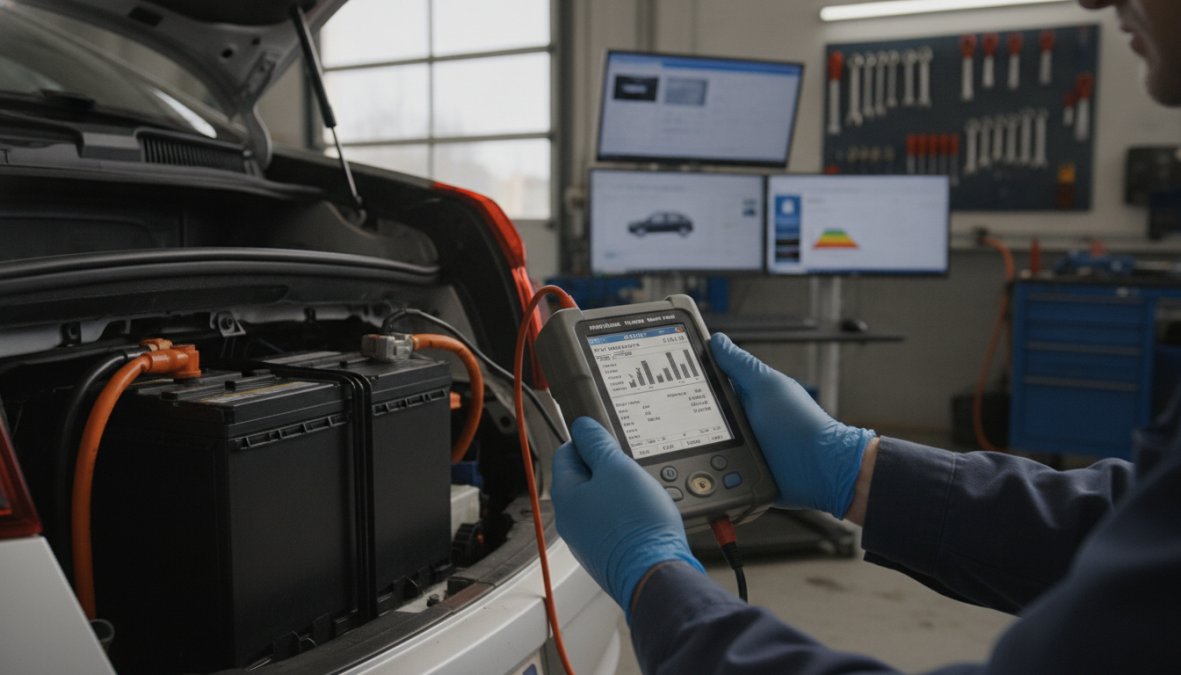
A certified technician in a professional workshop connecting professional diagnostic scan tools to a hybrid vehicle's high-voltage battery system, with equipment displays showing live cell voltage and temperature data visible in the background
Signs Your High-Voltage Battery Needs Attention
Noticeable reduction in fuel economy without a change in driving habits
The hybrid system warning light or check engine light appearing
Reduced electric-only driving range on plug-in hybrid models
The internal combustion engine running more frequently than usual at low speeds
Longer charging times or inconsistent charge acceptance on PHEVs
Battery temperature warnings or the hybrid system entering a reduced-power mode
Many owners attribute reduced fuel efficiency to driving conditions. In practice, a degraded high-voltage battery is frequently the cause, the battery management system compensates for weak cells by restricting the usable charge window, forcing the engine to work harder.
Battery Replacement vs. Reconditioning: What Are Your Options
Battery reconditioning cycles the pack through controlled charge and discharge sequences to rebalance cells and recover lost capacity. Tools like the Nuvant Systems EVc Battery Reconditioner are used by specialist workshops for automated reconditioning with detailed performance reporting. Battery replacement becomes necessary when cell degradation is widespread or physical damage is present. The Bosch High Voltage Battery Repair Kit allows individual module substitution while reusing the original housing and electronics, reducing cost and waste, though it requires a technician with high-voltage Level 3 qualification. Reconditioning is worth attempting first on packs with moderate capacity loss; full replacement is the right call when SOH has dropped below the point where reconditioning delivers meaningful recovery.
Watch OutNever attempt high-voltage battery work without proper insulation equipment and training. Hybrid battery packs operate at voltages that are immediately lethal. This is one area where DIY is genuinely dangerous, not just inadvisable.
Brake System and Cooling System Maintenance in Hybrid Vehicles
Both systems require a different service mindset than their conventional equivalents, and both are easier to neglect because the failure signals are less obvious.
Regenerative Braking: Why Brake Fluid Matters More Than Pad Wear
Regenerative braking handles the majority of low-speed deceleration, so hybrid brake pads can last two to three times longer than on a conventional vehicle. This creates a hidden risk: calipers can seize and brake fluid can absorb moisture over a longer period without obvious symptoms. Brake fluid should be replaced every two years regardless of pad condition. According to SAE International technical standards for vehicle braking systems, moisture contamination lowers brake fluid's boiling point, increasing the risk of vapour lock under hard braking.
Thermal Management and Cooling System Inspections
Hybrid vehicles typically run two or three separate cooling circuits: one for the engine, one for the power electronics, and in some models a dedicated circuit for the high-voltage battery. Each uses different coolant specifications and has its own service interval. Overheating accelerates cell degradation irreversibly; overcooling in cold climates reduces efficiency and triggers power restrictions. A cooling system inspection should cover all circuits, not just the engine radiator, and the battery cooling fan filter should be cleaned or replaced annually.
Hybrid Diagnostic Services: Tools, Technology, and What to Expect
Hybrid diagnostic services require specialist equipment beyond a standard OBD-II reader. A generic scan tool reads engine fault codes but will not access the battery management system, inverter data, or hybrid control module logs. Professional-grade tools like the Launch Tech USA diagnostic scanners provide OE-level coverage including bi-directional component testing. XTOOL EV Diagnostic Tools offer dedicated hybrid and EV software with battery SOH and SOC monitoring and high-voltage system safety management. For Toyota and Lexus owners, the Dr. Prius app paired with an OBDLink MX+ Bluetooth adapter provides useful battery cell visibility between professional services.
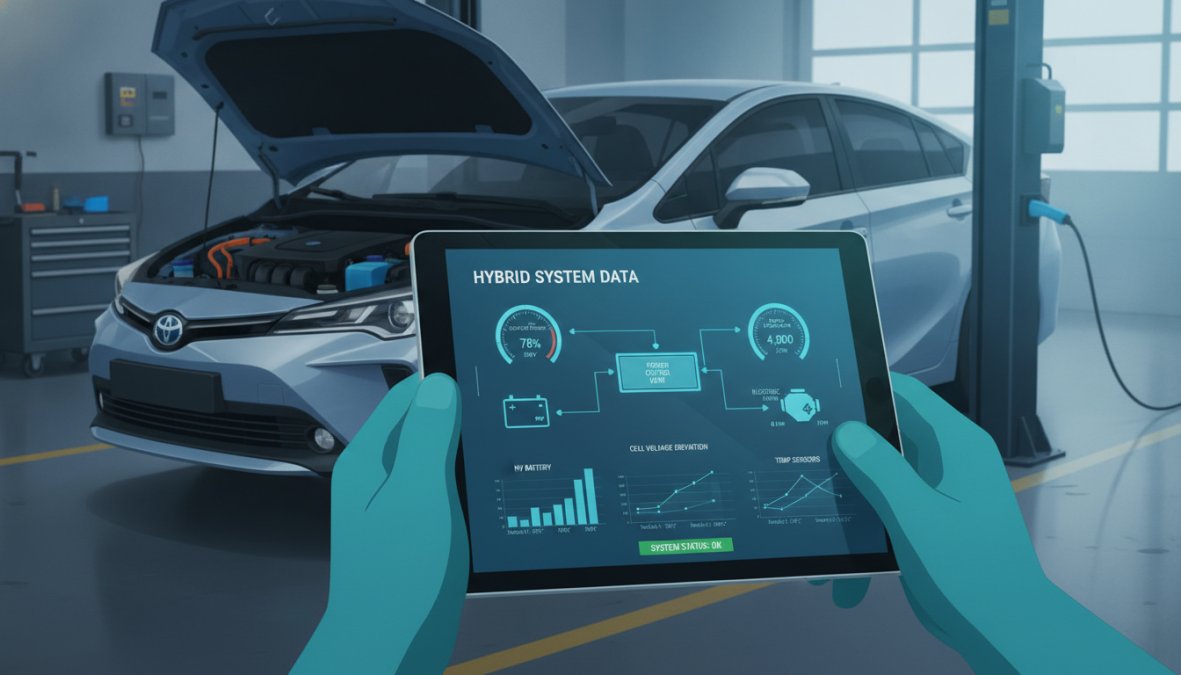
Close-up of a technician's hands holding a professional OBD diagnostic tablet displaying live hybrid system data including cell voltages and temperature readings, with a hybrid vehicle in a clean workshop service bay visible in the background
A professional hybrid diagnostic service should include:
Full system scan across all modules, not just the engine control unit
Live data capture of battery cell voltages under load
Inverter and motor performance log review
Cooling system pressure and temperature checks
Hybrid control module software version verification
12-volt auxiliary battery load test
KMC Electric, based in Kettering, Northamptonshire, performs comprehensive hybrid vehicle service diagnostics using OEM-equivalent software and over 25 years of automotive experience. As an independent specialist with Level 4 Master Technician status in electric vehicles since 2016, the team can access and interpret hybrid system data that many general garages cannot reach.
Cost of Hybrid Car Service: OEM vs. Aftermarket and DIY vs. Professional
The assumption that independent garages are always cheaper than dealers, or that aftermarket parts are always inferior to OEM, does not hold consistently in the hybrid space.
OEM vs. Aftermarket Parts: A Practical Cost-Benefit View
For hybrid-specific components, battery modules, inverters, and hybrid control modules, OEM parts carry a meaningful reliability advantage because the vehicle's management systems are calibrated to their precise characteristics. An unvalidated aftermarket battery module is a significant risk: the battery management system may not interpret cell data correctly, leading to accelerated degradation or protective shutdowns.
DIY vs. Professional Hybrid Service: Safety Risks You Must Understand
DIY is reasonable for conventional mechanical tasks: tyre rotation, cabin air filter replacement, and visual inspections. The case collapses entirely for anything involving the high-voltage system. According to UK Health and Safety Executive guidance on electrical safety, contact with voltages above 50V AC or 120V DC carries a risk of ventricular fibrillation, and most hybrid packs exceed these thresholds significantly. The cost of a professional hybrid battery service is considerably less than the cost of a serious electrical injury.
Key TakeawayThe most cost-effective hybrid vehicle service strategy is to handle conventional mechanical maintenance yourself where competent, use an independent specialist for high-voltage system work, and prioritise OEM or spec-matched parts for any component that interacts with the battery management system.
Seasonal and PHEV-Specific Hybrid Vehicle Service Considerations
Seasonal variation affects hybrid systems more than most owners realise, and plug-in hybrids add a further layer of service complexity that standard hybrid guides rarely address properly.
Cold Weather, Hot Weather, and What They Do to Hybrid Systems
Cold temperatures reduce lithium-ion battery capacity temporarily and increase internal resistance, forcing the hybrid control module to rely more heavily on the engine. In Northamptonshire winters, where temperatures regularly drop below 5°C, owners should expect reduced electric-only range and longer engine warm-up periods, placing additional load on engine oil and the cooling system.
Practical seasonal service actions:
Check the battery cooling fan and filter before summer. Heat causes permanent battery degradation.
Verify coolant concentration before winter. Diluted coolant risks freeze damage to the inverter cooling system.
Test the 12-volt auxiliary battery in autumn. Cold reduces cranking capacity; a battery adequate in summer may fail to initialise the hybrid system in January.
Inspect brake calipers in spring. Winter salt accelerates corrosion on vehicles where mechanical brakes are used infrequently.
Plug-In Hybrid (PHEV) Service: What's Different From a Standard Hybrid
PHEVs carry larger battery packs with deeper charge cycles, making battery health management more critical. The charging system, including the onboard charger and charge port, requires periodic inspection for corrosion, cable wear, and software faults. PHEVs driven primarily on electric power accumulate engine hours slowly, creating a specific risk: engine oil degrades chemically without accumulating mileage. Manufacturers typically specify a time-based oil change interval alongside a mileage interval; ignoring the time interval is a common mistake with real consequences for engine longevity.
The onboard charger is a high-voltage component unique to PHEVs. Faults often produce no visible symptoms until charging fails entirely. A hybrid vehicle service for a PHEV should include a charging system function test and a review of stored charging-related fault codes, even if the vehicle appears to be charging normally.
As noted in UK government guidance on ultra-low emission vehicles and their maintenance, PHEV owners in areas like Kettering and across the East Midlands benefit from understanding both electric and combustion service requirements to maintain fuel economy and emissions compliance. Owners should seek a technician with verified high-voltage qualifications and access to OEM-equivalent diagnostic software.
Hybrid vehicles are more reliable than their reputation suggests, but only when serviced by someone who understands the full system. The most common failures in ageing hybrids trace back to missed battery cooling maintenance, ignored 12-volt battery degradation, and brake systems that were visually checked rather than properly tested. KMC Electric provides professional hybrid vehicle service from Kettering, Northamptonshire, with over 25 years of automotive experience and Level 4 Master Technician status in electric vehicles. The team offers independent battery health verification, cost-effective alternatives to main dealer pricing, and the diagnostic capability to identify faults before they become failures. Submit your vehicle details to KMC Electric and get a transparent assessment of exactly what your hybrid needs.
Frequently Asked Questions
Do hybrid cars require special maintenance compared to petrol or diesel cars?
Yes, hybrid vehicle service requires specialist knowledge beyond standard servicing. While routine items like engine oil, filters, and tyres are similar, hybrids also need checks on the high-voltage battery, battery management system, inverter, hybrid control module, and regenerative braking system. These components require certified technicians with specialist diagnostic tools and high-voltage safety qualifications. Attempting hybrid-specific work without proper training carries serious safety risks.
How often should a hybrid vehicle be serviced?
A hybrid car maintenance schedule typically follows similar mileage intervals to conventional vehicles, often every 10,000 to 12,000 miles or annually, whichever comes first. However, hybrid-specific checks such as high-voltage battery health, the hybrid battery fan, cooling system, and brake fluid condition should be inspected at each service. Some manufacturers also recommend a dedicated hybrid system check at set intervals. Always consult your vehicle handbook and a qualified hybrid specialist for model-specific guidance.
Is hybrid car service more expensive than servicing a petrol car?
The cost of hybrid car service can be comparable to or slightly higher than conventional servicing, depending on what's included. Routine items may cost similarly, but hybrid-specific diagnostics, specialist labour rates, and high-voltage battery work can add to the bill. Choosing an independent specialist over a main dealer can reduce costs significantly without compromising quality. OEM parts offer reliability, while reputable aftermarket alternatives can lower costs further for non-critical components.
Can any mechanic service a hybrid vehicle?
Not safely. Hybrid vehicles contain high-voltage systems, often 200 to 650 volts, that require technicians to hold specific high-voltage safety qualifications. Standard mechanics are not trained to work on these systems, and doing so without proper certification is dangerous. Always use a certified technician with recognised hybrid or EV qualifications. In the UK, look for technicians holding IMI or equivalent Level 3 or Level 4 high-voltage accreditation.
Do hybrid batteries need regular maintenance?
Hybrid batteries generally require less active maintenance than you might expect, but regular hybrid battery health checks are still important. Over time, cell balance can degrade, capacity can reduce, and the battery fan or cooling system can become blocked. A professional health check using specialist diagnostic tools monitors state-of-health (SOH), cell voltages, and thermal performance. Catching early degradation can extend battery life and help you avoid costly full-pack replacement.
What is typically included in a hybrid vehicle service?
A comprehensive hybrid vehicle service usually covers engine oil and filter change using the correct low-viscosity oil, air and cabin filter checks, tyre inspection, brake fluid condition check, 12-volt battery test, cooling system inspection, and a full hybrid system check using diagnostic scan tools. It should also include a high-voltage battery health assessment, inverter and powertrain review, and a check of regenerative braking function. A thorough service will also flag any fault codes via the check engine light or hybrid warning systems.