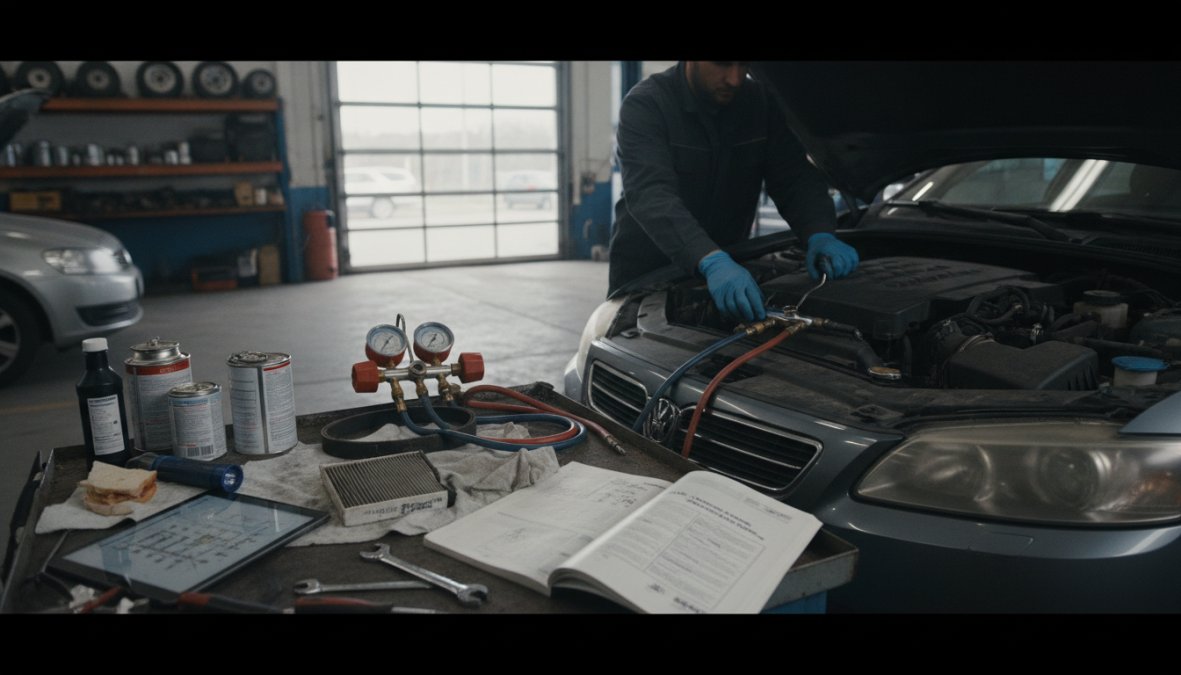
If your car's air conditioning is blowing warm air, you are not alone. The question of why is my car air con not cold is one of the most common vehicle complaints during warmer months, and the causes range from a simple cabin air filter to a failed compressor. This guide from KMC Electric covers every likely fault so you can diagnose the problem accurately before spending money on repairs.
Here's what most guides get wrong: they treat all AC faults as refrigerant problems. The reality is that low refrigerant is just one of at least six distinct failure points in a modern HVAC system, and misdiagnosing the root cause means spending money on a recharge that does nothing.
Why Is My Car Air Con Not Cold? The Core Reasons Explained
Car air conditioning fails to blow cold air when one or more components in the refrigerant circuit or electrical control system stop functioning correctly. The most common causes are low refrigerant due to a leak, a faulty compressor or AC clutch, a blocked condenser, a clogged cabin air filter, or a failed pressure switch or sensor.
How Your Car's AC System Actually Works
A car's AC system is a closed-loop refrigerant circuit that transfers heat from inside the cabin to the outside air. Refrigerant circulates through four key components: the compressor, condenser, expansion valve, and evaporator.
The compressor pressurises refrigerant gas and pushes it through the system via a drive belt.
The pressurised gas flows into the condenser, where a cooling fan dissipates heat into the outside air and the gas becomes liquid.
The liquid passes through the thermal expansion valve, which drops the pressure rapidly.
Low-pressure refrigerant enters the evaporator inside the dashboard, absorbs cabin heat, returns to gas, and cycles back to the compressor.
Pressure switches, temperature sensors, and hoses keep the circuit functioning. A fault anywhere in this chain stops cold air reaching the vents.
Key TakeawayThe AC system is only as strong as its weakest component. Before assuming a recharge will fix the problem, identify which part of the circuit has failed.
Signs of Low Car AC Refrigerant You Should Not Ignore
Signs of low car AC refrigerant include warm air from the vents, the AC clutch cycling rapidly, oily residue around hose connections, and a hissing sound when the system runs. Refrigerant does not get used up like fuel, if the level is low, there is a breach somewhere. Topping up without finding the leak will fail again within weeks.
How to Check for a Refrigerant Leak at Home
What to look for:
Oily residue around AC hose connections, the compressor, condenser fittings, or evaporator drain area
Frost or ice forming on AC hoses (indicates very low refrigerant and moisture contamination)
A sweet or chemical smell inside the cabin
The AC compressor clutch not engaging when AC is switched on
UV dye leak detection kits are available from motor factors. According to Society of Automotive Engineers technical resources, UV dye detection remains one of the most reliable DIY-accessible methods for identifying refrigerant leaks in closed-loop systems.
Watch OutNever attempt to recharge the AC system if you suspect a significant leak. Refrigerant released into the atmosphere is subject to environmental regulations in the UK, and pressurising a system with a major breach can damage the compressor.
Common Faults That Stop Your Car AC Blowing Cold Air
Most car AC failures fall into one of four categories: compressor failure, condenser blockage, airflow restriction, or electrical faults. Each produces slightly different symptoms, which is why a systematic approach saves time and money.
A mechanic in a well-lit workshop leaning over an open engine bay, shining a torch at the AC compressor and surrounding refrigerant hoses on a mid-size family car
Faulty Compressor or AC Clutch
The AC clutch is an electromagnetic coupling that engages the compressor when AC is switched on. If it fails, no refrigerant circulates, you will hear no change in engine note when pressing the AC button, and the compressor pulley will spin without the clutch plate engaging.
Common compressor failure symptoms:
Loud grinding or rattling from the front of the engine when AC is on
AC clutch not engaging when inspected with engine running
Refrigerant pressure readings outside normal range
Sudden loss of cold air after previously working correctly
Compressor failure is often caused by low refrigerant running the unit dry, moisture contamination, or a seized bearing from age.
Blocked Condenser or Cooling Fan Failure
The condenser sits at the front of the vehicle, making it vulnerable to blockage from insects, debris, and leaves. A blocked condenser cannot dissipate heat, causing system pressure to rise and vent temperature to climb. Cooling fan failure compounds this, the fan is the only airflow source at low speeds, so AC will work at motorway speeds but blow warm air in traffic. Check the condenser visually through the front grille; careful cleaning with a low-pressure hose can restore performance.
Clogged Cabin Air Filter and Restricted Airflow
A clogged cabin air filter is the most overlooked and cheapest AC fault to fix. When blocked with dust and pollen, airflow across the evaporator drops significantly, producing weak, slightly cool air rather than a strong cold blast. Many drivers assume the refrigerant is low when the filter is the actual problem. Replace every 12,000 to 15,000 miles or annually, the filter is usually accessible behind the glove box without specialist tools.
Electrical Faults, Sensor Failure, and Pressure Switch Issues
Pressure switches protect the compressor by cutting power if refrigerant pressure is too low or too high. A faulty switch can prevent the compressor from engaging even when refrigerant level is correct.
Other electrical faults include:
Failed AC relay or blown fuse in the HVAC circuit
Faulty temperature sensor sending incorrect readings to the control module
Wiring damage or corroded connectors at the compressor or pressure switch
A malfunctioning blend door actuator mixing warm air with cooled air
Diagnosing electrical faults requires an OBD scanner or dedicated HVAC diagnostic tool. Fault codes in the climate control module identify failed sensors far faster than visual inspection alone.
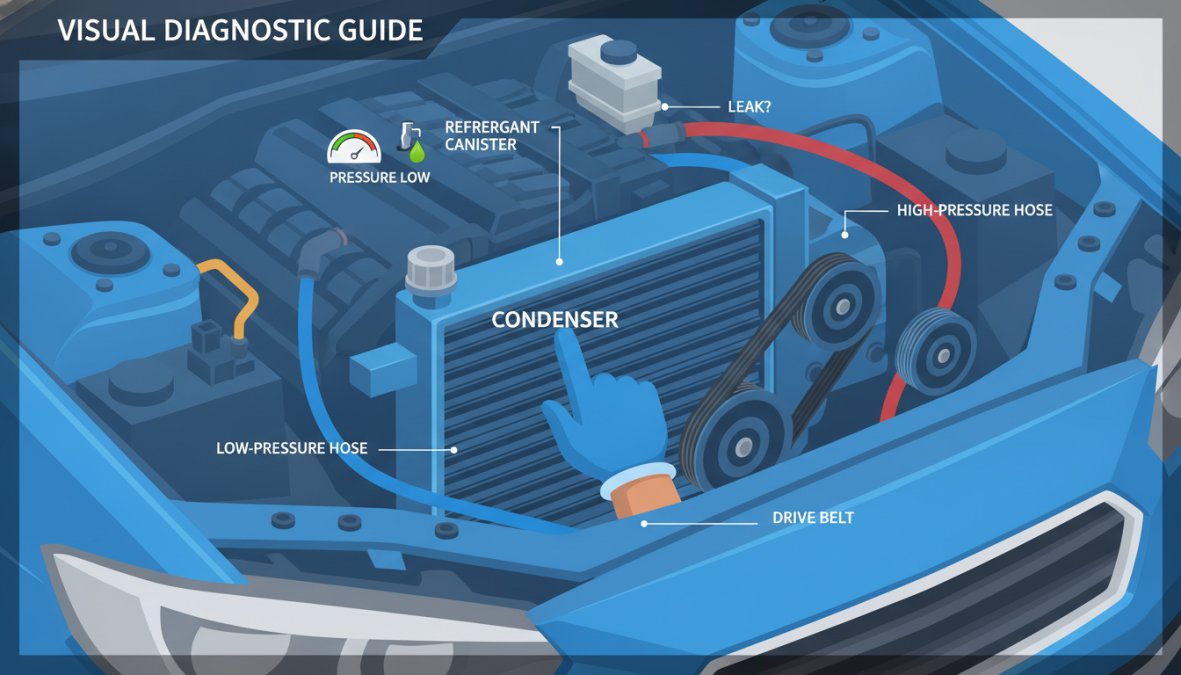
Visual Diagnostic Guide: What to Look For Before Calling a Technician
With engine off:
Check the cabin air filter, if grey or black with debris, replace it before anything else.
Inspect refrigerant hoses for oily residue, cracks, or soft spots at connection points.
Check the condenser fins through the front grille for blockage or damage.
Inspect the drive belt for cracking, fraying, or glazing.
Look for visible coolant leaks near the firewall (evaporator area).
With engine running and AC on:
Watch the AC compressor clutch, the centre plate should engage with an audible click. If it does not, suspect a clutch fault, low refrigerant, or an electrical fault.
Listen for grinding, rattling, or squealing from the compressor area.
Confirm the cooling fan is spinning when AC is on.
Hold a thermometer in the centre vent, cold air should register below 10°C on a moderate day. Anything above 15°C indicates a fault.
Close-up of a car engine bay in bright natural daylight showing the condenser, refrigerant hoses, and drive belt, with a person's hand pointing toward the condenser unit near the front of the vehicle
Pro TipVent temperature is one of the most useful quick diagnostics. A functioning AC system on a 20°C day should deliver vent air between 4°C and 8°C. If you are seeing 14°C or above, the system is compromised regardless of whether the compressor appears to be running.
Using a Car AC Recharge Kit: What It Can and Cannot Fix
A car AC recharge kit adds refrigerant via the low-pressure service port and is appropriate for one specific situation: a system that has lost a small amount of refrigerant over time with no identifiable leak.
What a recharge kit can fix:
Gradual refrigerant depletion in an older system with minor seal seepage
Borderline low refrigerant causing slightly warm air
What a recharge kit cannot fix:
A significant refrigerant leak (the system will lose the gas again)
A failed compressor, blocked condenser, or clogged cabin air filter
Electrical faults, sensor failure, or moisture contamination
The biggest risk is overcharging, too much refrigerant raises system pressure beyond safe limits and can damage the compressor. According to UK government guidance on fluorinated gas handling regulations, professional recharging with R-134a or R-1234yf must be carried out by a certified technician under F-gas regulations. DIY top-up canisters fall outside this requirement but are not a substitute for a proper system evacuation and recharge.
Car AC Compressor Replacement Cost: DIY vs Professional Repair
Car AC compressor replacement cost varies by vehicle make, part quality, and repairer type.
Repair Type
Typical Cost Range
Notes
Cabin air filter replacement (DIY)
£5 - £20
Part only; 15-minute job
AC recharge (professional)
£50 - £120
Includes leak check on most jobs
Condenser replacement (independent)
£180 - £400
Parts and labour
Compressor replacement (independent)
£400 - £900
Significant variation by vehicle
Compressor replacement (main dealer)
£700 - £1,500+
Premium labour rates
Full system flush and recharge
£120 - £250
Required after compressor replacement
DIY compressor replacement requires a vacuum pump and refrigerant recovery equipment to properly evacuate the system. Without the correct tools, moisture enters the circuit, causes acid formation, and destroys the new compressor within months. For electric and hybrid vehicles, the compressor runs at high voltage, meaning any AC work intersects with the high-voltage system and requires specialist knowledge.
When to Book a Diagnostic Check With a Specialist
Book a professional diagnostic check when:
The compressor clutch is not engaging and refrigerant level appears correct
The AC failed suddenly (suggests electrical or compressor fault)
You have recharged the system and it failed again within a month (active leak)
The vehicle is an EV or hybrid with an electrically driven compressor
Fault codes are stored in the climate control module
KMC Electric, based in Kettering, Northamptonshire, provides specialist AC diagnosis for electric and hybrid vehicles. With over 25 years of automotive experience and Level 4 Master Technician status in EVs, the team identifies faults that generic OBD scanners miss, particularly on Tesla and other EV platforms where the AC system integrates with battery cooling circuits.
AC Maintenance Schedule to Prevent Your Car Air Con Going Warm
Annual tasks:
Run the AC for at least 10 minutes every two weeks throughout winter to circulate refrigerant and lubricate compressor seals.
Replace the cabin air filter every 12 months or 12,000 miles.
Check the condenser for debris blockage, particularly in autumn.
Every two years:
Have the system professionally checked for refrigerant level and leak tested.
Inspect the drive belt, a glazed or cracked belt will slip under AC load.
Every four to five years:
Full system flush and recharge to remove accumulated moisture and old refrigerant.
Inspect hoses and O-ring seals for deterioration from age and heat cycling.
Pro TipOne of the most common mistakes is switching the AC off entirely during winter to save fuel. This allows compressor seals to dry and crack. Running it briefly once a fortnight costs almost nothing and prevents a £600 compressor replacement.
Why Is My Car Air Con Not Cold? EV and Hybrid-Specific Quirks
Electric and hybrid vehicles introduce additional complexity. Most EVs use an electrically driven compressor rather than a belt-driven unit, removing the drive belt failure mode but introducing high-voltage dependencies.
Key differences in EV and hybrid AC systems:
The compressor runs on high-voltage power (typically 400V or 800V). A fault in the battery, inverter, or DC-DC converter can cut power to the compressor entirely.
The AC system often shares components with battery thermal management. On Tesla models, the refrigerant circuit cools both the cabin and the battery pack, a fault in one circuit can affect the other.
Many newer EVs use R-1234yf refrigerant, requiring different handling equipment and certified technicians.
Software controls the entire HVAC system. A firmware fault can prevent the compressor from activating even when all hardware is functioning correctly.
On Tesla Model 3 and Model Y vehicles, the heat pump system is known to develop faults in cold conditions, causing reduced heating and cooling performance. According to Tesla owner technical documentation and service bulletins, these faults often store specific diagnostic codes that require Tesla-compatible software to read accurately.
KMC Electric holds specialist knowledge of Tesla systems across all models and has held EV qualifications since 2016. For owners in Kettering and across Northamptonshire dealing with AC faults on out-of-warranty Tesla or hybrid vehicles, this combination of EV expertise and independent status means diagnostic accuracy without main dealer pricing. If your EV air con has stopped working and standard checks have found nothing obvious, the fault is likely electrical or software-related and needs specialist attention.
Frequently Asked Questions
Why is my car AC blowing warm air even when it is turned up to full?
When your car air con is not cold despite being on full, the most likely causes are low refrigerant due to a leak, a failing compressor or AC clutch, a blocked condenser, or an electrical fault such as a faulty pressure switch or sensor. Start by checking whether the compressor is engaging, you should hear a click and see the clutch spinning. If not, a diagnostic check with a qualified technician is the next step.
How do I know if my car AC needs refrigerant?
Common signs of low car AC refrigerant include warm or barely cool air from the vents, the AC taking much longer than usual to cool the cabin, a hissing or bubbling noise near the dashboard or under the bonnet, and visible oily residue around refrigerant hoses or fittings. You may also notice the AC cycling on and off rapidly. A pressure test or leak detection dye test carried out by a technician will confirm whether a recharge or leak repair is needed.
Can I recharge my car AC myself using a recharge kit?
A car AC recharge kit can top up refrigerant gas in a system with a very minor leak and may restore cooling temporarily. However, it will not fix the underlying cause, whether that is a leaking hose, a faulty thermal expansion valve, or a failing compressor. Overcharging the system with a DIY kit can also damage components. For persistent or recurring problems, a professional leak test and proper recharge using certified equipment is strongly recommended.
How much does car AC compressor replacement cost in the UK?
Car AC compressor replacement cost in the UK typically ranges from around £300 to over £800 including parts and labour, depending on the vehicle make, model, and whether additional components such as the drive belt, receiver drier, or expansion valve also need replacing. Electric and hybrid vehicles, including Teslas, may have higher costs due to the complexity of their HVAC systems. Getting a detailed diagnostic check before authorising any repair helps avoid unnecessary parts being replaced.
What are the signs of a bad AC compressor in a car?
Signs of a failing AC compressor include warm air from the vents, a loud grinding or squealing noise when the AC is switched on, the AC clutch not engaging, visible damage or oil staining around the compressor body, and the system failing to hold pressure during a leak test. In some cases the compressor may seize entirely, which can also damage the drive belt. A technician can confirm compressor health using system pressure readings and a full diagnostic check.
Do electric and hybrid cars have different AC problems?
Yes. Unlike conventional vehicles, electric and hybrid cars such as Teslas use an electrically driven compressor rather than one powered by a drive belt, meaning belt-related failures do not apply. However, their HVAC systems are more tightly integrated with battery thermal management, so faults can affect both cabin cooling and battery performance. Software-related sensor failures and high-voltage component issues are also more common. A specialist with EV qualifications is better placed to diagnose these faults accurately.
Car AC faults are rarely straightforward, and the wrong diagnosis wastes money. KMC Electric offers professional diagnosis and repair for electric, hybrid, and conventional vehicles from its base in Kettering, with over 25 years of hands-on experience and Level 4 Master Technician status that ensures faults are identified correctly the first time. Submit your vehicle details to KMC Electric and get an accurate diagnosis before committing to any repair.